

418
Control
1.6
1.2
.--..
o ~ 0.8
u... I
a.. Ul 0.4
'0
2 ~ 0.0
g. E 1.6
U
....
Q)
.... c
"0 1.2
E
::t 0.8
"-"
0.4
/~o,wheat
/0
0,
o
------......
0
/
-/.....-- - ,
"
o
/ .
. ,
0
/
/ .
wild oat.,
\
o /.
.'- 0
0.0 +-8 •. .-=-..·_-.-_--.._--.._---.-_---.-__ ...,.....;--=----1
4
6
8
10
12
14
16
18
20
16 Control
12
Q)
~ .--.. 8
.... a. I 4
:::J
Ul
N
. 0
Solar time
o N 4 ' - - - - - - - - - - - - - - - - - 1
U I -.,...
1i) E 16
C
. 12
~ "0 8
o E
c: ::t 4
o "-"
U
o
UV-8
6
8
10
12
14
16
18
20
Solar time
W. Beyschlag et al.
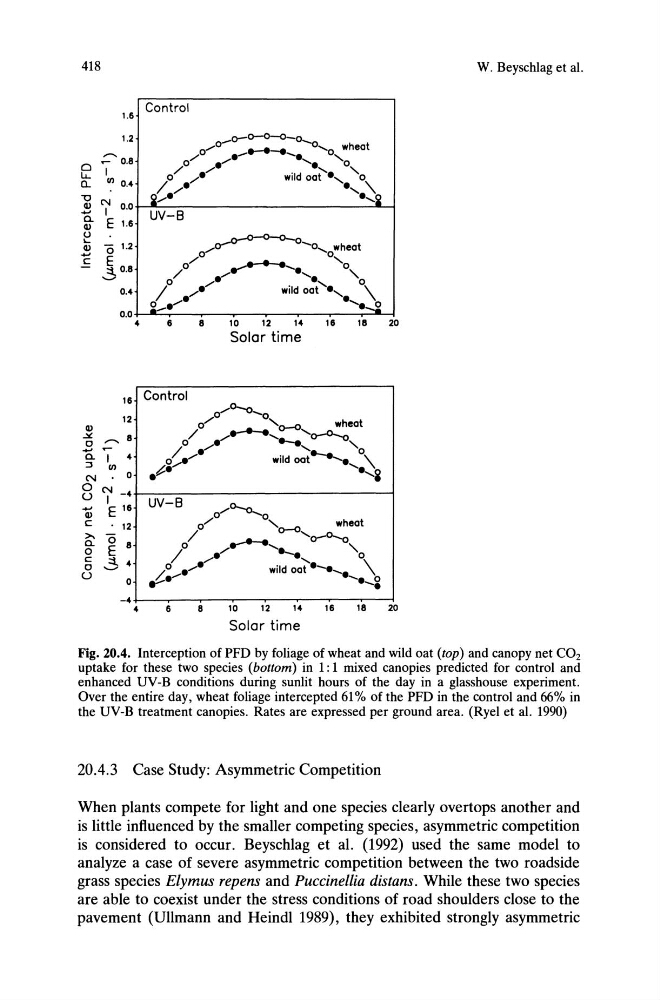
Fig. 20.4. Interception of PFD by foliage of wheat and wild oat (top) and canopy net CO2
uptake for these two species (bottom) in 1: 1 mixed canopies predicted for control and
enhanced UV-B conditions during sunlit hours of the day in a glasshouse experiment.
Over the entire day, wheat foliage intercepted 61 % of the PFD in the control and 66% in
the UV-B treatment canopies. Rates are expressed per ground area. (Ryel et al. 1990)
20.4.3 Case Study: Asymmetric Competition
When plants compete for light and one species clearly overtops another and
is little influenced by the smaller competing species, asymmetric competition
is considered to occur. Beyschlag et al. (1992) used the same model to
analyze a case of severe asymmetric competition between the two roadside
grass species Elymus repens and Puccinellia distans. While these two species
are able to coexist under the stress conditions of road shoulders close to the
pavement (Ullmann and Heindl 1989), they exhibited strongly asymmetric
Control
1.6
1.2
.--..
o ~ 0.8
u... I
a.. Ul 0.4
'0
2 ~ 0.0
g. E 1.6
U
....
Q)
.... c
"0 1.2
E
::t 0.8
"-"
0.4
/~o,wheat
/0
0,
o
------......
0
/
-/.....-- - ,
"
o
/ .
. ,
0
/
/ .
wild oat.,
\
o /.
.'- 0
0.0 +-8 •. .-=-..·_-.-_--.._--.._---.-_---.-__ ...,.....;--=----1
4
6
8
10
12
14
16
18
20
16 Control
12
Q)
~ .--.. 8
.... a. I 4
:::J
Ul
N
. 0
Solar time
o N 4 ' - - - - - - - - - - - - - - - - - 1
U I -.,...
1i) E 16
C
. 12
~ "0 8
o E
c: ::t 4
o "-"
U
o
UV-8
6
8
10
12
14
16
18
20
Solar time
W. Beyschlag et al.
Fig. 20.4. Interception of PFD by foliage of wheat and wild oat (top) and canopy net CO2
uptake for these two species (bottom) in 1: 1 mixed canopies predicted for control and
enhanced UV-B conditions during sunlit hours of the day in a glasshouse experiment.
Over the entire day, wheat foliage intercepted 61 % of the PFD in the control and 66% in
the UV-B treatment canopies. Rates are expressed per ground area. (Ryel et al. 1990)
20.4.3 Case Study: Asymmetric Competition
When plants compete for light and one species clearly overtops another and
is little influenced by the smaller competing species, asymmetric competition
is considered to occur. Beyschlag et al. (1992) used the same model to
analyze a case of severe asymmetric competition between the two roadside
grass species Elymus repens and Puccinellia distans. While these two species
are able to coexist under the stress conditions of road shoulders close to the
pavement (Ullmann and Heindl 1989), they exhibited strongly asymmetric