

Deuterium Content in Organic Material of Hosts and Their Parasites
395
not a parasite sensu stricto, but it obtains its organic material from the host
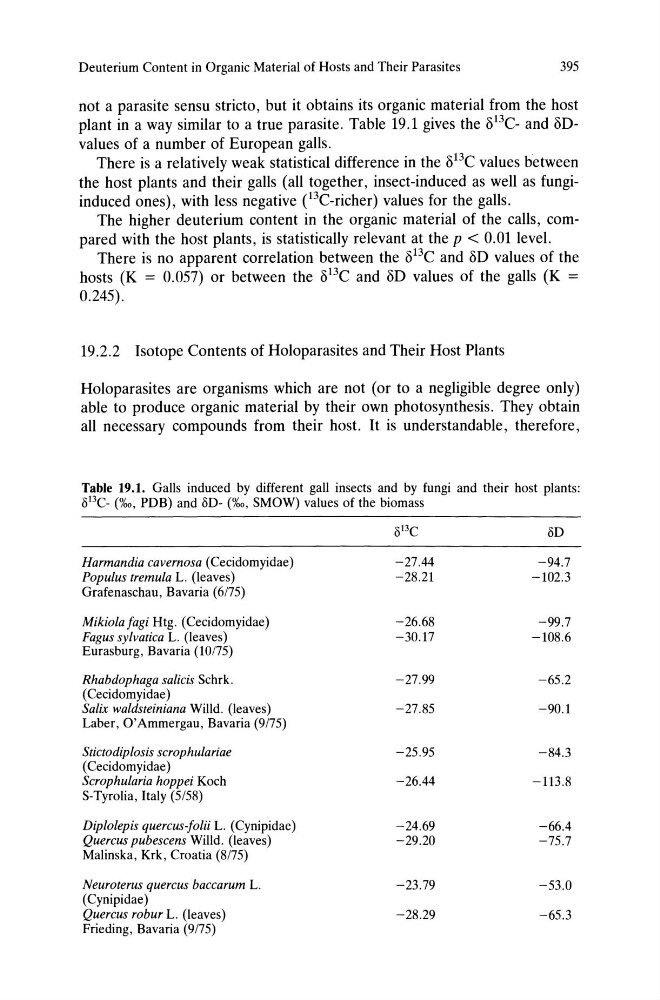
plant in a way similar to a true parasite. Table 19.1 gives the 013C- and oDvalues of a number of European galls.
There is a relatively weak statistical difference in the 013C values between
the host plants and their galls (all together, insect -induced as well as fungiinduced ones), with less negative (13C-richer) values for the galls.
The higher deuterium content in the organic material of the calls, compared with the host plants, is statistically relevant at the p < 0.01 level.
There is no apparent correlation between the 013C and oD values of the
hosts (K = 0.057) or between the 013C and oD values of the galls (K =
0.245).
19.2.2 Isotope Contents of Holoparasites and Their Host Plants
Holoparasites are organisms which are not (or to a negligible degree only)
able to produce organic material by their own photosynthesis. They obtain
all necessary compounds from their host. It is understandable, therefore,
Table 19.1. Galls induced by different gall insects and by fungi and their host plants:
1)13C- (%0, PDB) and 1)D- (0/00, SMOW) values of the biomass
1)13C
1)D
Harmandia cavernosa (Cecidomyidae)
-27.44
-94.7
Populus tremula L. (leaves)
-28.21
-102.3
Grafenaschau, Bavaria (6/75)
MikiolaJagi Htg. (Cecidomyidae)
-26.68
-99.7
Fagus sylvatica L. (leaves)
-30.17
-108.6
Eurasburg, Bavaria (10/75)
Rhabdophaga salids Schrk.
-27.99
-65.2
(Cecidomyidae)
Salix waldsteiniana WiUd. (leaves)
-27.85
-90.1
Laber, O'Ammergau, Bavaria (9/75)
Stictodiplosis scrophulariae
-25.95
-84.3
(Cecidomyidae)
Scrophularia hoppei Koch
-26.44
-113.8
S-Tyrolia, Italy (5/58)
Diplolepis quercus-Jolii L. (Cynipidae)
-24.69
-66.4
Quercus pubescens Willd. (leaves)
-29.20
-75.7
Malinska, Krk, Croatia (8/75)
Neuroterus quercus baccarum L.
-23.79
-53.0
(Cynipidae)
Quercus robur L. (leaves)
-28.29
-65.3
Frieding, Bavaria (9/75)
395
not a parasite sensu stricto, but it obtains its organic material from the host
plant in a way similar to a true parasite. Table 19.1 gives the 013C- and oDvalues of a number of European galls.
There is a relatively weak statistical difference in the 013C values between
the host plants and their galls (all together, insect -induced as well as fungiinduced ones), with less negative (13C-richer) values for the galls.
The higher deuterium content in the organic material of the calls, compared with the host plants, is statistically relevant at the p < 0.01 level.
There is no apparent correlation between the 013C and oD values of the
hosts (K = 0.057) or between the 013C and oD values of the galls (K =
0.245).
19.2.2 Isotope Contents of Holoparasites and Their Host Plants
Holoparasites are organisms which are not (or to a negligible degree only)
able to produce organic material by their own photosynthesis. They obtain
all necessary compounds from their host. It is understandable, therefore,
Table 19.1. Galls induced by different gall insects and by fungi and their host plants:
1)13C- (%0, PDB) and 1)D- (0/00, SMOW) values of the biomass
1)13C
1)D
Harmandia cavernosa (Cecidomyidae)
-27.44
-94.7
Populus tremula L. (leaves)
-28.21
-102.3
Grafenaschau, Bavaria (6/75)
MikiolaJagi Htg. (Cecidomyidae)
-26.68
-99.7
Fagus sylvatica L. (leaves)
-30.17
-108.6
Eurasburg, Bavaria (10/75)
Rhabdophaga salids Schrk.
-27.99
-65.2
(Cecidomyidae)
Salix waldsteiniana WiUd. (leaves)
-27.85
-90.1
Laber, O'Ammergau, Bavaria (9/75)
Stictodiplosis scrophulariae
-25.95
-84.3
(Cecidomyidae)
Scrophularia hoppei Koch
-26.44
-113.8
S-Tyrolia, Italy (5/58)
Diplolepis quercus-Jolii L. (Cynipidae)
-24.69
-66.4
Quercus pubescens Willd. (leaves)
-29.20
-75.7
Malinska, Krk, Croatia (8/75)
Neuroterus quercus baccarum L.
-23.79
-53.0
(Cynipidae)
Quercus robur L. (leaves)
-28.29
-65.3
Frieding, Bavaria (9/75)