

394
H. Ziegler
content of the food material. This is also true for heterotrophic tissues or
organs in an autotrophic higher plant, e.g., for roots and seeds.
An additional fractionation occurs in the metabolism, when products
of pyruvate dehydrogenase (acetyl-CoA) are involved: Lipids, for example,
are always depleted in deuterium compared with the source carbohydrates
(Smith and Epstein 1970; Smith and Ziegler 1990). This has to be taken into
account, when lipid-rich plant material (e.g., some seeds, fruits, membranerich cells) is analyzed.
As mentioned shortly earlier (Ziegler 1988), there were some indications
that the organic material of higher plant holoparasites, galls, and phytophagous fungi has a higher deuterium content (00 less negative) than that of
the host or gall-producing plant. This phenomenon is described in more
detail in the following.
19.2 The Relative Deuterium Content in the Host and Parasitic Organic
Material in Different Kinds of Parasite Performance
The data in the following tables were obtained according to the methods described by
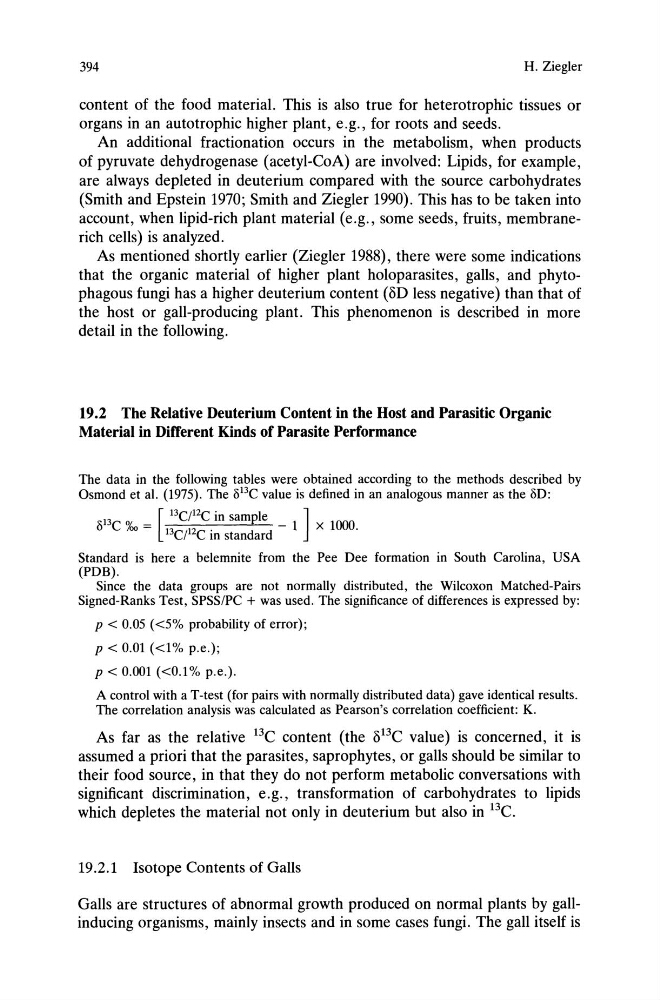
Osmond et al. (1975). The 013C value is defined in an analogous manner as the oD:
013C 0/00 = [ BC/
12 C.in sample - 1 ] x 1000.
BC/ I2 C III standard
Standard is here a belemnite from the Pee Dee formation in South Carolina, USA
(PDB).
Since the data groups are not normally distributed, the Wilcoxon Matched-Pairs
Signed-Ranks Test, SPSS/PC + was used. The significance of differences is expressed by:
p < 0.05 «5% probability of error);
p < 0.01 «1% p.e.);
p < 0.001 «0.1% p.e.).
A control with a T-test (for pairs with normally distributed data) gave identical results.
The correlation analysis was calculated as Pearson's correlation coefficient: K.
As far as the relative 13C content (the 013C value) is concerned, it is
assumed a priori that the parasites, saprophytes, or galls should be similar to
their food source, in that they do not perform metabolic conversations with
significant discrimination, e.g., transformation of carbohydrates to lipids
which depletes the material not only in deuterium but also in 13C.
19.2.1 Isotope Contents of Galls
Galls are structures of abnormal growth produced on normal plants by gallinducing organisms, mainly insects and in some cases fungi. The gall itself is
H. Ziegler
content of the food material. This is also true for heterotrophic tissues or
organs in an autotrophic higher plant, e.g., for roots and seeds.
An additional fractionation occurs in the metabolism, when products
of pyruvate dehydrogenase (acetyl-CoA) are involved: Lipids, for example,
are always depleted in deuterium compared with the source carbohydrates
(Smith and Epstein 1970; Smith and Ziegler 1990). This has to be taken into
account, when lipid-rich plant material (e.g., some seeds, fruits, membranerich cells) is analyzed.
As mentioned shortly earlier (Ziegler 1988), there were some indications
that the organic material of higher plant holoparasites, galls, and phytophagous fungi has a higher deuterium content (00 less negative) than that of
the host or gall-producing plant. This phenomenon is described in more
detail in the following.
19.2 The Relative Deuterium Content in the Host and Parasitic Organic
Material in Different Kinds of Parasite Performance
The data in the following tables were obtained according to the methods described by
Osmond et al. (1975). The 013C value is defined in an analogous manner as the oD:
013C 0/00 = [ BC/
12 C.in sample - 1 ] x 1000.
BC/ I2 C III standard
Standard is here a belemnite from the Pee Dee formation in South Carolina, USA
(PDB).
Since the data groups are not normally distributed, the Wilcoxon Matched-Pairs
Signed-Ranks Test, SPSS/PC + was used. The significance of differences is expressed by:
p < 0.05 «5% probability of error);
p < 0.01 «1% p.e.);
p < 0.001 «0.1% p.e.).
A control with a T-test (for pairs with normally distributed data) gave identical results.
The correlation analysis was calculated as Pearson's correlation coefficient: K.
As far as the relative 13C content (the 013C value) is concerned, it is
assumed a priori that the parasites, saprophytes, or galls should be similar to
their food source, in that they do not perform metabolic conversations with
significant discrimination, e.g., transformation of carbohydrates to lipids
which depletes the material not only in deuterium but also in 13C.
19.2.1 Isotope Contents of Galls
Galls are structures of abnormal growth produced on normal plants by gallinducing organisms, mainly insects and in some cases fungi. The gall itself is