

19 Deuterium Content in Organic Material
of Hosts and Their Parasites
H. Ziegler
19.1 Introduction
The basic source for the deuterium in the organic material of an autotrophic
plant (using water as a hydrogen source) is the medium water, and in
terrestrial plants this means the soil water. The deuterium content of this
soil water again depends normally mainly on its concentration in precipitation. Condensate from the water vapor is enriched in deuterium relative to
the vapor with the result that the remaining vapor will be increasingly
depleted in deuterium as moisture is removed from the air. Since the
absolute water content of the atmosphere is temperature-dependent, an
increasing depletion of deuterium in precipitation will result as a consequence of decreasing temperature. This is termed the "climatic effect" (ct.
Schiegl 1970). The variations in deuterium content of natural waters caused
by condensation and evaporation lie between + 100%0 and -400%0 with respect
to the deuterium content of the ocean [standard mean ocean water (SMOW)].
As early as 1934, 2 years after Urey (1932) discovered deuterium, Washburn
and Smith found that the leaf tissue water of terrestrial plants was heavier
than the soil water. It proved later that the leaf tissue water is enriched in
deuterium, as well as in oxygen-18.
This enrichment of deuterium in leaf tissue water is not due to a discrimination of the H20 (against HDO) during uptake into the roots or
during the transport of water in the xylem, but results during the transpiration in the leaves (ct. Ziegler 1988).
Bokhoven and Theeuwen (1956) were the first to describe a strong decrease in deuterium content in organic plant material, when compared with
that of tissue water. As was shown by Estep and Hoering (1981) with
micro algae , the deuterium content of the organic material of a plant depends on the deuterium content of the tissue (or medium) water only when
plants are growing photoautotrophically. If the cells grow heterotrophically,
the 8D value! of the organic material depends largely on the deuterium
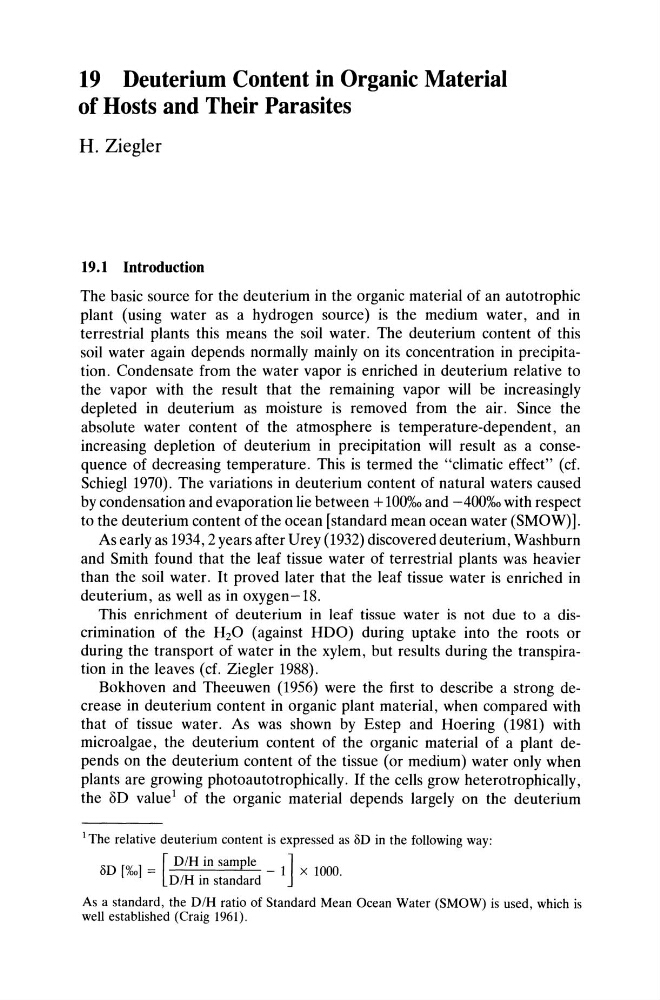
1 The relative deuterium content is expressed as SD in the following way:
~D [0/ 1 - [ D/H in sample
]
u
/00 -
.
-
1 X 1000.
D/H III standard
As a standard, the D/H ratio of Standard Mean Ocean Water (SMOW) is used, which is
well established (Craig 1961).
of Hosts and Their Parasites
H. Ziegler
19.1 Introduction
The basic source for the deuterium in the organic material of an autotrophic
plant (using water as a hydrogen source) is the medium water, and in
terrestrial plants this means the soil water. The deuterium content of this
soil water again depends normally mainly on its concentration in precipitation. Condensate from the water vapor is enriched in deuterium relative to
the vapor with the result that the remaining vapor will be increasingly
depleted in deuterium as moisture is removed from the air. Since the
absolute water content of the atmosphere is temperature-dependent, an
increasing depletion of deuterium in precipitation will result as a consequence of decreasing temperature. This is termed the "climatic effect" (ct.
Schiegl 1970). The variations in deuterium content of natural waters caused
by condensation and evaporation lie between + 100%0 and -400%0 with respect
to the deuterium content of the ocean [standard mean ocean water (SMOW)].
As early as 1934, 2 years after Urey (1932) discovered deuterium, Washburn
and Smith found that the leaf tissue water of terrestrial plants was heavier
than the soil water. It proved later that the leaf tissue water is enriched in
deuterium, as well as in oxygen-18.
This enrichment of deuterium in leaf tissue water is not due to a discrimination of the H20 (against HDO) during uptake into the roots or
during the transport of water in the xylem, but results during the transpiration in the leaves (ct. Ziegler 1988).
Bokhoven and Theeuwen (1956) were the first to describe a strong decrease in deuterium content in organic plant material, when compared with
that of tissue water. As was shown by Estep and Hoering (1981) with
micro algae , the deuterium content of the organic material of a plant depends on the deuterium content of the tissue (or medium) water only when
plants are growing photoautotrophically. If the cells grow heterotrophically,
the 8D value! of the organic material depends largely on the deuterium
1 The relative deuterium content is expressed as SD in the following way:
~D [0/ 1 - [ D/H in sample
]
u
/00 -
.
-
1 X 1000.
D/H III standard
As a standard, the D/H ratio of Standard Mean Ocean Water (SMOW) is used, which is
well established (Craig 1961).