

396
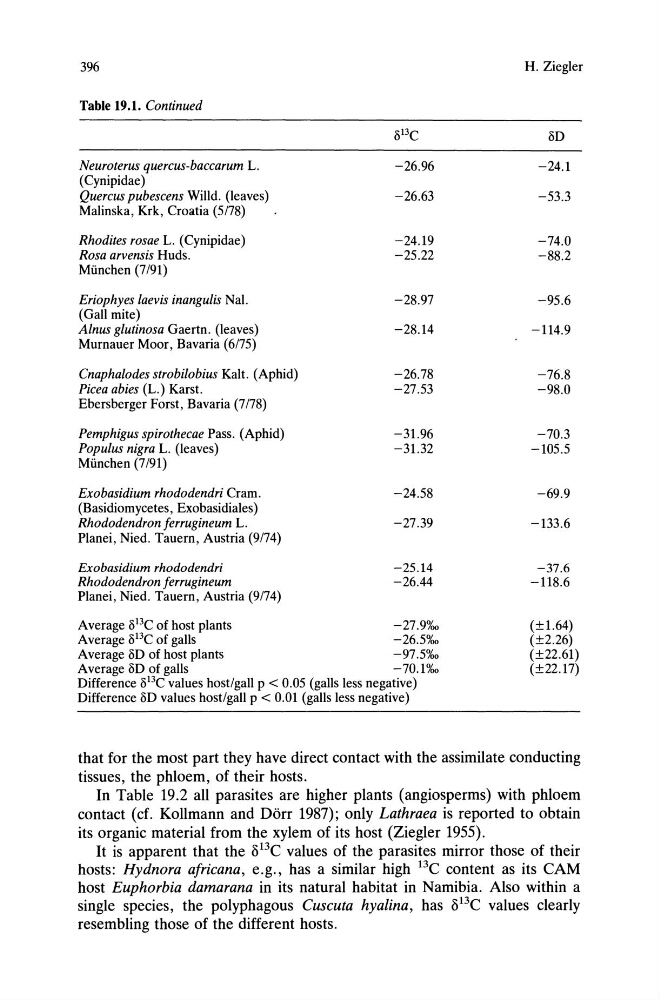
Table 19.1. Continued
Neuroterus quercus-baccarum L.
(Cynipidae)
Quercus pubescens Willd. (leaves)
Malinska, Krk, Croatia (5/78)
Rhodites rosae L. (Cynipidae)
Rosa arvensis Huds.
Miinchen (7/91)
Eriophyes laevis inangulis Nal.
(Gall mite)
Alnus glutinosa Gaertn. (leaves)
Mumauer Moor, Bavaria (6/75)
Cnaphalodes strobilobius Kalt. (Aphid)
Picea abies (L.) Karst.
Ebersberger Forst, Bavaria (7/78)
Pemphigus spirothecae Pass. (Aphid)
Populus nigra L. (leaves)
Miinchen (7/91)
Exobasidium rhododendri Cram.
(Basidiomycetes, Exobasidiales)
Rhododendron ferrugineum L.
Planei, Nied. Tauem, Austria (9/74)
Exobasidium rhododendri
Rhododendron ferrugineum
Planei, Nied. Tauem, Austria (9/74)
-26.96
-26.63
-24.19
-25.22
-28.97
-28.14
-26.78
-27.53
-31.96
-31.32
-24.58
-27.39
-25.14
-26.44
Average O!3C of host plants
- 27.9"100
Average O!3C of galls
-26.5"100
Average oD of host plants
-97.5%0
Average oD of galls
-70.1"100
Difference o!3e values host/gall p < 0.05 (galls less negative)
Difference oD values host/gall p < 0.01 (galls less negative)
H. Ziegler
oD
-24.1
-53.3
-74.0
-88.2
-95.6
-114.9
-76.8
-98.0
-70.3
-105.5
-69.9
-133.6
-37.6
-118.6
(±1.64)
(±2.26)
(±22.61)
(±22.17)
that for the most part they have direct contact with the assimilate conducting
tissues, the phloem, of their hosts.
In Table 19.2 all parasites are higher plants (angiosperms) with phloem
contact (cf. Kollmann and Dorr 1987); only Lathraea is reported to obtain
its organic material from the xylem of its host (Ziegler 1955).
It is apparent that the o13e values of the parasites mirror those of their
hosts: Hydnora africana, e.g., has a similar high 13e content as its eAM
host Euphorbia damarana in its natural habitat in Namibia. Also within a
single species, the polyphagous Cuscuta hyalina, has o13e values clearly
resembling those of the different hosts.
Table 19.1. Continued
Neuroterus quercus-baccarum L.
(Cynipidae)
Quercus pubescens Willd. (leaves)
Malinska, Krk, Croatia (5/78)
Rhodites rosae L. (Cynipidae)
Rosa arvensis Huds.
Miinchen (7/91)
Eriophyes laevis inangulis Nal.
(Gall mite)
Alnus glutinosa Gaertn. (leaves)
Mumauer Moor, Bavaria (6/75)
Cnaphalodes strobilobius Kalt. (Aphid)
Picea abies (L.) Karst.
Ebersberger Forst, Bavaria (7/78)
Pemphigus spirothecae Pass. (Aphid)
Populus nigra L. (leaves)
Miinchen (7/91)
Exobasidium rhododendri Cram.
(Basidiomycetes, Exobasidiales)
Rhododendron ferrugineum L.
Planei, Nied. Tauem, Austria (9/74)
Exobasidium rhododendri
Rhododendron ferrugineum
Planei, Nied. Tauem, Austria (9/74)
-26.96
-26.63
-24.19
-25.22
-28.97
-28.14
-26.78
-27.53
-31.96
-31.32
-24.58
-27.39
-25.14
-26.44
Average O!3C of host plants
- 27.9"100
Average O!3C of galls
-26.5"100
Average oD of host plants
-97.5%0
Average oD of galls
-70.1"100
Difference o!3e values host/gall p < 0.05 (galls less negative)
Difference oD values host/gall p < 0.01 (galls less negative)
H. Ziegler
oD
-24.1
-53.3
-74.0
-88.2
-95.6
-114.9
-76.8
-98.0
-70.3
-105.5
-69.9
-133.6
-37.6
-118.6
(±1.64)
(±2.26)
(±22.61)
(±22.17)
that for the most part they have direct contact with the assimilate conducting
tissues, the phloem, of their hosts.
In Table 19.2 all parasites are higher plants (angiosperms) with phloem
contact (cf. Kollmann and Dorr 1987); only Lathraea is reported to obtain
its organic material from the xylem of its host (Ziegler 1955).
It is apparent that the o13e values of the parasites mirror those of their
hosts: Hydnora africana, e.g., has a similar high 13e content as its eAM
host Euphorbia damarana in its natural habitat in Namibia. Also within a
single species, the polyphagous Cuscuta hyalina, has o13e values clearly
resembling those of the different hosts.