

Gas Exchange and Growth
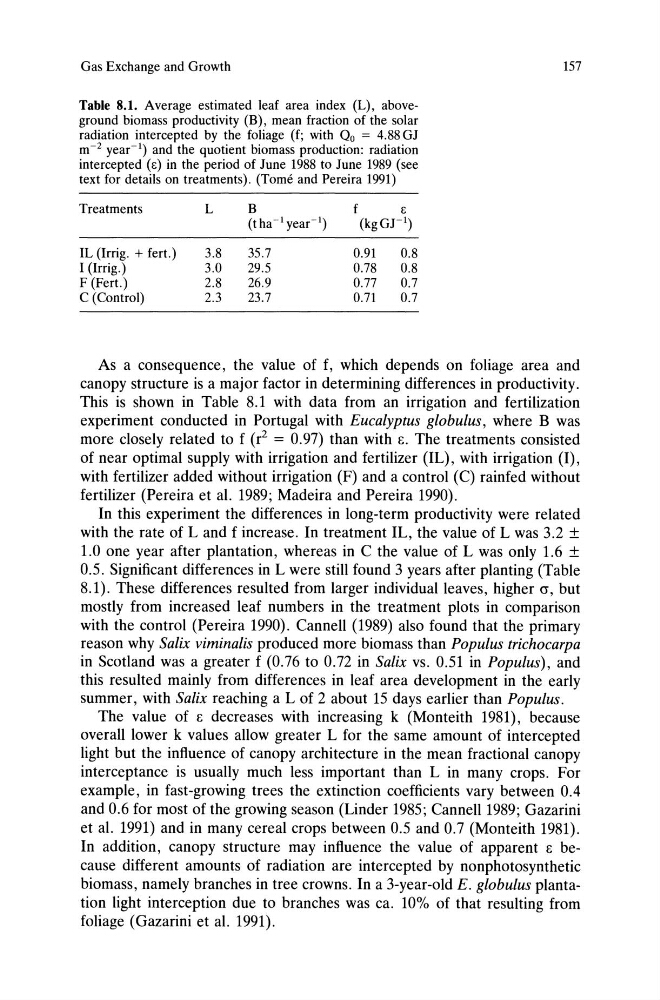
Table 8.1. Average estimated leaf area index (L), aboveground biomass productivity (B), mean fraction of the solar
radiation intercepted by the foliage (f; with Q o = 4.88 GJ
m- 2 year-I) and the quotient biomass production: radiation
intercepted (E) in the period of June 1988 to June 1989 (see
text for details on treatments). (Tome and Pereira 1991)
Treatments
L
B
f
10
(tha-Iyear- I )
(kgGJ- I )
IL (Irrig. + fert.)
3.8
35.7
0.91
0.8
I (Irrig.)
3.0
29.5
0.78
0.8
F (Fert.)
2.8
26.9
0.77
0.7
C (Control)
2.3
23.7
0.71
0.7
157
As a consequence, the value of f, which depends on foliage area and
canopy structure is a major factor in determining differences in productivity.
This is shown in Table 8.1 with data from an irrigation and fertilization
experiment conducted in Portugal with Eucalyptus globulus, where B was
more closely related to f (r2 = 0.97) than with E. The treatments consisted
of near optimal supply with irrigation and fertilizer (IL), with irrigation (I),
with fertilizer added without irrigation (F) and a control (C) rainfed without
fertilizer (Pereira et al. 1989; Madeira and Pereira 1990).
In this experiment the differences in long-term productivity were related
with the rate of Land f increase. In treatment IL, the value of L was 3.2 ±
1.0 one year after plantation, whereas in C the value of L was only 1.6 ±
0.5. Significant differences in L were still found 3 years after planting (Table
8.1). These differences resulted from larger individual leaves, higher cr, but
mostly from increased leaf numbers in the treatment plots in comparison
with the control (Pereira 1990). Cannell (1989) also found that the primary
reason why Salix viminalis produced more biomass than Populus trichocarpa
in Scotland was a greater f (0.76 to 0.72 in Salix vs. 0.51 in Populus), and
this resulted mainly from differences in leaf area development in the early
summer, with Salix reaching a L of 2 about 15 days earlier than Populus.
The value of E decreases with increasing k (Monteith 1981), because
overall lower k values allow greater L for the same amount of intercepted
light but the influence of canopy architecture in the mean fractional canopy
interceptance is usually much less important than L in many crops. For
example, in fast-growing trees the extinction coefficients vary between 0.4
and 0.6 for most of the growing season (Linder 1985; Cannell 1989; Gazarini
et al. 1991) and in many cereal crops between 0.5 and 0.7 (Monteith 1981).
In addition, canopy structure may influence the value of apparent E because different amounts of radiation are intercepted by nonphotosynthetic
biomass, namely branches in tree crowns. In a 3-year-old E. globulus plantation light interception due to branches was ca. 10% of that resulting from
foliage (Gazarini et al. 1991).
Table 8.1. Average estimated leaf area index (L), aboveground biomass productivity (B), mean fraction of the solar
radiation intercepted by the foliage (f; with Q o = 4.88 GJ
m- 2 year-I) and the quotient biomass production: radiation
intercepted (E) in the period of June 1988 to June 1989 (see
text for details on treatments). (Tome and Pereira 1991)
Treatments
L
B
f
10
(tha-Iyear- I )
(kgGJ- I )
IL (Irrig. + fert.)
3.8
35.7
0.91
0.8
I (Irrig.)
3.0
29.5
0.78
0.8
F (Fert.)
2.8
26.9
0.77
0.7
C (Control)
2.3
23.7
0.71
0.7
157
As a consequence, the value of f, which depends on foliage area and
canopy structure is a major factor in determining differences in productivity.
This is shown in Table 8.1 with data from an irrigation and fertilization
experiment conducted in Portugal with Eucalyptus globulus, where B was
more closely related to f (r2 = 0.97) than with E. The treatments consisted
of near optimal supply with irrigation and fertilizer (IL), with irrigation (I),
with fertilizer added without irrigation (F) and a control (C) rainfed without
fertilizer (Pereira et al. 1989; Madeira and Pereira 1990).
In this experiment the differences in long-term productivity were related
with the rate of Land f increase. In treatment IL, the value of L was 3.2 ±
1.0 one year after plantation, whereas in C the value of L was only 1.6 ±
0.5. Significant differences in L were still found 3 years after planting (Table
8.1). These differences resulted from larger individual leaves, higher cr, but
mostly from increased leaf numbers in the treatment plots in comparison
with the control (Pereira 1990). Cannell (1989) also found that the primary
reason why Salix viminalis produced more biomass than Populus trichocarpa
in Scotland was a greater f (0.76 to 0.72 in Salix vs. 0.51 in Populus), and
this resulted mainly from differences in leaf area development in the early
summer, with Salix reaching a L of 2 about 15 days earlier than Populus.
The value of E decreases with increasing k (Monteith 1981), because
overall lower k values allow greater L for the same amount of intercepted
light but the influence of canopy architecture in the mean fractional canopy
interceptance is usually much less important than L in many crops. For
example, in fast-growing trees the extinction coefficients vary between 0.4
and 0.6 for most of the growing season (Linder 1985; Cannell 1989; Gazarini
et al. 1991) and in many cereal crops between 0.5 and 0.7 (Monteith 1981).
In addition, canopy structure may influence the value of apparent E because different amounts of radiation are intercepted by nonphotosynthetic
biomass, namely branches in tree crowns. In a 3-year-old E. globulus plantation light interception due to branches was ca. 10% of that resulting from
foliage (Gazarini et al. 1991).