

158
J.S. Pereira
The value of c also depends on the way Band Qi are calculated. For
example, Cannell (1989) estimated E for poplar and willow clones in Scotland as ca. 1.5 g Mr 1 for the whole plant. The difference between these and
data of E. globulus shown in Table 8.1 results largely from considering
only the aboveground biomass in the eucalypt data. However, an additional reason is the use of whole-year Qo in the calculation of evergreen
productivity instead of only growing season Qo as in agricultural crops or
in deciduous tree species. This results in the apparent decrease in E of
evergreens when compared to deciduous tree species or crops. In the 12
months values Qo integrate periods when environmental stress (low winter
temperatures and/or summer drought) decreases c.
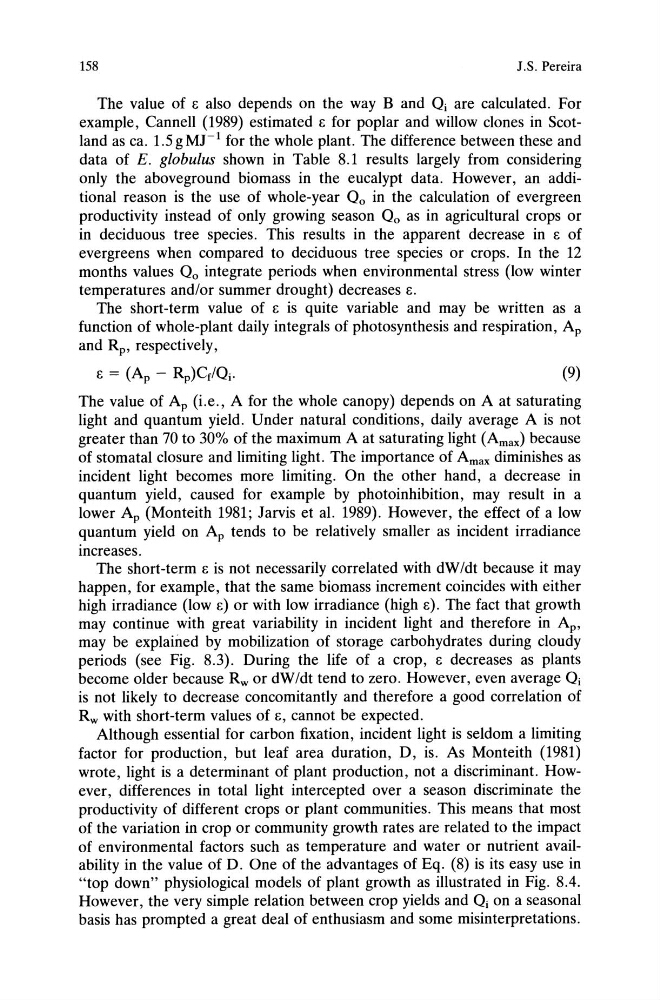
The short-term value of E is quite variable and may be written as a
function of whole-plant daily integrals of photosynthesis and respiration, Ap
and Rp, respectively,
(9)
The value of Ap (i.e., A for the whole canopy) depends on A at saturating
light and quantum yield. Under natural conditions, daily average A is not
greater than 70 to 30% of the maximum A at saturating light (Amax) because
of stomatal closure and limiting light. The importance of Amax diminishes as
incident light becomes more limiting. On the other hand, a decrease in
quantum yield, caused for example by photoinhibition, may result in a
lower Ap (Monteith 1981; Jarvis et al. 1989). However, the effect of a low
quantum yield on Ap tends to be relatively smaller as incident irradiance
increases.
The short-term c is not necessarily correlated with dW/dt because it may
happen, for example, that the same biomass increment coincides with either
high irradiance (low E) or with low irradiance (high E). The fact that growth
may continue with great variability in incident light and therefore in Ap,
may be explained by mobilization of storage carbohydrates during cloudy
periods (see Fig. 8.3). During the life of a crop, E decreases as plants
become older because Rw or dW/dt tend to zero. However, even average Qi
is not likely to decrease concomitantly and therefore a good correlation of
Rw with short-term values of E, cannot be expected.
Although essential for carbon fixation, incident light is seldom a limiting
factor for production, but leaf area duration, D, is. As Monteith (1981)
wrote, light is a determinant of plant production, not a discriminant. However, differences in total light intercepted over a season discriminate the
productivity of different crops or plant communities. This means that most
of the variation in crop or community growth rates are related to the impact
of environmental factors such as temperature and water or nutrient availability in the value of D. One of the advantages of Eq. (8) is its easy use in
"top down" physiological models of plant growth as illustrated in Fig. 8.4.
However, the very simple relation between crop yields and Qi on a seasonal
basis has prompted a great deal of enthusiasm and some misinterpretations.
J.S. Pereira
The value of c also depends on the way Band Qi are calculated. For
example, Cannell (1989) estimated E for poplar and willow clones in Scotland as ca. 1.5 g Mr 1 for the whole plant. The difference between these and
data of E. globulus shown in Table 8.1 results largely from considering
only the aboveground biomass in the eucalypt data. However, an additional reason is the use of whole-year Qo in the calculation of evergreen
productivity instead of only growing season Qo as in agricultural crops or
in deciduous tree species. This results in the apparent decrease in E of
evergreens when compared to deciduous tree species or crops. In the 12
months values Qo integrate periods when environmental stress (low winter
temperatures and/or summer drought) decreases c.
The short-term value of E is quite variable and may be written as a
function of whole-plant daily integrals of photosynthesis and respiration, Ap
and Rp, respectively,
(9)
The value of Ap (i.e., A for the whole canopy) depends on A at saturating
light and quantum yield. Under natural conditions, daily average A is not
greater than 70 to 30% of the maximum A at saturating light (Amax) because
of stomatal closure and limiting light. The importance of Amax diminishes as
incident light becomes more limiting. On the other hand, a decrease in
quantum yield, caused for example by photoinhibition, may result in a
lower Ap (Monteith 1981; Jarvis et al. 1989). However, the effect of a low
quantum yield on Ap tends to be relatively smaller as incident irradiance
increases.
The short-term c is not necessarily correlated with dW/dt because it may
happen, for example, that the same biomass increment coincides with either
high irradiance (low E) or with low irradiance (high E). The fact that growth
may continue with great variability in incident light and therefore in Ap,
may be explained by mobilization of storage carbohydrates during cloudy
periods (see Fig. 8.3). During the life of a crop, E decreases as plants
become older because Rw or dW/dt tend to zero. However, even average Qi
is not likely to decrease concomitantly and therefore a good correlation of
Rw with short-term values of E, cannot be expected.
Although essential for carbon fixation, incident light is seldom a limiting
factor for production, but leaf area duration, D, is. As Monteith (1981)
wrote, light is a determinant of plant production, not a discriminant. However, differences in total light intercepted over a season discriminate the
productivity of different crops or plant communities. This means that most
of the variation in crop or community growth rates are related to the impact
of environmental factors such as temperature and water or nutrient availability in the value of D. One of the advantages of Eq. (8) is its easy use in
"top down" physiological models of plant growth as illustrated in Fig. 8.4.
However, the very simple relation between crop yields and Qi on a seasonal
basis has prompted a great deal of enthusiasm and some misinterpretations.