

156
1.S. Pereira
more rapidly than it can be exported and accumulates in leaves, the concentrations of metabolites involved in determining the relative rates of
starch and sucrose synthesis, especially the cytoplasmic concentrations of
ortophosphate (Herold and Walker 1979) and of fructose 2, 6 bisphosphate
(Stitt et al. 1984, 1987; Huber 1986), may change, leading to a decrease
in photosynthetic rates. More recently, Krapp et al. (1991) showed that
feeding leaves with glucose led to the long-term decrease in photosynthetic
rate as a result of a decrease in Rubisco and other Calvin cycle enzymes and
to the increase of respiratory rates. Although it is interesting to understand
the short-term regulation of photosynthesis, these processes may be confounded by the fact that carbon assimilation and growth are not necessarily
in phase.
8.6 Light Interception by Canopies and Plant Productivity
Biomass productivity of a plant community (B, e.g., in tha-1year- 1 ) may
be estimated as a linear function of the amount of radiation intercepted by
the canopy, Qj (Monteith 1977, 1981; Jarvis and Leverenz 1983):
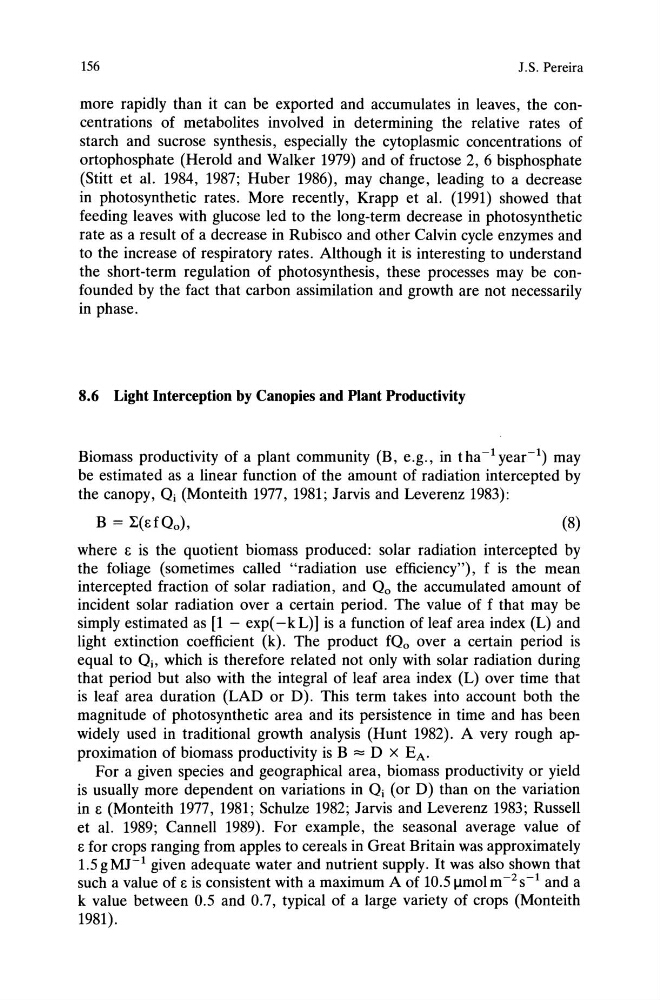
(8)
where s is the quotient biomass produced: solar radiation intercepted by
the foliage (sometimes called "radiation use efficiency"), f is the mean
intercepted fraction of solar radiation, and Qo the accumulated amount of
incident solar radiation over a certain period. The value of f that may be
simply estimated as [1 - exp( -kL)] is a function of leaf area index (L) and
light extinction coefficient (k). The product fQo over a certain period is
equal to Qj, which is therefore related not only with solar radiation during
that period but also with the integral of leaf area index (L) over time that
is leaf area duration (LAD or D). This term takes into account both the
magnitude of photosynthetic area and its persistence in time and has been
widely used in traditional growth analysis (Hunt 1982). A very rough approximation of biomass productivity is B ;::::: D X EA'
For a given species and geographical area, biomass productivity or yield
is usually more dependent on variations in Qj (or D) than on the variation
in s (Monteith 1977, 1981; Schulze 1982; Jarvis and Leverenz 1983; Russell
et al. 1989; Cannell 1989). For example, the seasonal average value of
s for crops ranging from apples to cereals in Great Britain was approximately
1.5 g Mr 1 given adequate water and nutrient supply. It was also shown that
such a value of E is consistent with a maximum A of 10.5Ilmolm-2s-1 and a
k value between 0.5 and 0.7, typical of a large variety of crops (Monteith
1981).
1.S. Pereira
more rapidly than it can be exported and accumulates in leaves, the concentrations of metabolites involved in determining the relative rates of
starch and sucrose synthesis, especially the cytoplasmic concentrations of
ortophosphate (Herold and Walker 1979) and of fructose 2, 6 bisphosphate
(Stitt et al. 1984, 1987; Huber 1986), may change, leading to a decrease
in photosynthetic rates. More recently, Krapp et al. (1991) showed that
feeding leaves with glucose led to the long-term decrease in photosynthetic
rate as a result of a decrease in Rubisco and other Calvin cycle enzymes and
to the increase of respiratory rates. Although it is interesting to understand
the short-term regulation of photosynthesis, these processes may be confounded by the fact that carbon assimilation and growth are not necessarily
in phase.
8.6 Light Interception by Canopies and Plant Productivity
Biomass productivity of a plant community (B, e.g., in tha-1year- 1 ) may
be estimated as a linear function of the amount of radiation intercepted by
the canopy, Qj (Monteith 1977, 1981; Jarvis and Leverenz 1983):
(8)
where s is the quotient biomass produced: solar radiation intercepted by
the foliage (sometimes called "radiation use efficiency"), f is the mean
intercepted fraction of solar radiation, and Qo the accumulated amount of
incident solar radiation over a certain period. The value of f that may be
simply estimated as [1 - exp( -kL)] is a function of leaf area index (L) and
light extinction coefficient (k). The product fQo over a certain period is
equal to Qj, which is therefore related not only with solar radiation during
that period but also with the integral of leaf area index (L) over time that
is leaf area duration (LAD or D). This term takes into account both the
magnitude of photosynthetic area and its persistence in time and has been
widely used in traditional growth analysis (Hunt 1982). A very rough approximation of biomass productivity is B ;::::: D X EA'
For a given species and geographical area, biomass productivity or yield
is usually more dependent on variations in Qj (or D) than on the variation
in s (Monteith 1977, 1981; Schulze 1982; Jarvis and Leverenz 1983; Russell
et al. 1989; Cannell 1989). For example, the seasonal average value of
s for crops ranging from apples to cereals in Great Britain was approximately
1.5 g Mr 1 given adequate water and nutrient supply. It was also shown that
such a value of E is consistent with a maximum A of 10.5Ilmolm-2s-1 and a
k value between 0.5 and 0.7, typical of a large variety of crops (Monteith
1981).