

Gas Exchange and Growth
153
8.4 The Importance of Allocation
An important feature invoked to explain the variation in inherent growth
rates is the difference in the partitioning of photo assimilates between plant
parts (see also Chap. 7, this Vol.). A major complication in the analysis of
the relationships between growth and gas exchange rates is the marked
difference in the timing of growth and gas exchange. Because maximum
growth rates rarely coincide with maximum average photosynthetic rates,
plants store carbon and nutrients as daily, long-term, and buffer reserves
(Chapin et al. 1990; Geiger and Servaites 1991) which allow the plants to
grow even when current assimilation rates are negligible or insufficient
to maintain growth. The type and role of storage in growth in different
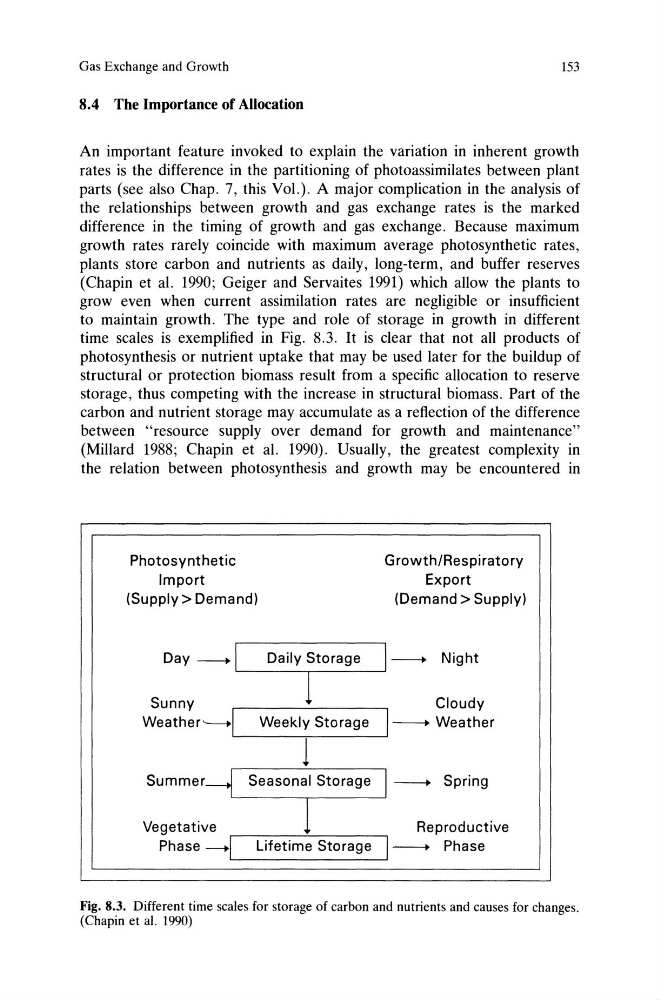
time scales is exemplified in Fig. 8.3. It is clear that not all products of
photosynthesis or nutrient uptake that may be used later for the buildup of
structural or protection biomass result from a specific allocation to reserve
storage, thus competing with the increase in structural biomass. Part of the
carbon and nutrient storage may accumulate as a reflection of the difference
between "resource supply over demand for growth and maintenance"
(Millard 1988; Chapin et al. 1990). Usually, the greatest complexity in
the relation between photosynthesis and growth may be encountered in
Photosynthetic
Import
(Supply> Demand)
Growth/Respiratory
Export
(Demand> Supply)
Day ____
_
Night
Sunny
Weather------.I
Summer
Vegetative
Phase _I
L -_ _ _ _ _ _ ~------~
Cloudy
Weekly Storage 1_ Weather
1
_
Spring
Reproductive
Lifetime Storage I_ Phase
Fig. 8.3. Different time scales for storage of carbon and nutrients and causes for changes.
(Chapin et al. 1990)
153
8.4 The Importance of Allocation
An important feature invoked to explain the variation in inherent growth
rates is the difference in the partitioning of photo assimilates between plant
parts (see also Chap. 7, this Vol.). A major complication in the analysis of
the relationships between growth and gas exchange rates is the marked
difference in the timing of growth and gas exchange. Because maximum
growth rates rarely coincide with maximum average photosynthetic rates,
plants store carbon and nutrients as daily, long-term, and buffer reserves
(Chapin et al. 1990; Geiger and Servaites 1991) which allow the plants to
grow even when current assimilation rates are negligible or insufficient
to maintain growth. The type and role of storage in growth in different
time scales is exemplified in Fig. 8.3. It is clear that not all products of
photosynthesis or nutrient uptake that may be used later for the buildup of
structural or protection biomass result from a specific allocation to reserve
storage, thus competing with the increase in structural biomass. Part of the
carbon and nutrient storage may accumulate as a reflection of the difference
between "resource supply over demand for growth and maintenance"
(Millard 1988; Chapin et al. 1990). Usually, the greatest complexity in
the relation between photosynthesis and growth may be encountered in
Photosynthetic
Import
(Supply> Demand)
Growth/Respiratory
Export
(Demand> Supply)
Day ____
_
Night
Sunny
Weather------.I
Summer
Vegetative
Phase _I
L -_ _ _ _ _ _ ~------~
Cloudy
Weekly Storage 1_ Weather
1
_
Spring
Reproductive
Lifetime Storage I_ Phase
Fig. 8.3. Different time scales for storage of carbon and nutrients and causes for changes.
(Chapin et al. 1990)