

154
J.S. Pereira
perennial woody species, where long-term storage is essential for the rapid
growth rates in spring even before photosynthesis can provide enough
carbon skeletons.
Growth of different plant parts is internally regulated and highly com pet -
itive for available carbohydrates. Renewal of fine roots, growth in diameter
of perennial roots and shoots, or fruit growth all have different timing.
For example, shoot elongation and canopy formation in many temperate
zone woody plants occur early in the growth season largely at the expense
of stored carbohydrates and nutrients rather than current season photosynthesis (Kozlowski and Keller 1966; Schulze 1982). In many evergreens of the
temperate zone and regions with a mediterranean type of climate, carbon
balance depends to some extent on winter photosynthesis, a period when
growth does not occur (Larcher 1973; Pereira et al. 1986; Tenhunen et al.
1987). The use of stored carbohydrates leads obviously to the uncoupling
of growth and carbon assimilation rates, a fact that is often ignored by
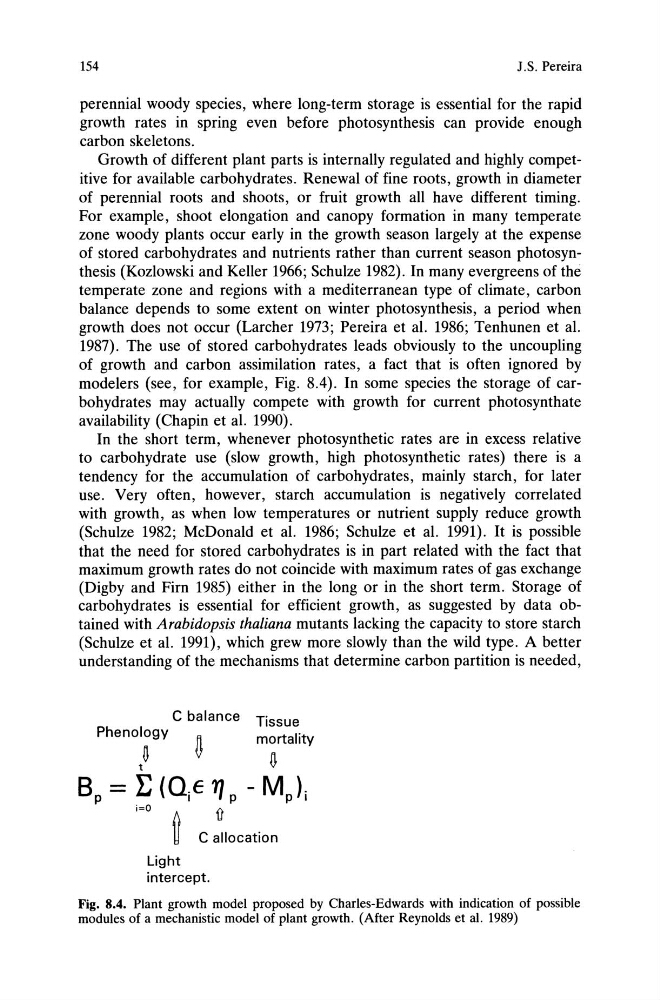
modelers (see, for example, Fig. 8.4). In some species the storage of carbohydrates may actually compete with growth for current photosynthate
availability (Chapin et al. 1990).
In the short term, whenever photosynthetic rates are in excess relative
to carbohydrate use (slow growth, high photosynthetic rates) there is a
tendency for the accumulation of carbohydrates, mainly starch, for later
use. Very often, however, starch accumulation is negatively correlated
with growth, as when low temperatures or nutrient supply reduce growth
(Schulze 1982; McDonald et al. 1986; Schulze et al. 1991). It is possible
that the need for stored carbohydrates is in part related with the fact that
maximum growth rates do not coincide with maximum rates of gas exchange
(Digby and Firn 1985) either in the long or in the short term. Storage of
carbohydrates is essential for efficient growth, as suggested by data obtained with Arabidopsis thaliana mutants lacking the capacity to store starch
(Schulze et al. 1991), which grew more slowly than the wild type. A better
understanding of the mechanisms that determine carbon partition is needed,
C balance Tissue
Phenology
~
mortality
t~
V
~
B p E (OJ € 'Y/ p - M p ) j
;=0
11
~ C allocation
Light
intercept.
Fig. 8.4. Plant growth model proposed by Charles-Edwards with indication of possible
modules of a mechanistic model of plant growth. (After Reynolds et al. 1989)
J.S. Pereira
perennial woody species, where long-term storage is essential for the rapid
growth rates in spring even before photosynthesis can provide enough
carbon skeletons.
Growth of different plant parts is internally regulated and highly com pet -
itive for available carbohydrates. Renewal of fine roots, growth in diameter
of perennial roots and shoots, or fruit growth all have different timing.
For example, shoot elongation and canopy formation in many temperate
zone woody plants occur early in the growth season largely at the expense
of stored carbohydrates and nutrients rather than current season photosynthesis (Kozlowski and Keller 1966; Schulze 1982). In many evergreens of the
temperate zone and regions with a mediterranean type of climate, carbon
balance depends to some extent on winter photosynthesis, a period when
growth does not occur (Larcher 1973; Pereira et al. 1986; Tenhunen et al.
1987). The use of stored carbohydrates leads obviously to the uncoupling
of growth and carbon assimilation rates, a fact that is often ignored by
modelers (see, for example, Fig. 8.4). In some species the storage of carbohydrates may actually compete with growth for current photosynthate
availability (Chapin et al. 1990).
In the short term, whenever photosynthetic rates are in excess relative
to carbohydrate use (slow growth, high photosynthetic rates) there is a
tendency for the accumulation of carbohydrates, mainly starch, for later
use. Very often, however, starch accumulation is negatively correlated
with growth, as when low temperatures or nutrient supply reduce growth
(Schulze 1982; McDonald et al. 1986; Schulze et al. 1991). It is possible
that the need for stored carbohydrates is in part related with the fact that
maximum growth rates do not coincide with maximum rates of gas exchange
(Digby and Firn 1985) either in the long or in the short term. Storage of
carbohydrates is essential for efficient growth, as suggested by data obtained with Arabidopsis thaliana mutants lacking the capacity to store starch
(Schulze et al. 1991), which grew more slowly than the wild type. A better
understanding of the mechanisms that determine carbon partition is needed,
C balance Tissue
Phenology
~
mortality
t~
V
~
B p E (OJ € 'Y/ p - M p ) j
;=0
11
~ C allocation
Light
intercept.
Fig. 8.4. Plant growth model proposed by Charles-Edwards with indication of possible
modules of a mechanistic model of plant growth. (After Reynolds et al. 1989)