

152
I.S. Pereira
6
- "i
~
N
E
IL
- as Q) 5
... as
- as
..92
0
~
·0
8.
en
4
2.0
2.5
3.0
3.5
4.0
Biomass production (kg m- 2 year- 1 )
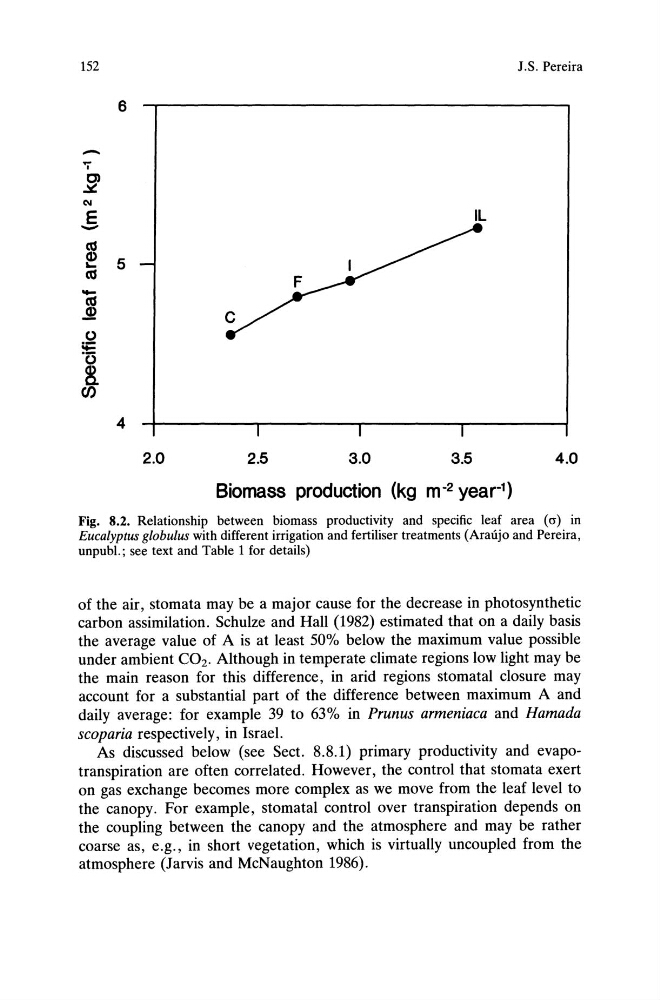
Fig. 8.2. Relationship between biomass productivity and specific leaf area (cr) in
Eucalyptus globulus with different irrigation and fertiliser treatments (Araujo and Pereira,
unpub!.; see text and Table 1 for details)
of the air, stomata may be a major cause for the decrease in photosynthetic
carbon assimilation. Schulze and Hall (1982) estimated that on a daily basis
the average value of A is at least 50% below the maximum value possible
under ambient CO 2 , Although in temperate climate regions low light may be
the main reason for this difference, in arid regions stomatal closure may
account for a substantial part of the difference between maximum A and
daily average: for example 39 to 63% in Prunus armeniaca and Hamada
scoparia respectively, in Israel.
As discussed below (see Sect. 8.8.1) primary productivity and evapotranspiration are often correlated. However, the control that stomata exert
on gas exchange becomes more complex as we move from the leaf level to
the canopy. For example, stomatal control over transpiration depends on
the coupling between the canopy and the atmosphere and may be rather
coarse as, e.g., in short vegetation, which is virtually uncoupled from the
atmosphere (Jarvis and McNaughton 1986).
I.S. Pereira
6
- "i
~
N
E
IL
- as Q) 5
... as
- as
..92
0
~
·0
8.
en
4
2.0
2.5
3.0
3.5
4.0
Biomass production (kg m- 2 year- 1 )
Fig. 8.2. Relationship between biomass productivity and specific leaf area (cr) in
Eucalyptus globulus with different irrigation and fertiliser treatments (Araujo and Pereira,
unpub!.; see text and Table 1 for details)
of the air, stomata may be a major cause for the decrease in photosynthetic
carbon assimilation. Schulze and Hall (1982) estimated that on a daily basis
the average value of A is at least 50% below the maximum value possible
under ambient CO 2 , Although in temperate climate regions low light may be
the main reason for this difference, in arid regions stomatal closure may
account for a substantial part of the difference between maximum A and
daily average: for example 39 to 63% in Prunus armeniaca and Hamada
scoparia respectively, in Israel.
As discussed below (see Sect. 8.8.1) primary productivity and evapotranspiration are often correlated. However, the control that stomata exert
on gas exchange becomes more complex as we move from the leaf level to
the canopy. For example, stomatal control over transpiration depends on
the coupling between the canopy and the atmosphere and may be rather
coarse as, e.g., in short vegetation, which is virtually uncoupled from the
atmosphere (Jarvis and McNaughton 1986).