

20
J.L. Giraudel . S. Lek
(2.1)
Step 6: Increase time t to t + 1. If t < t max then go to step 2 else stop the training.
There is no precise rule for the choice of the size of the grid, it can be chosen
larger than the number of SUs. A hexagonallattice has to be preferred, because it
does not favor horizontal or vertical directions as much as the rectangular array
(Kohonen 1995, page 112). For our dataset, the SOM has been formed with 16
hexagons: 4 rows and 4 columns (c = 4; r = 4; S = 16) .
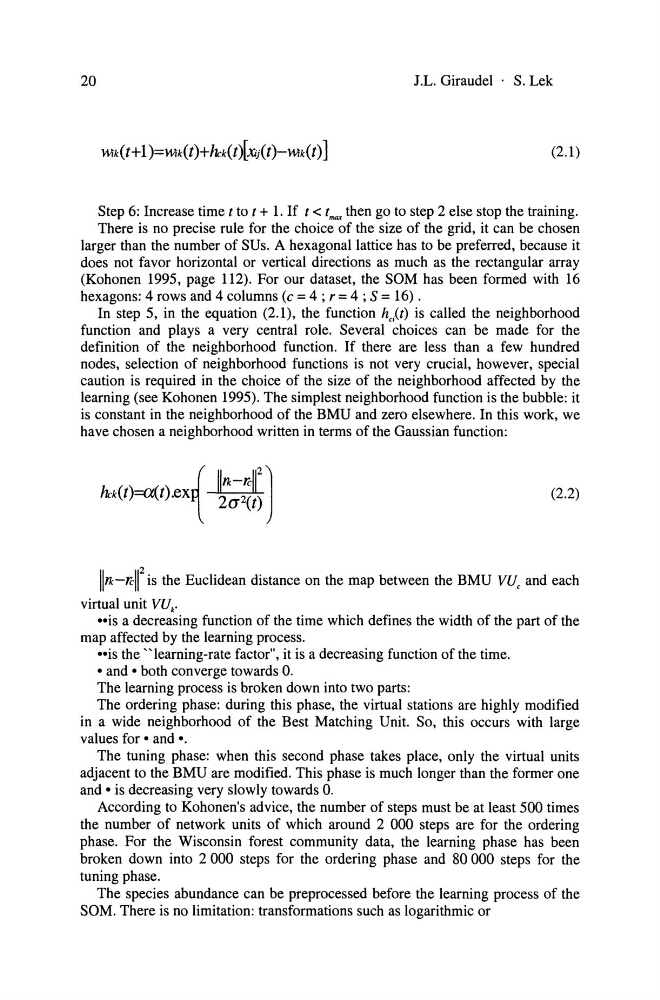
In step 5, in the equation (2.1), the function hcj(t) is called the neighborhood
function and plays a very central role. Several choices can be made for the
definition of the neighborhood function. If there are less than a few hundred
nodes, selection of neighborhood functions is not very crucial, however, special
caution is required in the choice of the size of the neighborhood affected by the
learning (see Kohonen 1995). The simplest neighborhood function is the bubble: it
is constant in the neighborhood of the BMU and zero elsewhere. In this work, we
have chosen a neighborhood written in terms of the Gaussian function:
(2.2)
Illk-rcl12 is the Euc1idean distance on the map between the BMU VU c and each
virtual unit VU ..
··is a decreasing function of the time which defines the width of the part of the
map affected by the learning process.
"is the "learning-rate factor", it is a decreasing function of the time.
• and • both converge towards O.
The learning process is broken down into two parts:
The ordering phase: during this phase, the virtual stations are highly modified
in a wide neighborhood of the Best Matching Unit. So, this occurs with large
values for • and •.
The tuning phase: when this second phase takes place, only the virtual units
adjacent to the BMU are modified. This phase is much longer than the former one
and • is decreasing very slowly towards O.
According to Kohonen's advice, the number of steps must be at least 500 times
the number of network units of which around 2 000 steps are for the ordering
phase. For the Wisconsin forest community data, the learning phase has been
broken down into 2 000 steps for the ordering phase and 80 000 steps for the
tuning phase.
The species abundance can be preprocessed before the learning process of the
SOM. There is no limitation: transformations such as logarithmic or
J.L. Giraudel . S. Lek
(2.1)
Step 6: Increase time t to t + 1. If t < t max then go to step 2 else stop the training.
There is no precise rule for the choice of the size of the grid, it can be chosen
larger than the number of SUs. A hexagonallattice has to be preferred, because it
does not favor horizontal or vertical directions as much as the rectangular array
(Kohonen 1995, page 112). For our dataset, the SOM has been formed with 16
hexagons: 4 rows and 4 columns (c = 4; r = 4; S = 16) .
In step 5, in the equation (2.1), the function hcj(t) is called the neighborhood
function and plays a very central role. Several choices can be made for the
definition of the neighborhood function. If there are less than a few hundred
nodes, selection of neighborhood functions is not very crucial, however, special
caution is required in the choice of the size of the neighborhood affected by the
learning (see Kohonen 1995). The simplest neighborhood function is the bubble: it
is constant in the neighborhood of the BMU and zero elsewhere. In this work, we
have chosen a neighborhood written in terms of the Gaussian function:
(2.2)
Illk-rcl12 is the Euc1idean distance on the map between the BMU VU c and each
virtual unit VU ..
··is a decreasing function of the time which defines the width of the part of the
map affected by the learning process.
"is the "learning-rate factor", it is a decreasing function of the time.
• and • both converge towards O.
The learning process is broken down into two parts:
The ordering phase: during this phase, the virtual stations are highly modified
in a wide neighborhood of the Best Matching Unit. So, this occurs with large
values for • and •.
The tuning phase: when this second phase takes place, only the virtual units
adjacent to the BMU are modified. This phase is much longer than the former one
and • is decreasing very slowly towards O.
According to Kohonen's advice, the number of steps must be at least 500 times
the number of network units of which around 2 000 steps are for the ordering
phase. For the Wisconsin forest community data, the learning phase has been
broken down into 2 000 steps for the ordering phase and 80 000 steps for the
tuning phase.
The species abundance can be preprocessed before the learning process of the
SOM. There is no limitation: transformations such as logarithmic or