

Chapter 2 . Unsupervised Artificial Neural Networks
19
input layer
so) ...
output layer
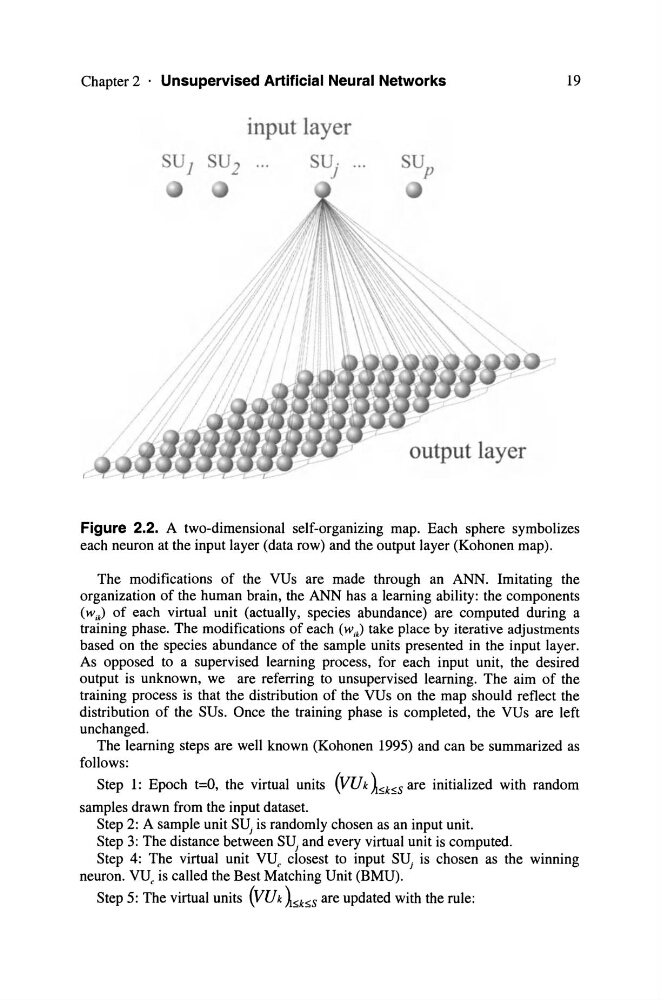
Figure 2.2. A two-dimensional self-organizing map. Each sphere symbolizes
each neuron at the input layer (data row) and the output layer (Kohonen map).
The modifications of the VUs are made through an ANN. Imitating the
organization of the human brain, the ANN has a leaming ability: the components
(W ik ) of each virtual unit (actually, species abundance) are computed during a
training phase. The modifications of each (W ik ) take place by iterative adjustments
based on the species abundance of the sampie units presented in the input layer.
As opposed to a supervised learning process, for each input unit, the desired
output is unknown, we are referring to unsupervised leaming. The aim of the
training process is that the distribution of the VUs on the map should reflect the
distribution of the SUs. Once the training phase is completed, the VUs are left
unchanged.
The leaming steps are weIl known (Kohonen 1995) and can be summarized as
follows:
Step 1: Epoch t=O, the virtual units (VUk A:S;k:S;S are initialized with random
sampIes drawn from the input dataset.
Step 2: A sampIe unit SU) is randomly chosen as an input unit.
Step 3: The distance between SU) and every virtual unit is computed.
Step 4: The virtual unit VU c dosest to input SU) is chosen as the winning
neuron. VU c is called the Best Matching Unit (BMU).
Step 5: The virtual units (VUk A:s;k:S;s are updated with the ruIe:
19
input layer
so) ...
output layer
Figure 2.2. A two-dimensional self-organizing map. Each sphere symbolizes
each neuron at the input layer (data row) and the output layer (Kohonen map).
The modifications of the VUs are made through an ANN. Imitating the
organization of the human brain, the ANN has a leaming ability: the components
(W ik ) of each virtual unit (actually, species abundance) are computed during a
training phase. The modifications of each (W ik ) take place by iterative adjustments
based on the species abundance of the sampie units presented in the input layer.
As opposed to a supervised learning process, for each input unit, the desired
output is unknown, we are referring to unsupervised leaming. The aim of the
training process is that the distribution of the VUs on the map should reflect the
distribution of the SUs. Once the training phase is completed, the VUs are left
unchanged.
The leaming steps are weIl known (Kohonen 1995) and can be summarized as
follows:
Step 1: Epoch t=O, the virtual units (VUk A:S;k:S;S are initialized with random
sampIes drawn from the input dataset.
Step 2: A sampIe unit SU) is randomly chosen as an input unit.
Step 3: The distance between SU) and every virtual unit is computed.
Step 4: The virtual unit VU c dosest to input SU) is chosen as the winning
neuron. VU c is called the Best Matching Unit (BMU).
Step 5: The virtual units (VUk A:s;k:S;s are updated with the ruIe: