

Chapter 20 . Classification of Remotely Sensed Images
387
20.3.1.1
Multi-Layer Perceptron (MLP)
The MLP is probably the most widely used type of neural network in remote
sensing (Day 1997; Atkinson and Tatnall 1997). With an MLP, the number of
hidden units and hidden layers is typically determined after aseries of trial runs,
although some heuristics may be used to help guide the selection of the network
architecture (e.g. Wang 1994; Kanellopoulos and Wilkinson 1997). In general, the
more complex the problem the larger the network, in terms of hidden units and
layers, required far its solution. Each unit in a layer of the MLP network is
connected to every unit in the adjacent layer(s) of the network by a weighted
connection (Figure 20.1). The units undertake very simple analyses. For example,
a unit in the hidden layer simply formulates the weighted sum of all of its inputs
and passes this through its transformation function to generate the output that is
then propagated to units in the next layer. The input to a unit, such as unit h in
Figure 20.1, is calculated from,
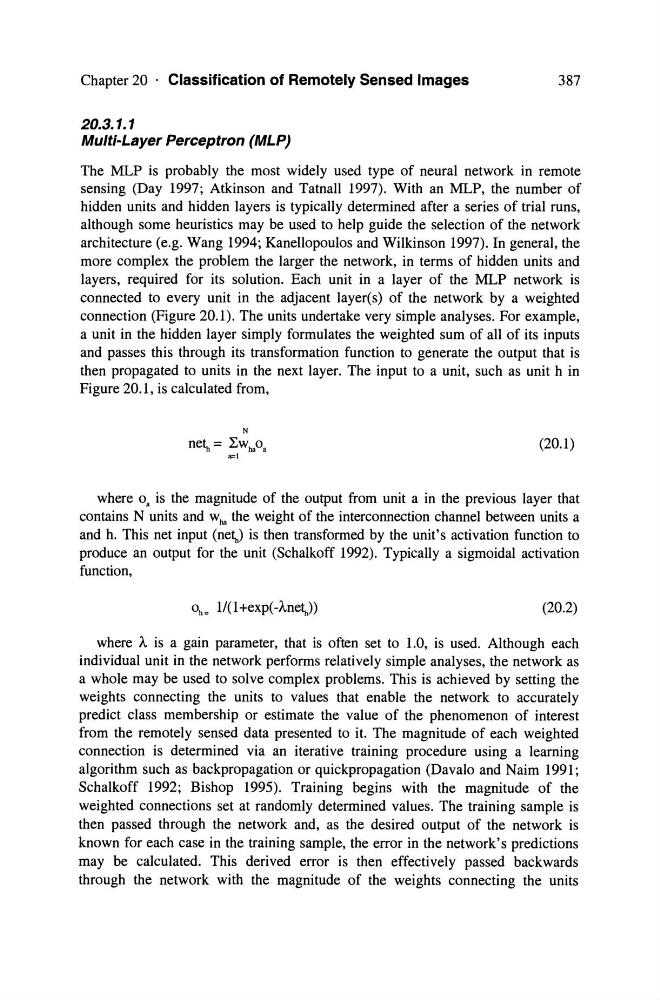
(20.1)
where 0. is the magnitude of the output from unit a in the previous layer that
contains N units and w ha the weight of the interconnection channel between units a
and h. This net input (ne~) is then transformed by the unit's activation function to
produce an output far the unit (Schalkoff 1992). Typically a sigmoidal activation
function,
0h= 1/(1 +exp( -Ane~»
(20.2)
where A is a gain parameter, that is often set to 1.0, is used. Although each
individual unit in the network perforrns relatively simple analyses, the network as
a whole may be used to solve complex problems. This is achieved by setting the
weights connecting the units to values that enable the network to accurately
predict dass membership or estimate the value of the phenomenon of interest
from the remotely sensed data presented to it. The magnitude of each weighted
connection is determined via an iterative training procedure using a learning
algorithm such as backpropagation ar quickpropagation (Davalo and Naim 1991;
Schalkoff 1992; Bishop 1995). Training begins with the magnitude of the
weighted connections set at randomly determined values. The training sampie is
then passed through the network and, as the desired output of the netwark is
known for each case in the training sampie, the error in the network's predictions
may be calculated. This derived error is then effectively passed backwards
through the netwark with the magnitude of the weights connecting the units
387
20.3.1.1
Multi-Layer Perceptron (MLP)
The MLP is probably the most widely used type of neural network in remote
sensing (Day 1997; Atkinson and Tatnall 1997). With an MLP, the number of
hidden units and hidden layers is typically determined after aseries of trial runs,
although some heuristics may be used to help guide the selection of the network
architecture (e.g. Wang 1994; Kanellopoulos and Wilkinson 1997). In general, the
more complex the problem the larger the network, in terms of hidden units and
layers, required far its solution. Each unit in a layer of the MLP network is
connected to every unit in the adjacent layer(s) of the network by a weighted
connection (Figure 20.1). The units undertake very simple analyses. For example,
a unit in the hidden layer simply formulates the weighted sum of all of its inputs
and passes this through its transformation function to generate the output that is
then propagated to units in the next layer. The input to a unit, such as unit h in
Figure 20.1, is calculated from,
(20.1)
where 0. is the magnitude of the output from unit a in the previous layer that
contains N units and w ha the weight of the interconnection channel between units a
and h. This net input (ne~) is then transformed by the unit's activation function to
produce an output far the unit (Schalkoff 1992). Typically a sigmoidal activation
function,
0h= 1/(1 +exp( -Ane~»
(20.2)
where A is a gain parameter, that is often set to 1.0, is used. Although each
individual unit in the network perforrns relatively simple analyses, the network as
a whole may be used to solve complex problems. This is achieved by setting the
weights connecting the units to values that enable the network to accurately
predict dass membership or estimate the value of the phenomenon of interest
from the remotely sensed data presented to it. The magnitude of each weighted
connection is determined via an iterative training procedure using a learning
algorithm such as backpropagation ar quickpropagation (Davalo and Naim 1991;
Schalkoff 1992; Bishop 1995). Training begins with the magnitude of the
weighted connections set at randomly determined values. The training sampie is
then passed through the network and, as the desired output of the netwark is
known for each case in the training sampie, the error in the network's predictions
may be calculated. This derived error is then effectively passed backwards
through the netwark with the magnitude of the weights connecting the units