

386
G.M. Foody
20.3.1
Feedforward Neural Networks
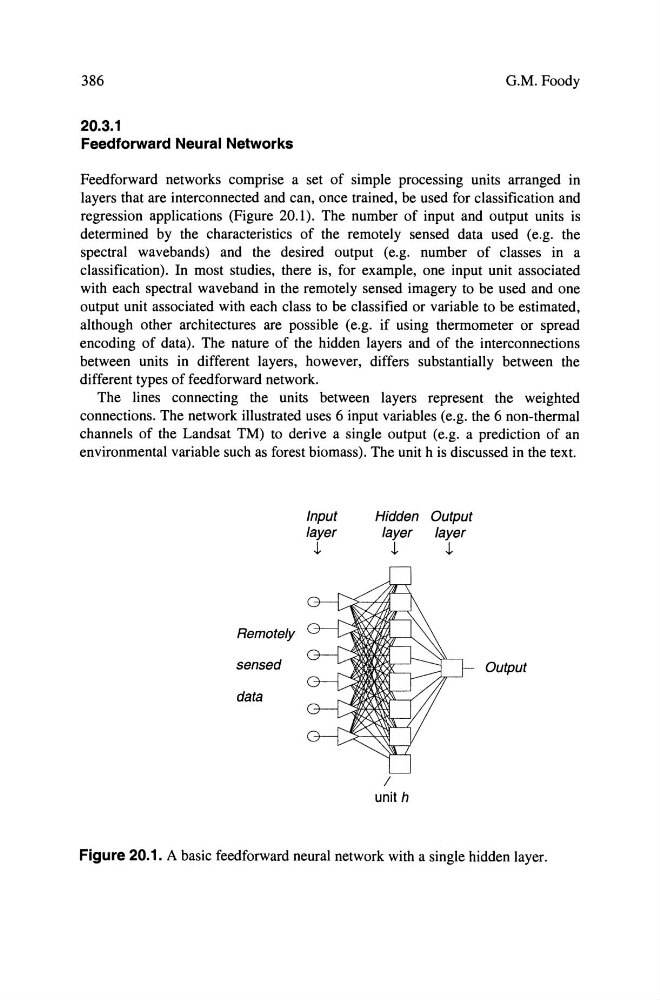
Feedforward networks comprise a set of simple processing units arranged in
layers that are interconnected and can, once trained, be used for classification and
regression applications (Figure 20.1). The number of input and output units is
determined by the characteristics of the remotely sensed data used (e.g. the
spectral wavebands) and the desired output (e.g. number of classes in a
classification). In most studies, there is, for example, one input unit associated
with each spectral waveband in the remotely sensed imagery to be used and one
output unit associated with each class to be classified or variable to be estimated,
although other architectures are possible (e.g. if using thermometer or spread
encoding of data). The nature of the hidden layers and of the interconnections
between units in different layers, however, differs substantially between the
different types of feedforward network.
The lines connecting the units between layers represent the weighted
connections. The network illustrated uses 6 input variables (e.g. the 6 non-thermal
channels of the Landsat TM) to derive a single output (e.g. a prediction of an
environmental variable such as forest biomass). The unit his discussed in the text.
Remotely
sensed
data
Input
Hidden Output
layer
layer
layer
-1.
-1.
-1.
/
unit h
Output
Figure 20.1. A basic feedforward neural network with a single hidden layer.
G.M. Foody
20.3.1
Feedforward Neural Networks
Feedforward networks comprise a set of simple processing units arranged in
layers that are interconnected and can, once trained, be used for classification and
regression applications (Figure 20.1). The number of input and output units is
determined by the characteristics of the remotely sensed data used (e.g. the
spectral wavebands) and the desired output (e.g. number of classes in a
classification). In most studies, there is, for example, one input unit associated
with each spectral waveband in the remotely sensed imagery to be used and one
output unit associated with each class to be classified or variable to be estimated,
although other architectures are possible (e.g. if using thermometer or spread
encoding of data). The nature of the hidden layers and of the interconnections
between units in different layers, however, differs substantially between the
different types of feedforward network.
The lines connecting the units between layers represent the weighted
connections. The network illustrated uses 6 input variables (e.g. the 6 non-thermal
channels of the Landsat TM) to derive a single output (e.g. a prediction of an
environmental variable such as forest biomass). The unit his discussed in the text.
Remotely
sensed
data
Input
Hidden Output
layer
layer
layer
-1.
-1.
-1.
/
unit h
Output
Figure 20.1. A basic feedforward neural network with a single hidden layer.