

374
S.G. Robertson . A.K. Morison
A probabilistic network was used for the test and implemented using
proprietary software (Ward Systems Neuroshell®). Probabilistic neural networks
(PNNs) are intrinsic c1assification models and are known for their ability to train
quickly (Masters 1993). PNNs categorise data into a specified number of output
categories that correspond to, in this application, age-c1asses. The topology of the
PNNs resembles the back propagation neural network i.e. there are three layers in
the networks. The difference lies in the number of neurons in the hidden layer and
the function of the hidden layer. There are as many neurons in the hidden layer as
there are sampies in the pattern dataset. The input layer uses the same linearly
scaled data as the input layer of the back propagation models. The output layer
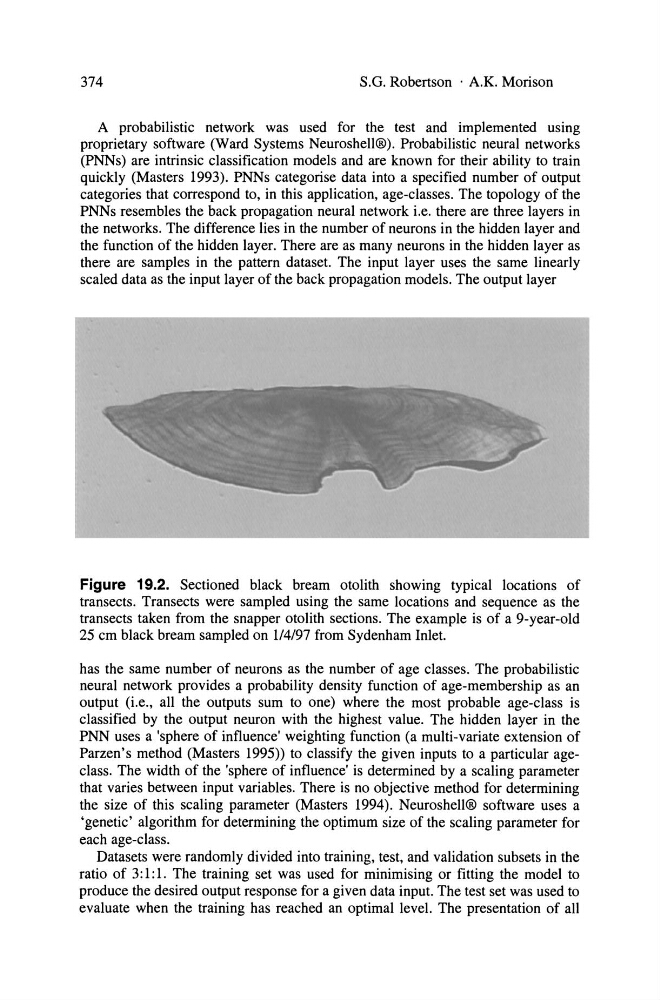
Figure 19.2. Sectioned black bream otolith showing typical locations of
transects. Transects were sampled using the same locations and sequence as the
transects taken from the snapper otolith sections. The example is of a 9-year-old
25 cm black bream sampled on 1/4/97 from Sydenham Inlet.
has the same number of neurons as the number of age c1asses. The probabilistic
neural network provides a probability density function of age-membership as an
output (i.e., all the outputs sum to one) where the most probable age-c1ass is
c1assified by the output neuron with the highest value. The hidden layer in the
PNN uses a 'sphere of influence' weighting function (a multi-variate extension of
Parzen's method (Masters 1995)) to c1assify the given inputs to a particular agec1ass. The width of the 'sphere of influence' is determined by a scaling parameter
that varies between input variables. There is no objective method for determining
the size of this scaling parameter (Masters 1994). Neuroshell® software uses a
'genetic' algorithm for determining the optimum size of the scaling parameter for
each age-c1ass.
Datasets were randomly divided into training, test, and validation subsets in the
ratio of 3: 1: 1. The training set was used for minimising or fitting the model to
produce the desired output response for a given data input. The test set was used to
evaluate when the training has reached an optimal level. The presentation of all
S.G. Robertson . A.K. Morison
A probabilistic network was used for the test and implemented using
proprietary software (Ward Systems Neuroshell®). Probabilistic neural networks
(PNNs) are intrinsic c1assification models and are known for their ability to train
quickly (Masters 1993). PNNs categorise data into a specified number of output
categories that correspond to, in this application, age-c1asses. The topology of the
PNNs resembles the back propagation neural network i.e. there are three layers in
the networks. The difference lies in the number of neurons in the hidden layer and
the function of the hidden layer. There are as many neurons in the hidden layer as
there are sampies in the pattern dataset. The input layer uses the same linearly
scaled data as the input layer of the back propagation models. The output layer
Figure 19.2. Sectioned black bream otolith showing typical locations of
transects. Transects were sampled using the same locations and sequence as the
transects taken from the snapper otolith sections. The example is of a 9-year-old
25 cm black bream sampled on 1/4/97 from Sydenham Inlet.
has the same number of neurons as the number of age c1asses. The probabilistic
neural network provides a probability density function of age-membership as an
output (i.e., all the outputs sum to one) where the most probable age-c1ass is
c1assified by the output neuron with the highest value. The hidden layer in the
PNN uses a 'sphere of influence' weighting function (a multi-variate extension of
Parzen's method (Masters 1995)) to c1assify the given inputs to a particular agec1ass. The width of the 'sphere of influence' is determined by a scaling parameter
that varies between input variables. There is no objective method for determining
the size of this scaling parameter (Masters 1994). Neuroshell® software uses a
'genetic' algorithm for determining the optimum size of the scaling parameter for
each age-c1ass.
Datasets were randomly divided into training, test, and validation subsets in the
ratio of 3: 1: 1. The training set was used for minimising or fitting the model to
produce the desired output response for a given data input. The test set was used to
evaluate when the training has reached an optimal level. The presentation of all