

Chapter 17 . Classification of Fish Stock-Recruitment Relationships 337
algorithms, it has been found that the algorithms do require a large amount of
computer time to find the global optima. In a situation requiring bootstrapping
which inc1udes re-sampling the SR data for a large number of times, the genetic
algorithms do not seem practical. In this paper, a hybrid optimal learning
algorithm which combines the gradient descent and linear least-squares estimation
(LSE) is adopted to search for the global optima and also for the bootstrap resampling procedure.
17.3.1
Hybrid Optimal Learning Aigorithms
The gradient method is the basic learning algorithm for any optimization (Press et
(JE
al. 1988). To implement the gradient descent, the errar rate, - - , needs to be
(Jp
ca1culated for each parameter (P = ~ ß, a J , a 2 , b J , b 2 ), which can be easily
obtained from equation (17.10). Then, the optimal parameter estimate can be
learned as:
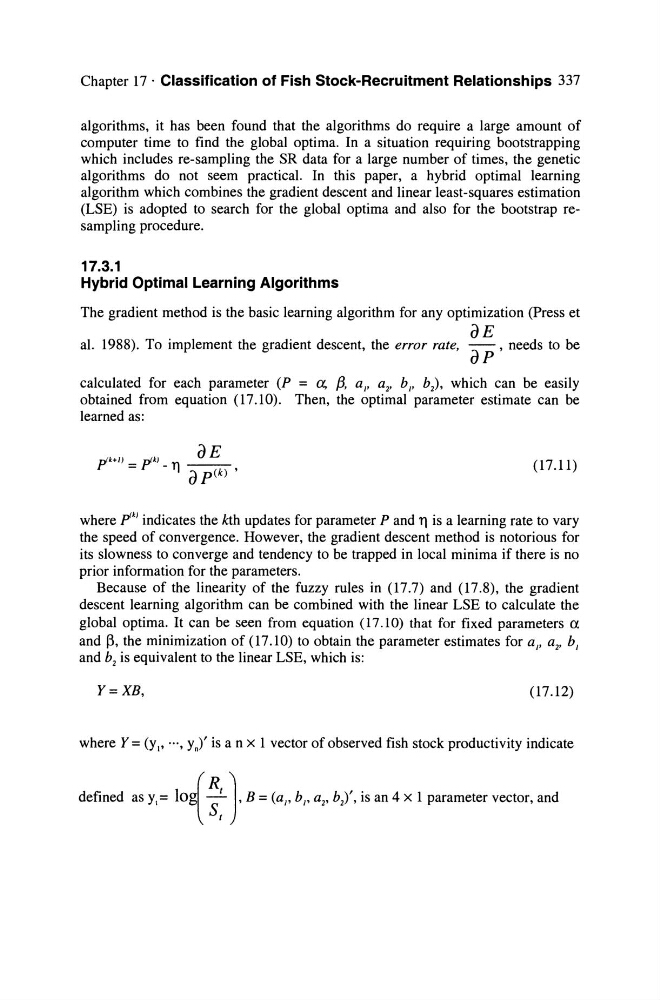
(17.11)
where pik) indicates the kth updates for parameter P and YJ is a learning rate to vary
the speed of convergence. However, the gradient descent method is notorious for
its slowness to converge and tendency to be trapped in local minima if there is no
prior information for the parameters.
Because of the linearity of the fuzzy rules in (17.7) and (17.8), the gradient
descent learning algorithm can be combined with the linear LSE to ca1culate the
global optima. It can be seen from equation (17.10) that for fixed parameters a
and ß, the minimization of (17.10) to obtain the parameter estimates for a J , a 2 , b J
and b 2 is equivalent to the linear LSE, which is:
Y=XB,
(17.12)
where Y = (Yl' ... , y.)' is a n x 1 vector of observed fish stock productivity indicate
defined "y,= lO{ ~: ]. B = Ca,. b,. a,. b,)'. i,.n 4 x 1 p"",meten""o, •• nd
algorithms, it has been found that the algorithms do require a large amount of
computer time to find the global optima. In a situation requiring bootstrapping
which inc1udes re-sampling the SR data for a large number of times, the genetic
algorithms do not seem practical. In this paper, a hybrid optimal learning
algorithm which combines the gradient descent and linear least-squares estimation
(LSE) is adopted to search for the global optima and also for the bootstrap resampling procedure.
17.3.1
Hybrid Optimal Learning Aigorithms
The gradient method is the basic learning algorithm for any optimization (Press et
(JE
al. 1988). To implement the gradient descent, the errar rate, - - , needs to be
(Jp
ca1culated for each parameter (P = ~ ß, a J , a 2 , b J , b 2 ), which can be easily
obtained from equation (17.10). Then, the optimal parameter estimate can be
learned as:
(17.11)
where pik) indicates the kth updates for parameter P and YJ is a learning rate to vary
the speed of convergence. However, the gradient descent method is notorious for
its slowness to converge and tendency to be trapped in local minima if there is no
prior information for the parameters.
Because of the linearity of the fuzzy rules in (17.7) and (17.8), the gradient
descent learning algorithm can be combined with the linear LSE to ca1culate the
global optima. It can be seen from equation (17.10) that for fixed parameters a
and ß, the minimization of (17.10) to obtain the parameter estimates for a J , a 2 , b J
and b 2 is equivalent to the linear LSE, which is:
Y=XB,
(17.12)
where Y = (Yl' ... , y.)' is a n x 1 vector of observed fish stock productivity indicate
defined "y,= lO{ ~: ]. B = Ca,. b,. a,. b,)'. i,.n 4 x 1 p"",meten""o, •• nd