

338
x = (
l-Wl'-(l-W\)Sl' wl' -w\S\
M
M
M
M
l-wn,-(l-wn)Sn' w n ' -wnS n
D.G. ehen
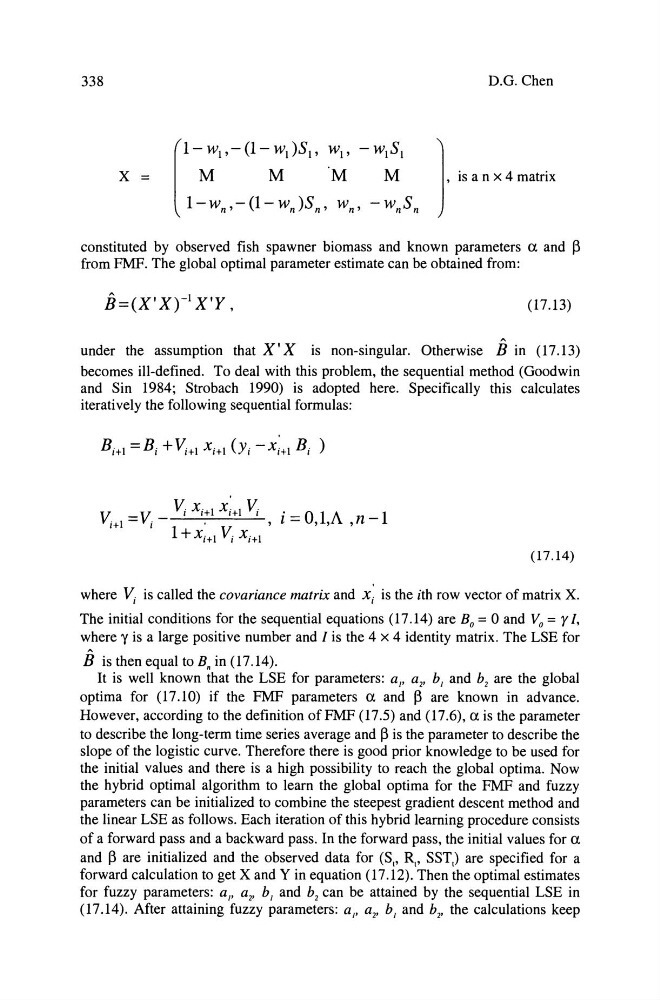
constituted by observed fish spawner biomass and known parameters IX and ß
from FMF. The global optimal parameter estimate can be obtained from:
B=(X' X)-\ X'Y ,
(17.13)
A
under the assumption that X' X is non-singular. Otherwise B in (17.13)
becomes ill-defined. To deal with this problem, the sequential method (Goodwin
and Sin 1984; Strobach 1990) is adopted here. Specifically this calculates
iteratively the following sequential formulas:
(17.14)
where Vi is called the covariance matrix and x; is the ith row vector of matrix X.
The initial conditions for the sequential equations (17.14) are B o = 0 and V o = r I,
where y is a large positive number and I is the 4 x 4 identity matrix. The LSE for
A
B is then equal to B n in (17.14).
It is well known that the LSE for parameters: aj • a 2 • b j and b 2 are the global
optima for (17.10) if the FMF parameters IX and ß are known in advance.
However, according to the definition ofFMF (17.5) and (17.6), IX is the parameter
to describe the long-term time series average and ß is the parameter to describe the
slope of the logistic curve. Therefore there is good prior knowledge to be used for
the initial values and there is a high possibility to reach the global optima. Now
the hybrid optimal algorithm to leam the global optima for the FMF and fuzzy
parameters can be initialized to combine the steepest gradient descent method and
the linear LSE as follows. Each iteration of this hybrid leaming procedure consists
of a forward pass and a backward pass. In the forward pass, the initial values for IX
and ß are initialized and the observed data for (S,. R,. SST,) are specified for a
forward calculation to get X and Y in equation (17.12). Then the optimal estimates
for fuzzy parameters: aj • a 2 • bj and b z can be attained by the sequential LSE in
(17.14). After attaining fuzzy parameters: a j • a 2 • b j and b 2 • the calculations keep
x = (
l-Wl'-(l-W\)Sl' wl' -w\S\
M
M
M
M
l-wn,-(l-wn)Sn' w n ' -wnS n
D.G. ehen
constituted by observed fish spawner biomass and known parameters IX and ß
from FMF. The global optimal parameter estimate can be obtained from:
B=(X' X)-\ X'Y ,
(17.13)
A
under the assumption that X' X is non-singular. Otherwise B in (17.13)
becomes ill-defined. To deal with this problem, the sequential method (Goodwin
and Sin 1984; Strobach 1990) is adopted here. Specifically this calculates
iteratively the following sequential formulas:
(17.14)
where Vi is called the covariance matrix and x; is the ith row vector of matrix X.
The initial conditions for the sequential equations (17.14) are B o = 0 and V o = r I,
where y is a large positive number and I is the 4 x 4 identity matrix. The LSE for
A
B is then equal to B n in (17.14).
It is well known that the LSE for parameters: aj • a 2 • b j and b 2 are the global
optima for (17.10) if the FMF parameters IX and ß are known in advance.
However, according to the definition ofFMF (17.5) and (17.6), IX is the parameter
to describe the long-term time series average and ß is the parameter to describe the
slope of the logistic curve. Therefore there is good prior knowledge to be used for
the initial values and there is a high possibility to reach the global optima. Now
the hybrid optimal algorithm to leam the global optima for the FMF and fuzzy
parameters can be initialized to combine the steepest gradient descent method and
the linear LSE as follows. Each iteration of this hybrid leaming procedure consists
of a forward pass and a backward pass. In the forward pass, the initial values for IX
and ß are initialized and the observed data for (S,. R,. SST,) are specified for a
forward calculation to get X and Y in equation (17.12). Then the optimal estimates
for fuzzy parameters: aj • a 2 • bj and b z can be attained by the sequential LSE in
(17.14). After attaining fuzzy parameters: a j • a 2 • b j and b 2 • the calculations keep