

Chapter 17 . Classification of Fish Stock-Recruitment Relationships 335
recruits per spawner for the "Warm" regime. The parameter b} and b z represent
density-dependence in juvenile survival rate in "Cool" and "Warm" regimes,
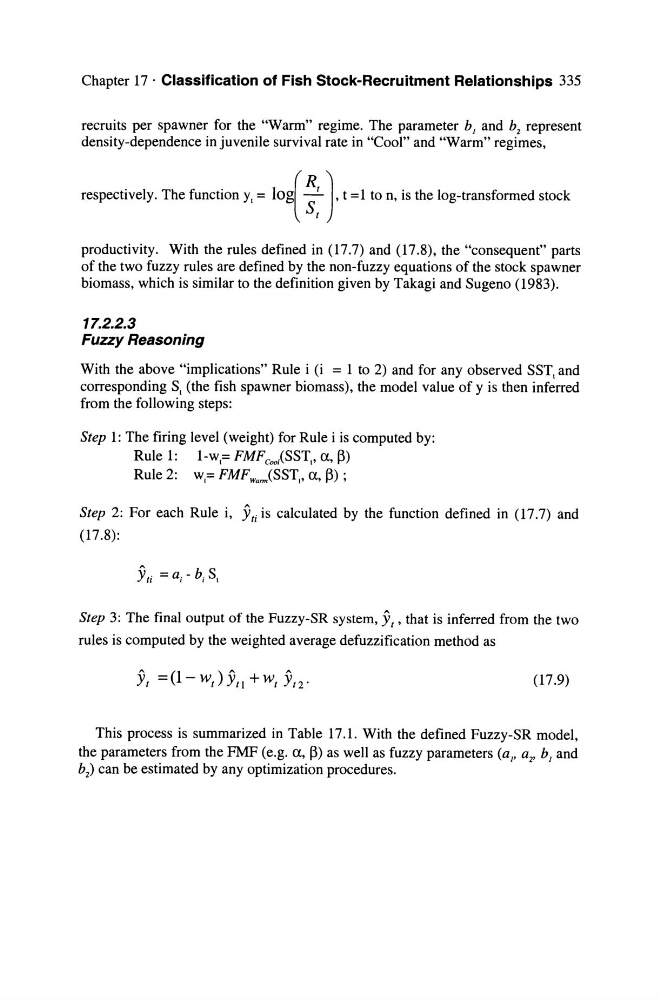
respectively. The fun,tion y, = IO{ ~: ), t = I to n, is the log-transfonned stook
productivity. With the rules defined in (17.7) and (17.8), the "consequent" parts
of the two fuzzy rules are defined by the non-fuzzy equations of the stock spawner
biomass, which is similar to the definition given by Takagi and Sugeno (1983).
17.2.2.3
Fuzzy Reasoning
With the above "implications" Rule i (i = 1 to 2) and for any observed SST, and
corresponding S, (the fish spawner biomass), the model value of y is then inferred
from the following steps:
Step 1: The firing level (weight) for Rule i is computed by:
Rule 1: 1-w,= FMFcoo/(SST" a, ß)
Rule 2: w,= FMF wa""(SST,, a, ß) ;
Step 2: For each Rule i, 9 1i is calculated by the function defined in (17.7) and
(17.8):
9 1i = ai - bi S,
Step 3: The final output of the Fuzzy-SR system, 9 1 , that is inferred from the two
rules is computed by the weighted average defuzzification method as
(17.9)
This process is summarized in Table 17.1. With the defined Fuzzy-SR model,
the parameters from the FMF (e.g. a, ß) as weil as fuzzy parameters (al' a z ' b} and
b z ) can be estimated by any optimization procedures.
recruits per spawner for the "Warm" regime. The parameter b} and b z represent
density-dependence in juvenile survival rate in "Cool" and "Warm" regimes,
respectively. The fun,tion y, = IO{ ~: ), t = I to n, is the log-transfonned stook
productivity. With the rules defined in (17.7) and (17.8), the "consequent" parts
of the two fuzzy rules are defined by the non-fuzzy equations of the stock spawner
biomass, which is similar to the definition given by Takagi and Sugeno (1983).
17.2.2.3
Fuzzy Reasoning
With the above "implications" Rule i (i = 1 to 2) and for any observed SST, and
corresponding S, (the fish spawner biomass), the model value of y is then inferred
from the following steps:
Step 1: The firing level (weight) for Rule i is computed by:
Rule 1: 1-w,= FMFcoo/(SST" a, ß)
Rule 2: w,= FMF wa""(SST,, a, ß) ;
Step 2: For each Rule i, 9 1i is calculated by the function defined in (17.7) and
(17.8):
9 1i = ai - bi S,
Step 3: The final output of the Fuzzy-SR system, 9 1 , that is inferred from the two
rules is computed by the weighted average defuzzification method as
(17.9)
This process is summarized in Table 17.1. With the defined Fuzzy-SR model,
the parameters from the FMF (e.g. a, ß) as weil as fuzzy parameters (al' a z ' b} and
b z ) can be estimated by any optimization procedures.