

3.6 Selection of Diagnostic Characteristics: What Process Should be Used?
45
VEGETATION PATTERN
BIOTIC PROCESSES
10 7
10 7
10 6
10 6
en 10 5
en 10 5
c::: 10 4
c::: 10 4
«
«
UJ
UJ
>- 10 3
>- 10 3
10 2
10 2
10 1
10 1
10 6
10 8
10 12
10 8
10 12
METERS2
METERS2
PLOT!
LANDPLOT!
LAN 0STAND I SCAPE IECOREGION I CONTINENT
STAND I SCAPE IECOREGION I CONTINENT
(a)
(b)
ENVIRONMENTAL CONSTRAINTS
DISTURBANCES
10 7
10 7
10 6
10 6
en 10 5
en 10 5
c::: 10 4
c::: 10 4
«
«
UJ
UJ
>- 10 3
>- 10 3
10 2
10 2
10 1
10 1
10 6
10 8
10 6
10 8
10 12
METERS2
METERS2
PLOT!
LANDPLOT!
LAN 0STAND ISCAPE IECOREGION I CONTINENT
STAND
ISCAPE IECOREGION I CONTINENT
(c)
(d)
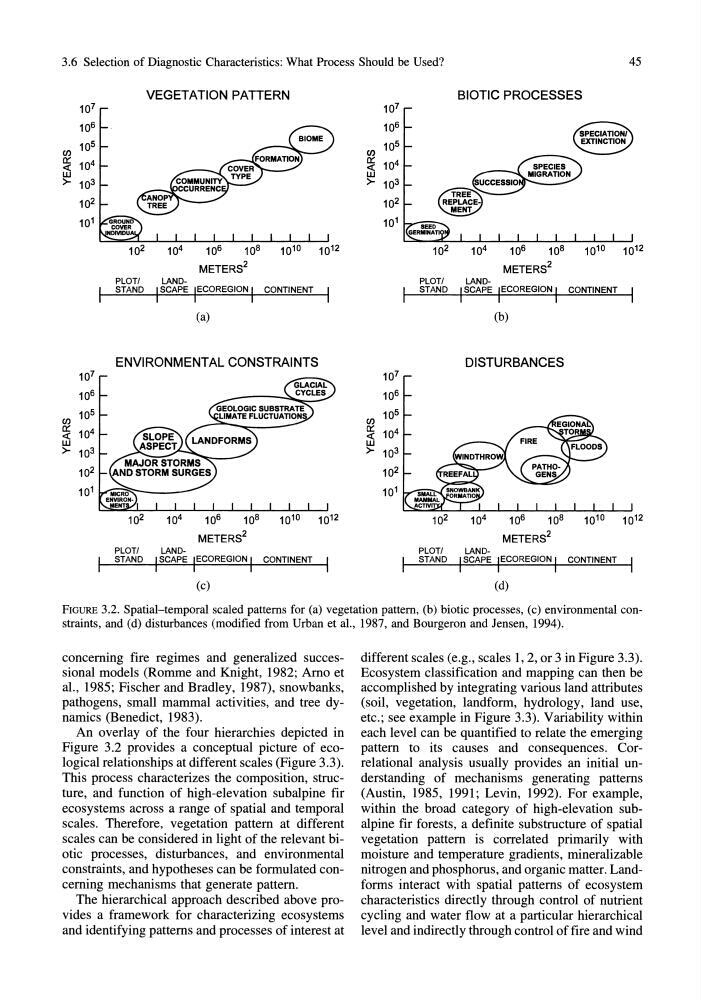
FIGURE 3.2. Spatial-temporal scaled patterns for (a) vegetation pattern, (b) biotic processes, (c) environmental constraints, and (d) disturbances (modified from Urban et aI., 1987, and Bourgeron and Jensen, 1994).
concerning fire regimes and generalized successional models (Romme and Knight, 1982; Arno et
aI., 1985; Fischer and Bradley, 1987), snowbanks,
pathogens, small mammal activities, and tree dynamics (Benedict, 1983).
An overlay of the four hierarchies depicted in
Figure 3.2 provides a conceptual picture of ecological relationships at different scales (Figure 3.3).
This process characterizes the composition, structure, and function of high-elevation subalpine fir
ecosystems across a range of spatial and temporal
scales. Therefore, vegetation pattern at different
scales can be considered in light of the relevant biotic processes, disturbances, and environmental
constraints, and hypotheses can be formulated concerning mechanisms that generate pattern.
The hierarchical approach described above provides a framework for characterizing ecosystems
and identifying patterns and processes of interest at
different scales (e.g., scales 1,2, or 3 in Figure 3.3).
Ecosystem classification and mapping can then be
accomplished by integrating various land attributes
(soil, vegetation, landform, hydrology, land use,
etc.; see example in Figure 3.3). Variability within
each level can be quantified to relate the emerging
pattern to its causes and consequences. Correlational analysis usually provides an initial understanding of mechanisms generating patterns
(Austin, 1985, 1991; Levin, 1992). For example,
within the broad category of high-elevation subalpine fir forests, a definite substructure of spatial
vegetation pattern is correlated primarily with
moisture and temperature gradients, mineralizable
nitrogen and phosphorus, and organic matter. Landforms interact with spatial patterns of ecosystem
characteristics directly through control of nutrient
cycling and water flow at a particular hierarchical
level and indirectly through control of fire and wind
45
VEGETATION PATTERN
BIOTIC PROCESSES
10 7
10 7
10 6
10 6
en 10 5
en 10 5
c::: 10 4
c::: 10 4
«
«
UJ
UJ
>- 10 3
>- 10 3
10 2
10 2
10 1
10 1
10 6
10 8
10 12
10 8
10 12
METERS2
METERS2
PLOT!
LANDPLOT!
LAN 0STAND I SCAPE IECOREGION I CONTINENT
STAND I SCAPE IECOREGION I CONTINENT
(a)
(b)
ENVIRONMENTAL CONSTRAINTS
DISTURBANCES
10 7
10 7
10 6
10 6
en 10 5
en 10 5
c::: 10 4
c::: 10 4
«
«
UJ
UJ
>- 10 3
>- 10 3
10 2
10 2
10 1
10 1
10 6
10 8
10 6
10 8
10 12
METERS2
METERS2
PLOT!
LANDPLOT!
LAN 0STAND ISCAPE IECOREGION I CONTINENT
STAND
ISCAPE IECOREGION I CONTINENT
(c)
(d)
FIGURE 3.2. Spatial-temporal scaled patterns for (a) vegetation pattern, (b) biotic processes, (c) environmental constraints, and (d) disturbances (modified from Urban et aI., 1987, and Bourgeron and Jensen, 1994).
concerning fire regimes and generalized successional models (Romme and Knight, 1982; Arno et
aI., 1985; Fischer and Bradley, 1987), snowbanks,
pathogens, small mammal activities, and tree dynamics (Benedict, 1983).
An overlay of the four hierarchies depicted in
Figure 3.2 provides a conceptual picture of ecological relationships at different scales (Figure 3.3).
This process characterizes the composition, structure, and function of high-elevation subalpine fir
ecosystems across a range of spatial and temporal
scales. Therefore, vegetation pattern at different
scales can be considered in light of the relevant biotic processes, disturbances, and environmental
constraints, and hypotheses can be formulated concerning mechanisms that generate pattern.
The hierarchical approach described above provides a framework for characterizing ecosystems
and identifying patterns and processes of interest at
different scales (e.g., scales 1,2, or 3 in Figure 3.3).
Ecosystem classification and mapping can then be
accomplished by integrating various land attributes
(soil, vegetation, landform, hydrology, land use,
etc.; see example in Figure 3.3). Variability within
each level can be quantified to relate the emerging
pattern to its causes and consequences. Correlational analysis usually provides an initial understanding of mechanisms generating patterns
(Austin, 1985, 1991; Levin, 1992). For example,
within the broad category of high-elevation subalpine fir forests, a definite substructure of spatial
vegetation pattern is correlated primarily with
moisture and temperature gradients, mineralizable
nitrogen and phosphorus, and organic matter. Landforms interact with spatial patterns of ecosystem
characteristics directly through control of nutrient
cycling and water flow at a particular hierarchical
level and indirectly through control of fire and wind