

31.2 Background
461
Abraham Lincoln 's House Divided Speech -
I I
"If we could lirsl know where
•... and whither we are lending .. ."
" .. we could beller judge what to do
we are ...•
and how 10 do il."
Economy
VICIOUS
"
VIRTUOUS
International
CYClES
CYCLES
--agricultural
Increasing demand
breadbasket
for agricultural
WHAT?
"Take destiny
I
~_u,
"RaIlroad thIB
into our own
Over 60% of U.S. grain exports
plan throughr
hands"
travellhe Mississippi
"SIopHdead
"Identify each
Increasing
In ill track8r
olher's real
barge traHie
the future
needs'
of navigation
HOW?
................. DIaInformatIon
Be reallsticEcology
and environmental
campaigns
no easy
World class
management
answers
I
river resource
programs?
L.awauIta
I
Vital floodplain ecosystem
Increasing
Mid·continent flyway
degradation of
rive r ecology
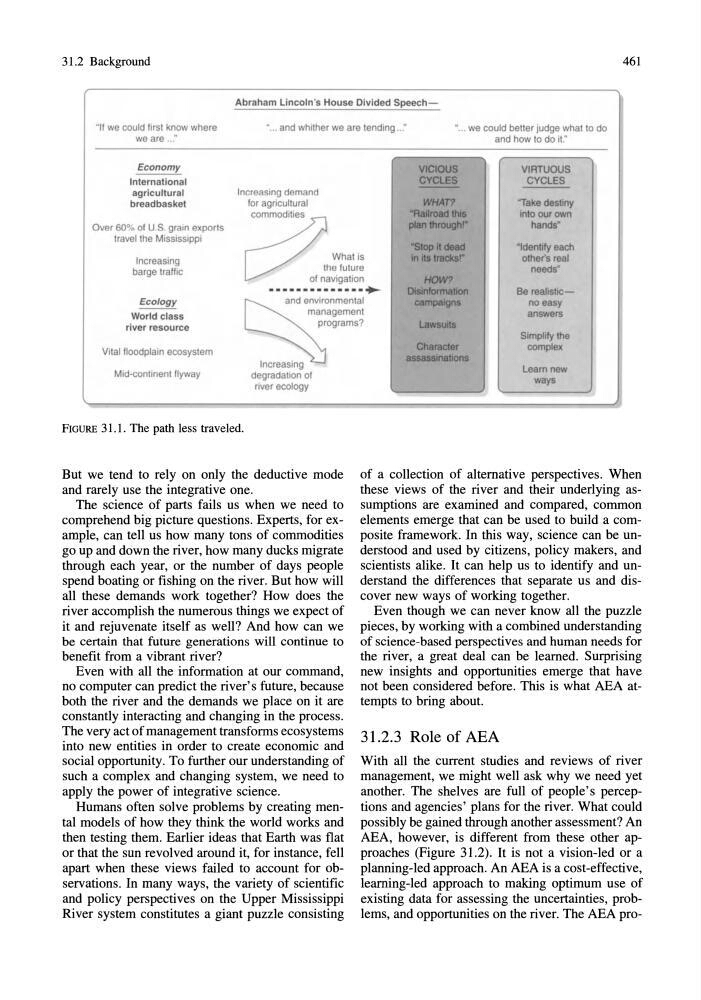
FIGURE 31.1. The path less traveled.
But we tend to rely on only the deductive mode
and rarely use the integrative one.
The science of parts fails us when we need to
comprehend big picture questions. Experts, for example, can tell us how many tons of commodities
go up and down the river, how many ducks migrate
through each year, or the number of days people
spend boating or fishing on the river. But how will
all these demands work together? How does the
river accomplish the numerous things we expect of
it and rejuvenate itself as well? And how can we
be certain that future generations will continue to
benefit from a vibrant river?
Even with all the information at our command,
no computer can predict the river's future, because
both the river and the demands we place on it are
constantly interacting and changing in the process.
The very act of management transforms ecosystems
into new entities in order to create economic and
social opportunity. To further our understanding of
such a complex and changing system, we need to
apply the power of integrative science.
Humans often solve problems by creating mental models of how they think the world works and
then testing them. Earlier ideas that Earth was flat
or that the sun revolved around it, for instance, fell
apart when these views failed to account for observations. In many ways, the variety of scientific
and policy perspectives on the Upper Mississippi
River system constitutes a giant puzzle consisting
Simplify the
CII8Iacter
complex
assassinations
Learn new
ways
of a collection of alternative perspectives. When
these views of the river and their underlying assumptions are examined and compared, common
elements emerge that can be used to build a composite framework. In this way, science can be understood and used by citizens, policy makers, and
scientists alike. It can help us to identify and understand the differences that separate us and discover new ways of working together.
Even though we can never know all the puzzle
pieces, by working with a combined understanding
of science-based perspectives and human needs for
the river, a great deal can be learned. Surprising
new insights and opportunities emerge that have
not been considered before. This is what AEA attempts to bring about.
31.2.3 Role of ABA
With all the current studies and reviews of river
management, we might well ask why we need yet
another. The shelves are full of people's perceptions and agencies' plans for the river. What could
possibly be gained through another assessment? An
AEA, however, is different from these other approaches (Figure 31.2). It is not a vision-led or a
planning-led approach. An AEA is a cost-effective,
learning-led approach to making optimum use of
existing data for assessing the uncertainties, problems, and opportunities on the river. The AEA pro-
461
Abraham Lincoln 's House Divided Speech -
I I
"If we could lirsl know where
•... and whither we are lending .. ."
" .. we could beller judge what to do
we are ...•
and how 10 do il."
Economy
VICIOUS
"
VIRTUOUS
International
CYClES
CYCLES
--agricultural
Increasing demand
breadbasket
for agricultural
WHAT?
"Take destiny
I
~_u,
"RaIlroad thIB
into our own
Over 60% of U.S. grain exports
plan throughr
hands"
travellhe Mississippi
"SIopHdead
"Identify each
Increasing
In ill track8r
olher's real
barge traHie
the future
needs'
of navigation
HOW?
................. DIaInformatIon
Be reallsticEcology
and environmental
campaigns
no easy
World class
management
answers
I
river resource
programs?
L.awauIta
I
Vital floodplain ecosystem
Increasing
Mid·continent flyway
degradation of
rive r ecology
FIGURE 31.1. The path less traveled.
But we tend to rely on only the deductive mode
and rarely use the integrative one.
The science of parts fails us when we need to
comprehend big picture questions. Experts, for example, can tell us how many tons of commodities
go up and down the river, how many ducks migrate
through each year, or the number of days people
spend boating or fishing on the river. But how will
all these demands work together? How does the
river accomplish the numerous things we expect of
it and rejuvenate itself as well? And how can we
be certain that future generations will continue to
benefit from a vibrant river?
Even with all the information at our command,
no computer can predict the river's future, because
both the river and the demands we place on it are
constantly interacting and changing in the process.
The very act of management transforms ecosystems
into new entities in order to create economic and
social opportunity. To further our understanding of
such a complex and changing system, we need to
apply the power of integrative science.
Humans often solve problems by creating mental models of how they think the world works and
then testing them. Earlier ideas that Earth was flat
or that the sun revolved around it, for instance, fell
apart when these views failed to account for observations. In many ways, the variety of scientific
and policy perspectives on the Upper Mississippi
River system constitutes a giant puzzle consisting
Simplify the
CII8Iacter
complex
assassinations
Learn new
ways
of a collection of alternative perspectives. When
these views of the river and their underlying assumptions are examined and compared, common
elements emerge that can be used to build a composite framework. In this way, science can be understood and used by citizens, policy makers, and
scientists alike. It can help us to identify and understand the differences that separate us and discover new ways of working together.
Even though we can never know all the puzzle
pieces, by working with a combined understanding
of science-based perspectives and human needs for
the river, a great deal can be learned. Surprising
new insights and opportunities emerge that have
not been considered before. This is what AEA attempts to bring about.
31.2.3 Role of ABA
With all the current studies and reviews of river
management, we might well ask why we need yet
another. The shelves are full of people's perceptions and agencies' plans for the river. What could
possibly be gained through another assessment? An
AEA, however, is different from these other approaches (Figure 31.2). It is not a vision-led or a
planning-led approach. An AEA is a cost-effective,
learning-led approach to making optimum use of
existing data for assessing the uncertainties, problems, and opportunities on the river. The AEA pro-