

462
Upper Mississippi River Adaptive Environmental Assessment
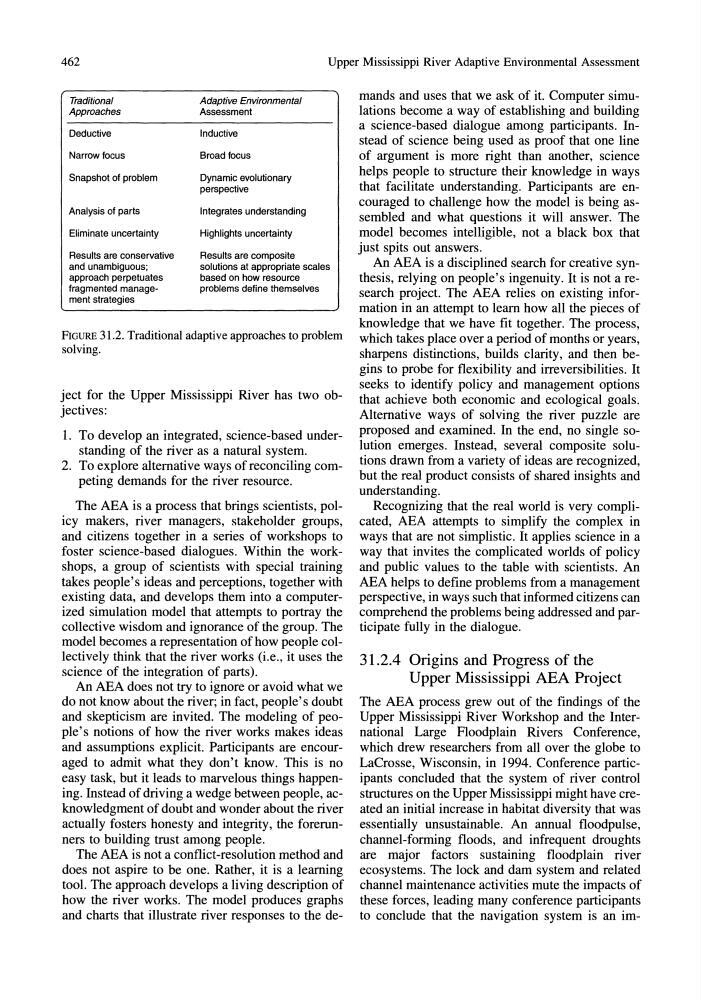
Traditional
Approaches
Deductive
Narrow focus
Snapshot of problem
Analysis of parts
Eliminate uncertainty
Results are conservative
and unambiguous;
approach perpetuates
fragmented management strategies
Adaptive Environmental
Assessment
Inductive
Broad focus
Dynamic evolutionary
perspective
Integrates understanding
Highlights uncertainty
Results are composite
solutions at appropriate scales
based on how resource
problems define themselves
FIGURE 31.2. Traditional adaptive approaches to problem
solving.
ject for the Upper Mississippi River has two objectives:
1. To develop an integrated, science-based understanding of the river as a natural system.
2. To explore alternative ways of reconciling competing demands for the river resource.
The AEA is a process that brings scientists, policy makers, river managers, stakeholder groups,
and citizens together in a series of workshops to
foster science-based dialogues. Within the workshops, a group of scientists with special training
takes people's ideas and perceptions, together with
existing data, and develops them into a computerized simulation model that attempts to portray the
collective wisdom and ignorance of the group. The
model becomes a representation of how people collectively think that the river works (i.e., it uses the
science of the integration of parts).
An AEA does not try to ignore or avoid what we
do not know about the river; in fact, people's doubt
and skepticism are invited. The modeling of people's notions of how the river works makes ideas
and assumptions explicit. Participants are encouraged to admit what they don't know. This is no
easy task, but it leads to marvelous things happening. Instead of driving a wedge between people, acknowledgment of doubt and wonder about the river
actually fosters honesty and integrity, the forerunners to building trust among people.
The AEA is not a conflict-resolution method and
does not aspire to be one. Rather, it is a learning
tool. The approach develops a living description of
how the river works. The model produces graphs
and charts that illustrate river responses to the demands and uses that we ask of it. Computer simulations become a way of establishing and building
a science-based dialogue among participants. Instead of science being used as proof that one line
of argument is more right than another, science
helps people to structure their knowledge in ways
that facilitate understanding. Participants are encouraged to challenge how the model is being assembled and what questions it will answer. The
model becomes intelligible, not a black box that
just spits out answers.
An AEA is a disciplined search for creative synthesis, relying on people's ingenuity. It is not a research project. The AEA relies on existing information in an attempt to learn how all the pieces of
knowledge that we have fit together. The process,
which takes place over a period of months or years,
sharpens distinctions, builds clarity, and then begins to probe for flexibility and irreversibilities. It
seeks to identify policy and management options
that achieve both economic and ecological goals.
Alternative ways of solving the river puzzle are
proposed and examined. In the end, no single solution emerges. Instead, several composite solutions drawn from a variety of ideas are recognized,
but the real product consists of shared insights and
understanding.
Recognizing that the real world is very complicated, AEA attempts to simplify the complex in
ways that are not simplistic. It applies science in a
way that invites the complicated worlds of policy
and public values to the table with scientists. An
AEA helps to define problems from a management
perspective, in ways such that informed citizens can
comprehend the problems being addressed and participate fully in the dialogue.
31.2.4 Origins and Progress of the
Upper Mississippi AEA Project
The AEA process grew out of the findings of the
Upper Mississippi River Workshop and the International Large Floodplain Rivers Conference,
which drew researchers from all over the globe to
LaCrosse, Wisconsin, in 1994. Conference participants concluded that the system of river control
structures on the Upper Mississippi might have created an initial increase in habitat diversity that was
essentially unsustainable. An annual floodpulse,
channel-forming floods, and infrequent droughts
are major factors sustaining floodplain river
ecosystems. The lock and dam system and related
channel maintenance activities mute the impacts of
these forces, leading many conference participants
to conclude that the navigation system is an im-
Upper Mississippi River Adaptive Environmental Assessment
Traditional
Approaches
Deductive
Narrow focus
Snapshot of problem
Analysis of parts
Eliminate uncertainty
Results are conservative
and unambiguous;
approach perpetuates
fragmented management strategies
Adaptive Environmental
Assessment
Inductive
Broad focus
Dynamic evolutionary
perspective
Integrates understanding
Highlights uncertainty
Results are composite
solutions at appropriate scales
based on how resource
problems define themselves
FIGURE 31.2. Traditional adaptive approaches to problem
solving.
ject for the Upper Mississippi River has two objectives:
1. To develop an integrated, science-based understanding of the river as a natural system.
2. To explore alternative ways of reconciling competing demands for the river resource.
The AEA is a process that brings scientists, policy makers, river managers, stakeholder groups,
and citizens together in a series of workshops to
foster science-based dialogues. Within the workshops, a group of scientists with special training
takes people's ideas and perceptions, together with
existing data, and develops them into a computerized simulation model that attempts to portray the
collective wisdom and ignorance of the group. The
model becomes a representation of how people collectively think that the river works (i.e., it uses the
science of the integration of parts).
An AEA does not try to ignore or avoid what we
do not know about the river; in fact, people's doubt
and skepticism are invited. The modeling of people's notions of how the river works makes ideas
and assumptions explicit. Participants are encouraged to admit what they don't know. This is no
easy task, but it leads to marvelous things happening. Instead of driving a wedge between people, acknowledgment of doubt and wonder about the river
actually fosters honesty and integrity, the forerunners to building trust among people.
The AEA is not a conflict-resolution method and
does not aspire to be one. Rather, it is a learning
tool. The approach develops a living description of
how the river works. The model produces graphs
and charts that illustrate river responses to the demands and uses that we ask of it. Computer simulations become a way of establishing and building
a science-based dialogue among participants. Instead of science being used as proof that one line
of argument is more right than another, science
helps people to structure their knowledge in ways
that facilitate understanding. Participants are encouraged to challenge how the model is being assembled and what questions it will answer. The
model becomes intelligible, not a black box that
just spits out answers.
An AEA is a disciplined search for creative synthesis, relying on people's ingenuity. It is not a research project. The AEA relies on existing information in an attempt to learn how all the pieces of
knowledge that we have fit together. The process,
which takes place over a period of months or years,
sharpens distinctions, builds clarity, and then begins to probe for flexibility and irreversibilities. It
seeks to identify policy and management options
that achieve both economic and ecological goals.
Alternative ways of solving the river puzzle are
proposed and examined. In the end, no single solution emerges. Instead, several composite solutions drawn from a variety of ideas are recognized,
but the real product consists of shared insights and
understanding.
Recognizing that the real world is very complicated, AEA attempts to simplify the complex in
ways that are not simplistic. It applies science in a
way that invites the complicated worlds of policy
and public values to the table with scientists. An
AEA helps to define problems from a management
perspective, in ways such that informed citizens can
comprehend the problems being addressed and participate fully in the dialogue.
31.2.4 Origins and Progress of the
Upper Mississippi AEA Project
The AEA process grew out of the findings of the
Upper Mississippi River Workshop and the International Large Floodplain Rivers Conference,
which drew researchers from all over the globe to
LaCrosse, Wisconsin, in 1994. Conference participants concluded that the system of river control
structures on the Upper Mississippi might have created an initial increase in habitat diversity that was
essentially unsustainable. An annual floodpulse,
channel-forming floods, and infrequent droughts
are major factors sustaining floodplain river
ecosystems. The lock and dam system and related
channel maintenance activities mute the impacts of
these forces, leading many conference participants
to conclude that the navigation system is an im-