

27
Characterizing the Human Imprint
on Landscapes for
Ecological Assessment
Daniel G. Brown
27.1 Introduction
Human activity has altered natural landscape patterns and ecosystem functioning to varying degrees
over the course of recorded history (Turner, 1990).
Even the act of "preserving" a wilderness landscape
results from a societal decision based on the value
placed on that landscape. Such acts, as with many
ecosystem uses, rarely happen by accident. Therefore, to assess ecosystem function and integrity,
some understanding of the human dimension is
necessary. It is useful to identify two critical aspects of the human dimension: factors that drive
and can be used to predict human activities, and
factors that characterize the impacts of these activities on ecosystems. By and large, the drivers of
human activity are intangible (e.g., profit motive or
concern for beauty) and the impacts result from tangible structures or activities on the landscape. At
the same time, it is important to view human activity as a critical component of, and not separate
from, ecosystem functioning. Ecosystem structure
and function can influence society's valuation of
resources, driving human activity. For example, the
presence of a pristine or high-quality landscape
might drive development nearby, degrading the
quality of this landscape.
TABLE 27.1. Elements of the human imprint on
landscapes that might be included in an ecological
assessment.
Tangible elements
Transportation corridors
and junctions
Utilities
Land cover
Sites of cultural importance
Key commercial and
industrial concerns
404
Intangible elements
Political and census
boundaries
Ownership boundaries
Land use
The human imprint on landscapes is variable in
time and space and varies at a multitude of different time and space scales. Temporal variability implies that (1) data about human activities must be
updated on a regular basis and (2) multitemporal
or time series data may be necessary to characterize changes in the human dimension, especially
when these changes drive significant ecological
changes. Spatial variability demands that these elements be represented spatially, usually using a geographic information system (GIS). A GIS facilitates the management of multithematic spatial data
and can be used to manage multiple scale representations of a given theme to deal with the variability in scale.
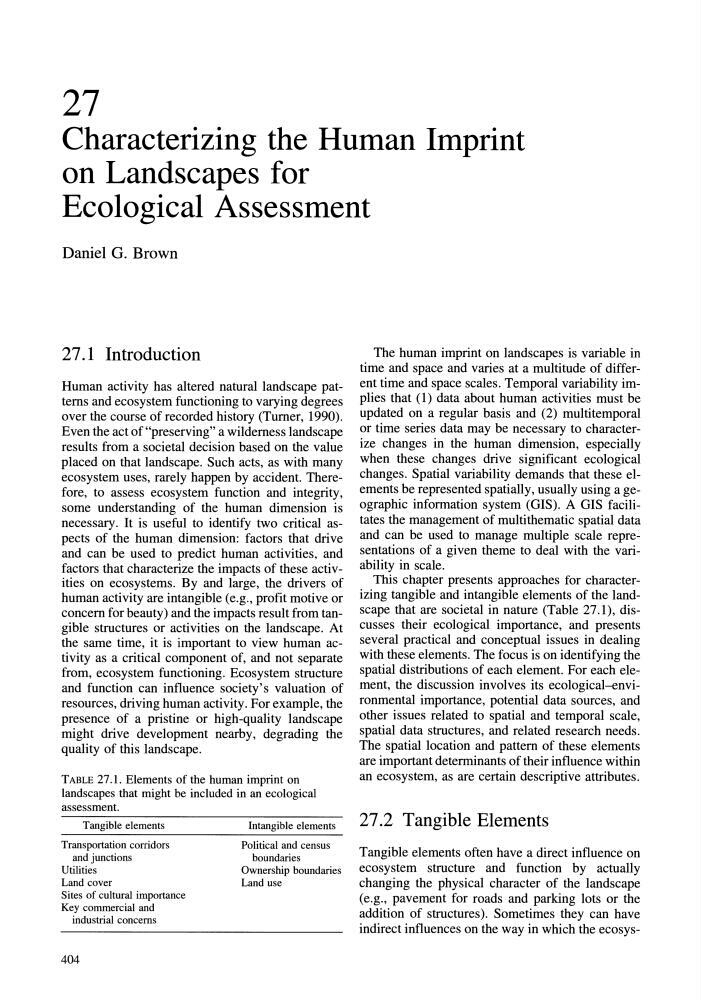
This chapter presents approaches for characterizing tangible and intangible elements of the landscape that are societal in nature (Table 27.1), discusses their ecological importance, and presents
several practical and conceptual issues in dealing
with these elements. The focus is on identifying the
spatial distributions of each element. For each element, the discussion involves its ecological-environmental importance, potential data sources, and
other issues related to spatial and temporal scale,
spatial data structures, and related research needs.
The spatial location and pattern of these elements
are important determinants of their influence within
an ecosystem, as are certain descriptive attributes.
27.2 Tangible Elements
Tangible elements often have a direct influence on
ecosystem structure and function by actually
changing the physical character of the landscape
(e.g., pavement for roads and parking lots or the
addition of structures). Sometimes they can have
indirect influences on the way in which the ecosys-
Characterizing the Human Imprint
on Landscapes for
Ecological Assessment
Daniel G. Brown
27.1 Introduction
Human activity has altered natural landscape patterns and ecosystem functioning to varying degrees
over the course of recorded history (Turner, 1990).
Even the act of "preserving" a wilderness landscape
results from a societal decision based on the value
placed on that landscape. Such acts, as with many
ecosystem uses, rarely happen by accident. Therefore, to assess ecosystem function and integrity,
some understanding of the human dimension is
necessary. It is useful to identify two critical aspects of the human dimension: factors that drive
and can be used to predict human activities, and
factors that characterize the impacts of these activities on ecosystems. By and large, the drivers of
human activity are intangible (e.g., profit motive or
concern for beauty) and the impacts result from tangible structures or activities on the landscape. At
the same time, it is important to view human activity as a critical component of, and not separate
from, ecosystem functioning. Ecosystem structure
and function can influence society's valuation of
resources, driving human activity. For example, the
presence of a pristine or high-quality landscape
might drive development nearby, degrading the
quality of this landscape.
TABLE 27.1. Elements of the human imprint on
landscapes that might be included in an ecological
assessment.
Tangible elements
Transportation corridors
and junctions
Utilities
Land cover
Sites of cultural importance
Key commercial and
industrial concerns
404
Intangible elements
Political and census
boundaries
Ownership boundaries
Land use
The human imprint on landscapes is variable in
time and space and varies at a multitude of different time and space scales. Temporal variability implies that (1) data about human activities must be
updated on a regular basis and (2) multitemporal
or time series data may be necessary to characterize changes in the human dimension, especially
when these changes drive significant ecological
changes. Spatial variability demands that these elements be represented spatially, usually using a geographic information system (GIS). A GIS facilitates the management of multithematic spatial data
and can be used to manage multiple scale representations of a given theme to deal with the variability in scale.
This chapter presents approaches for characterizing tangible and intangible elements of the landscape that are societal in nature (Table 27.1), discusses their ecological importance, and presents
several practical and conceptual issues in dealing
with these elements. The focus is on identifying the
spatial distributions of each element. For each element, the discussion involves its ecological-environmental importance, potential data sources, and
other issues related to spatial and temporal scale,
spatial data structures, and related research needs.
The spatial location and pattern of these elements
are important determinants of their influence within
an ecosystem, as are certain descriptive attributes.
27.2 Tangible Elements
Tangible elements often have a direct influence on
ecosystem structure and function by actually
changing the physical character of the landscape
(e.g., pavement for roads and parking lots or the
addition of structures). Sometimes they can have
indirect influences on the way in which the ecosys-