

programming or extensive customization require more time and resources
than models that can be implemented with existing software platforms.
The third decision is about the relative investment in developing models
by integrating existing models versus creating new models. The former
option results in models with enhanced capabilities in a medium time
horizon, whereas the latter option results in new models in the long term.
The resources required for developing new models depend on the type of
model, the species, and the landscape or the ecosystem being modeled.
13.4 Conclusion
In this paper, we considered four areas for making investments needed to
enhance the use of ecological modeling in decision making: training and
education; application of existing models; integration of existing models;
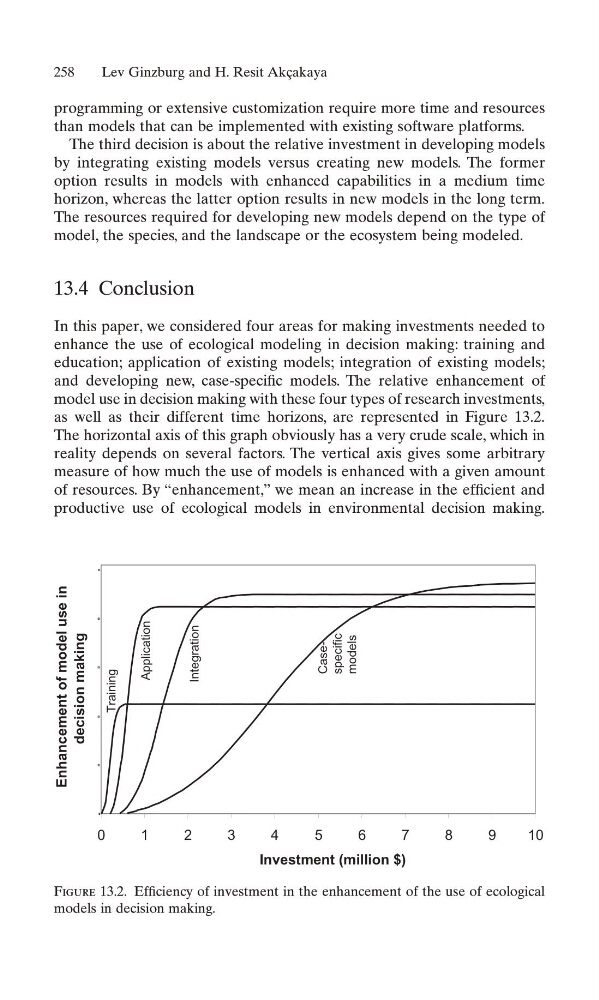
and developing new, case-specific models. The relative enhancement of
model use in decision making with these four types of research investments,
as well as their different time horizons, are represented in Figure 13.2.
The horizontal axis of this graph obviously has a very crude scale, which in
reality depends on several factors. The vertical axis gives some arbitrary
measure of how much the use of models is enhanced with a given amount
of resources. By “enhancement,” we mean an increase in the efficient and
productive use of ecological models in environmental decision making.
258
Lev Ginzburg and H. Resit Akçakaya
0
0.2
0.4
0.6
0.8
1
0
1
2
3
4
5
6
7
8
9
10
Investment (million $)
Enhancement of model use in
decision making
Training
Application
Integration
Case- specific
models
Figure 13.2. Efficiency of investment in the enhancement of the use of ecological
models in decision making.
than models that can be implemented with existing software platforms.
The third decision is about the relative investment in developing models
by integrating existing models versus creating new models. The former
option results in models with enhanced capabilities in a medium time
horizon, whereas the latter option results in new models in the long term.
The resources required for developing new models depend on the type of
model, the species, and the landscape or the ecosystem being modeled.
13.4 Conclusion
In this paper, we considered four areas for making investments needed to
enhance the use of ecological modeling in decision making: training and
education; application of existing models; integration of existing models;
and developing new, case-specific models. The relative enhancement of
model use in decision making with these four types of research investments,
as well as their different time horizons, are represented in Figure 13.2.
The horizontal axis of this graph obviously has a very crude scale, which in
reality depends on several factors. The vertical axis gives some arbitrary
measure of how much the use of models is enhanced with a given amount
of resources. By “enhancement,” we mean an increase in the efficient and
productive use of ecological models in environmental decision making.
258
Lev Ginzburg and H. Resit Akçakaya
0
0.2
0.4
0.6
0.8
1
0
1
2
3
4
5
6
7
8
9
10
Investment (million $)
Enhancement of model use in
decision making
Training
Application
Integration
Case- specific
models
Figure 13.2. Efficiency of investment in the enhancement of the use of ecological
models in decision making.