

(e.g., by telephone). Thus, we recommend that Web-based short courses on
ecological modeling be developed and offered to technical personnel in
agencies involved in environmental decision making.
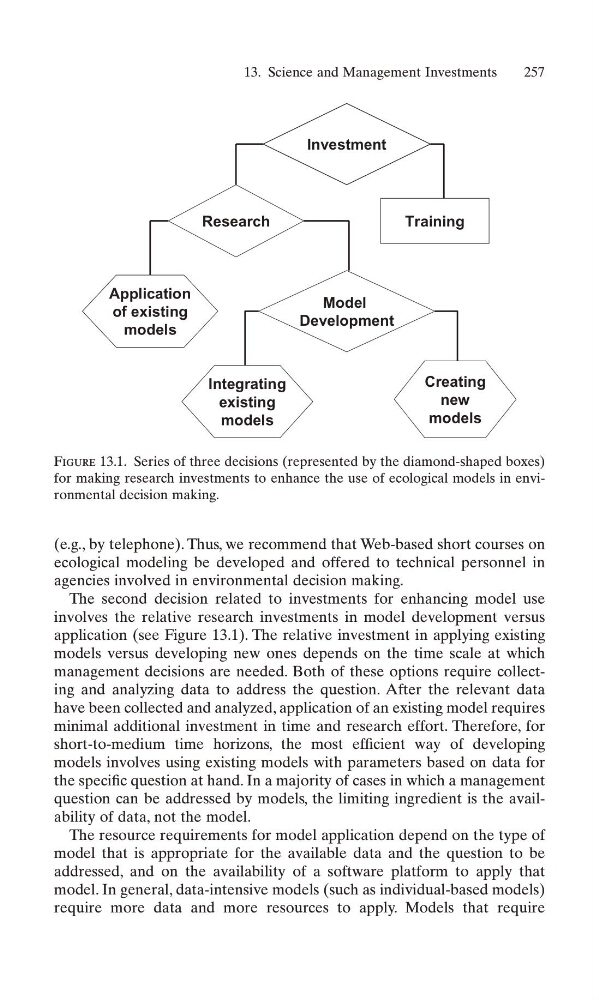
The second decision related to investments for enhancing model use
involves the relative research investments in model development versus
application (see Figure 13.1). The relative investment in applying existing
models versus developing new ones depends on the time scale at which
management decisions are needed. Both of these options require collecting and analyzing data to address the question. After the relevant data
have been collected and analyzed, application of an existing model requires
minimal additional investment in time and research effort. Therefore, for
short-to-medium time horizons, the most efficient way of developing
models involves using existing models with parameters based on data for
the specific question at hand. In a majority of cases in which a management
question can be addressed by models, the limiting ingredient is the availability of data, not the model.
The resource requirements for model application depend on the type of
model that is appropriate for the available data and the question to be
addressed, and on the availability of a software platform to apply that
model. In general, data-intensive models (such as individual-based models)
require more data and more resources to apply. Models that require
13. Science and Management Investments
257
Investment
Research
Training
Application
of existing
models
Model
Development
Integrating
existing
models
Creating
new
models
Figure 13.1. Series of three decisions (represented by the diamond-shaped boxes)
for making research investments to enhance the use of ecological models in environmental decision making.
ecological modeling be developed and offered to technical personnel in
agencies involved in environmental decision making.
The second decision related to investments for enhancing model use
involves the relative research investments in model development versus
application (see Figure 13.1). The relative investment in applying existing
models versus developing new ones depends on the time scale at which
management decisions are needed. Both of these options require collecting and analyzing data to address the question. After the relevant data
have been collected and analyzed, application of an existing model requires
minimal additional investment in time and research effort. Therefore, for
short-to-medium time horizons, the most efficient way of developing
models involves using existing models with parameters based on data for
the specific question at hand. In a majority of cases in which a management
question can be addressed by models, the limiting ingredient is the availability of data, not the model.
The resource requirements for model application depend on the type of
model that is appropriate for the available data and the question to be
addressed, and on the availability of a software platform to apply that
model. In general, data-intensive models (such as individual-based models)
require more data and more resources to apply. Models that require
13. Science and Management Investments
257
Investment
Research
Training
Application
of existing
models
Model
Development
Integrating
existing
models
Creating
new
models
Figure 13.1. Series of three decisions (represented by the diamond-shaped boxes)
for making research investments to enhance the use of ecological models in environmental decision making.