

156
Eric Gustafson et al.
If total movement greater than passive
transport, then fish swims with flow:
If total movement less than passive
transport, then fish swims against flow:
(Tail First)
(Head First)
Passive
Transport
Volitional
Movement
A
A
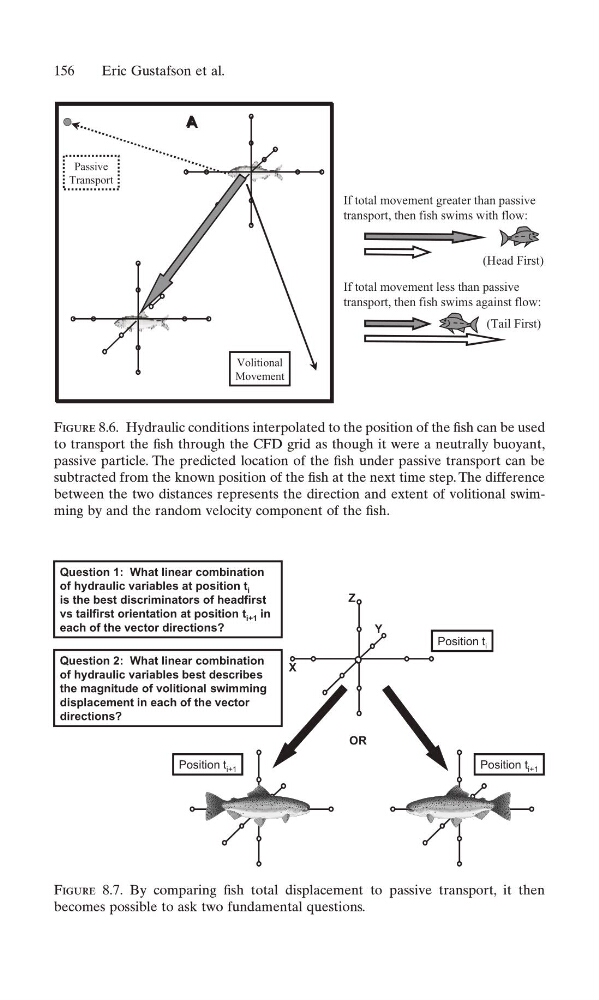
Figure 8.6. Hydraulic conditions interpolated to the position of the fish can be used
to transport the fish through the CFD grid as though it were a neutrally buoyant,
passive particle. The predicted location of the fish under passive transport can be
subtracted from the known position of the fish at the next time step. The difference
between the two distances represents the direction and extent of volitional swimming by and the random velocity component of the fish.
Position t i
Position t i+1
Position t i+1
X
Y
Z
OR
Question 1: What linear combination
of hydraulic variables at position t i
is the best discriminators of headfirst
vs tailfirst orientation at position t i+1 in
each of the vector directions?
Question 2: What linear combination
of hydraulic variables best describes
the magnitude of volitional swimming
displacement in each of the vector
directions?
Figure 8.7. By comparing fish total displacement to passive transport, it then
becomes possible to ask two fundamental questions.
Eric Gustafson et al.
If total movement greater than passive
transport, then fish swims with flow:
If total movement less than passive
transport, then fish swims against flow:
(Tail First)
(Head First)
Passive
Transport
Volitional
Movement
A
A
Figure 8.6. Hydraulic conditions interpolated to the position of the fish can be used
to transport the fish through the CFD grid as though it were a neutrally buoyant,
passive particle. The predicted location of the fish under passive transport can be
subtracted from the known position of the fish at the next time step. The difference
between the two distances represents the direction and extent of volitional swimming by and the random velocity component of the fish.
Position t i
Position t i+1
Position t i+1
X
Y
Z
OR
Question 1: What linear combination
of hydraulic variables at position t i
is the best discriminators of headfirst
vs tailfirst orientation at position t i+1 in
each of the vector directions?
Question 2: What linear combination
of hydraulic variables best describes
the magnitude of volitional swimming
displacement in each of the vector
directions?
Figure 8.7. By comparing fish total displacement to passive transport, it then
becomes possible to ask two fundamental questions.