

The use of CFD model output coupled to fish swim-behavior models is
relatively new, and methods are still evolving. Extensive model calibration
and verification must be made before the results of such analyses can be
used for natural resources management. However, in spite of challenges,
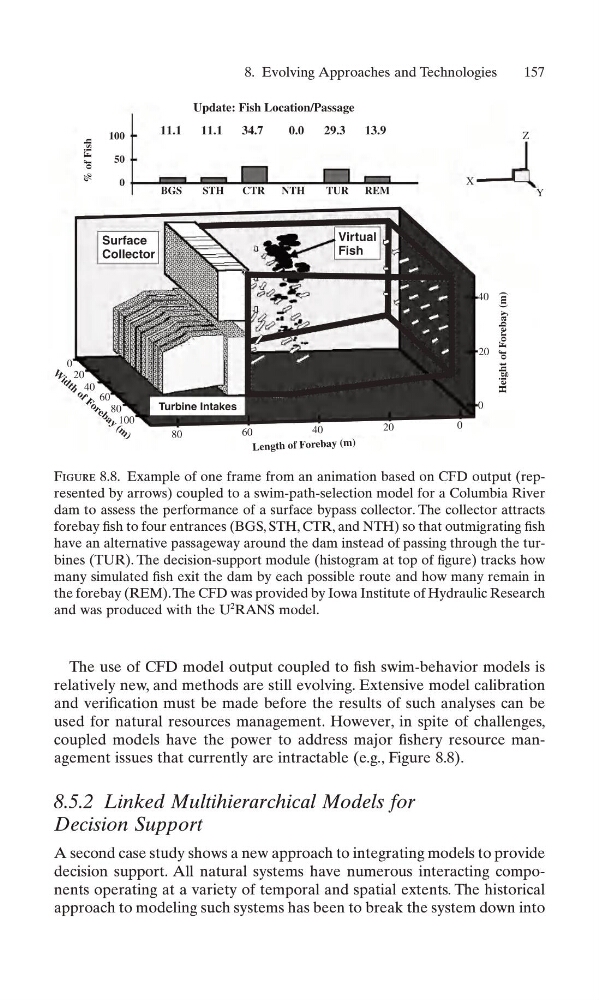
coupled models have the power to address major fishery resource management issues that currently are intractable (e.g., Figure 8.8).
8.5.2 Linked Multihierarchical Models for
Decision Support
A second case study shows a new approach to integrating models to provide
decision support. All natural systems have numerous interacting components operating at a variety of temporal and spatial extents. The historical
approach to modeling such systems has been to break the system down into
8. Evolving Approaches and Technologies
157
Update: Fish Location/Passage
Surface
Collector
Height of Forebay (m)
11.1
11.1
34.7
0.0
29.3
13.9
Virtual
Fish
W
i d t h o f F o r e b a y ( m )
Turbine Intakes
BGS
STH
CTR
NTH
TUR
REM
100
50
0
% of Fish
Length of Foreba y (m)
0
20
40
60
80
100
80
60
40
20
0
40
20
0
X
Z
Y
Figure 8.8. Example of one frame from an animation based on CFD output (represented by arrows) coupled to a swim-path-selection model for a Columbia River
dam to assess the performance of a surface bypass collector. The collector attracts
forebay fish to four entrances (BGS, STH, CTR, and NTH) so that outmigrating fish
have an alternative passageway around the dam instead of passing through the turbines (TUR). The decision-support module (histogram at top of figure) tracks how
many simulated fish exit the dam by each possible route and how many remain in
the forebay (REM).The CFD was provided by Iowa Institute of Hydraulic Research
and was produced with the U
2 RANS model.
relatively new, and methods are still evolving. Extensive model calibration
and verification must be made before the results of such analyses can be
used for natural resources management. However, in spite of challenges,
coupled models have the power to address major fishery resource management issues that currently are intractable (e.g., Figure 8.8).
8.5.2 Linked Multihierarchical Models for
Decision Support
A second case study shows a new approach to integrating models to provide
decision support. All natural systems have numerous interacting components operating at a variety of temporal and spatial extents. The historical
approach to modeling such systems has been to break the system down into
8. Evolving Approaches and Technologies
157
Update: Fish Location/Passage
Surface
Collector
Height of Forebay (m)
11.1
11.1
34.7
0.0
29.3
13.9
Virtual
Fish
W
i d t h o f F o r e b a y ( m )
Turbine Intakes
BGS
STH
CTR
NTH
TUR
REM
100
50
0
% of Fish
Length of Foreba y (m)
0
20
40
60
80
100
80
60
40
20
0
40
20
0
X
Z
Y
Figure 8.8. Example of one frame from an animation based on CFD output (represented by arrows) coupled to a swim-path-selection model for a Columbia River
dam to assess the performance of a surface bypass collector. The collector attracts
forebay fish to four entrances (BGS, STH, CTR, and NTH) so that outmigrating fish
have an alternative passageway around the dam instead of passing through the turbines (TUR). The decision-support module (histogram at top of figure) tracks how
many simulated fish exit the dam by each possible route and how many remain in
the forebay (REM).The CFD was provided by Iowa Institute of Hydraulic Research
and was produced with the U
2 RANS model.