

of position pairs comprising an initial and sequential position, with the
change in position determined by the sum of two different vector processes,
passive transport and volitional swimming. Over short time steps (a second
or less), a fish must be swimming headfirst into the current if its displacement is less than what would be predicted by passive transport because fish
generally do not swim backwards. Conversely, if its displacement was
greater than would be predicted by passive transport alone, it must be swimming with the current (Figure 8.6).
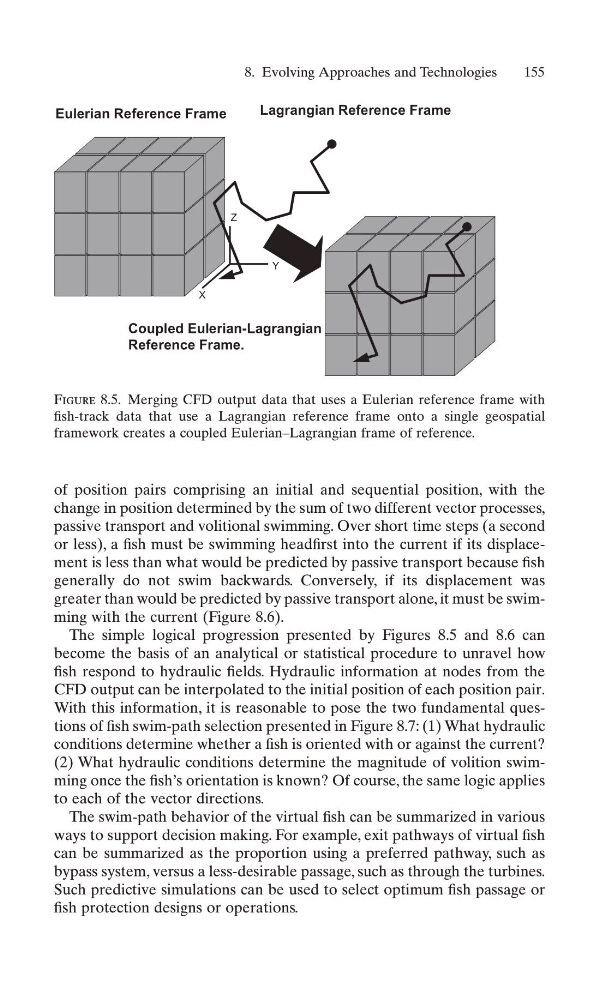
The simple logical progression presented by Figures 8.5 and 8.6 can
become the basis of an analytical or statistical procedure to unravel how
fish respond to hydraulic fields. Hydraulic information at nodes from the
CFD output can be interpolated to the initial position of each position pair.
With this information, it is reasonable to pose the two fundamental questions of fish swim-path selection presented in Figure 8.7: (1) What hydraulic
conditions determine whether a fish is oriented with or against the current?
(2) What hydraulic conditions determine the magnitude of volition swimming once the fish’s orientation is known? Of course, the same logic applies
to each of the vector directions.
The swim-path behavior of the virtual fish can be summarized in various
ways to support decision making. For example, exit pathways of virtual fish
can be summarized as the proportion using a preferred pathway, such as
bypass system, versus a less-desirable passage, such as through the turbines.
Such predictive simulations can be used to select optimum fish passage or
fish protection designs or operations.
8. Evolving Approaches and Technologies
155
14
Lagrangian Reference Frame
Eulerian Reference Frame
Coupled Eulerian-Lagrangian
Reference Frame.
X
Y
Z
Figure 8.5. Merging CFD output data that uses a Eulerian reference frame with
fish-track data that use a Lagrangian reference frame onto a single geospatial
framework creates a coupled Eulerian–Lagrangian frame of reference.
change in position determined by the sum of two different vector processes,
passive transport and volitional swimming. Over short time steps (a second
or less), a fish must be swimming headfirst into the current if its displacement is less than what would be predicted by passive transport because fish
generally do not swim backwards. Conversely, if its displacement was
greater than would be predicted by passive transport alone, it must be swimming with the current (Figure 8.6).
The simple logical progression presented by Figures 8.5 and 8.6 can
become the basis of an analytical or statistical procedure to unravel how
fish respond to hydraulic fields. Hydraulic information at nodes from the
CFD output can be interpolated to the initial position of each position pair.
With this information, it is reasonable to pose the two fundamental questions of fish swim-path selection presented in Figure 8.7: (1) What hydraulic
conditions determine whether a fish is oriented with or against the current?
(2) What hydraulic conditions determine the magnitude of volition swimming once the fish’s orientation is known? Of course, the same logic applies
to each of the vector directions.
The swim-path behavior of the virtual fish can be summarized in various
ways to support decision making. For example, exit pathways of virtual fish
can be summarized as the proportion using a preferred pathway, such as
bypass system, versus a less-desirable passage, such as through the turbines.
Such predictive simulations can be used to select optimum fish passage or
fish protection designs or operations.
8. Evolving Approaches and Technologies
155
14
Lagrangian Reference Frame
Eulerian Reference Frame
Coupled Eulerian-Lagrangian
Reference Frame.
X
Y
Z
Figure 8.5. Merging CFD output data that uses a Eulerian reference frame with
fish-track data that use a Lagrangian reference frame onto a single geospatial
framework creates a coupled Eulerian–Lagrangian frame of reference.