

to a common vision (Shipley 1995). Models are tools designed to increase
the speed and clarity of such interactions.
6.5 Remaining Concerns
The above discussion raises several concerns. One is the value of modeling
to decision making. Modeling and decision making are not parallel parts of
resource management. Rather, modeling is a tool that can be used in various
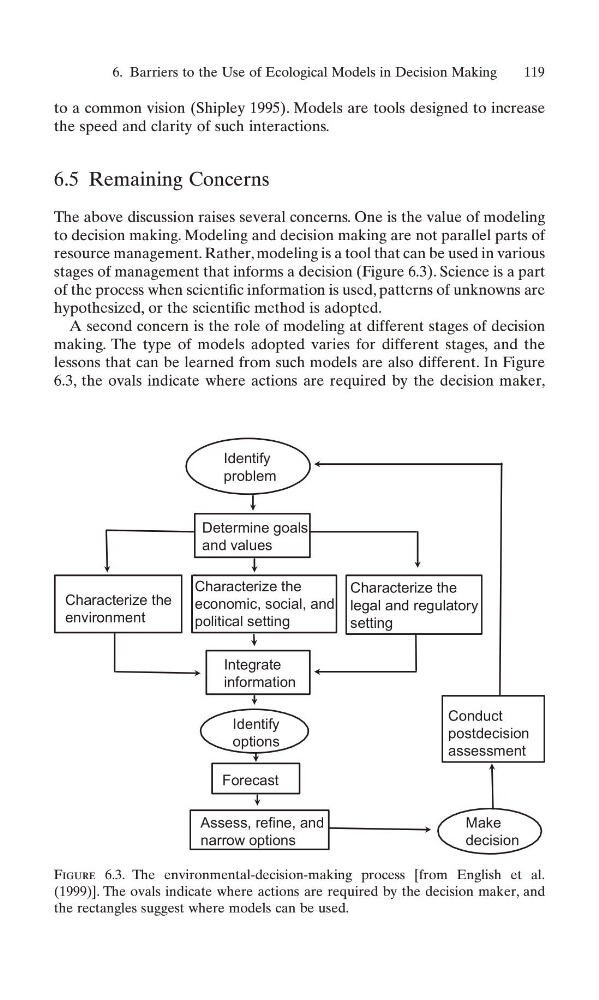
stages of management that informs a decision (Figure 6.3). Science is a part
of the process when scientific information is used, patterns of unknowns are
hypothesized, or the scientific method is adopted.
A second concern is the role of modeling at different stages of decision
making. The type of models adopted varies for different stages, and the
lessons that can be learned from such models are also different. In Figure
6.3, the ovals indicate where actions are required by the decision maker,
6. Barriers to the Use of Ecological Models in Decision Making
119
Identify
problem
Determine goals
and values
Identify
options
Make
decision
Characterize the
environment
Characterize the
economic, social, and
political setting
Characterize the
legal and regulatory
setting
Integrate
information
Forecast
Assess, refine, and
narrow options
Conduct
postdecision
assessment
Figure 6.3. The environmental-decision-making process [from English et al.
(1999)]. The ovals indicate where actions are required by the decision maker, and
the rectangles suggest where models can be used.
the speed and clarity of such interactions.
6.5 Remaining Concerns
The above discussion raises several concerns. One is the value of modeling
to decision making. Modeling and decision making are not parallel parts of
resource management. Rather, modeling is a tool that can be used in various
stages of management that informs a decision (Figure 6.3). Science is a part
of the process when scientific information is used, patterns of unknowns are
hypothesized, or the scientific method is adopted.
A second concern is the role of modeling at different stages of decision
making. The type of models adopted varies for different stages, and the
lessons that can be learned from such models are also different. In Figure
6.3, the ovals indicate where actions are required by the decision maker,
6. Barriers to the Use of Ecological Models in Decision Making
119
Identify
problem
Determine goals
and values
Identify
options
Make
decision
Characterize the
environment
Characterize the
economic, social, and
political setting
Characterize the
legal and regulatory
setting
Integrate
information
Forecast
Assess, refine, and
narrow options
Conduct
postdecision
assessment
Figure 6.3. The environmental-decision-making process [from English et al.
(1999)]. The ovals indicate where actions are required by the decision maker, and
the rectangles suggest where models can be used.