

environmental information to produce a qualitative or quantitative statement that assesses the magnitude and probability of adverse effects. The
risk assessment process can also be used less rigorously to provide a basis
for developing a relative ranking of potential risks. Relative risk assessments can reduce the dimensionality of the problem, provide the basis to
prioritize research activities and allocate resources, and assign relative risks
among options [see Harwell and Kelly (1987); Harwell et al. (1992); USEPA
SAB (1990a,b)].
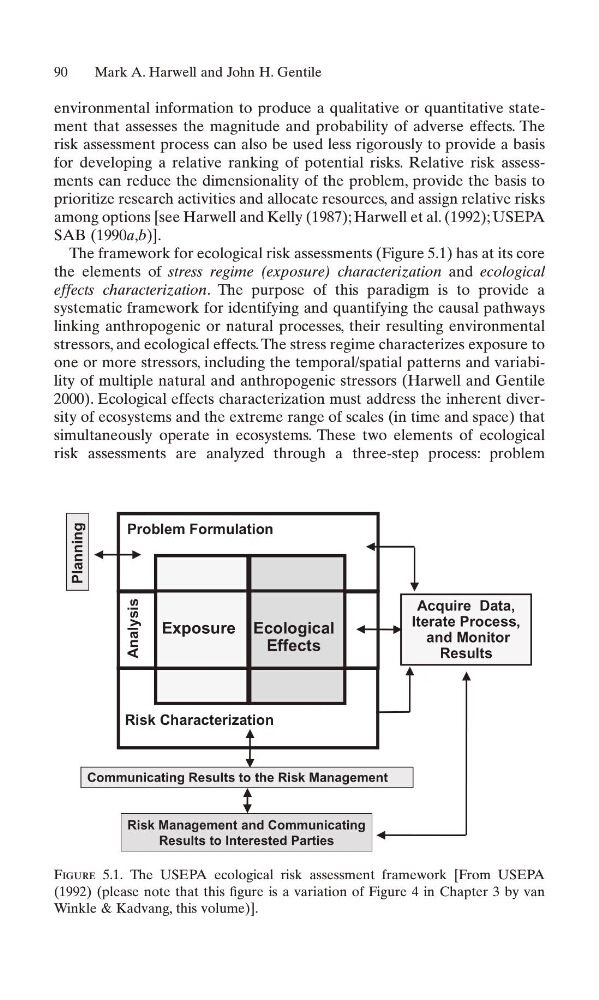
The framework for ecological risk assessments (Figure 5.1) has at its core
the elements of stress regime (exposure) characterization and ecological
effects characterization. The purpose of this paradigm is to provide a
systematic framework for identifying and quantifying the causal pathways
linking anthropogenic or natural processes, their resulting environmental
stressors, and ecological effects. The stress regime characterizes exposure to
one or more stressors, including the temporal/spatial patterns and variability of multiple natural and anthropogenic stressors (Harwell and Gentile
2000). Ecological effects characterization must address the inherent diversity of ecosystems and the extreme range of scales (in time and space) that
simultaneously operate in ecosystems. These two elements of ecological
risk assessments are analyzed through a three-step process: problem
90
Mark A. Harwell and John H. Gentile
Acquire Data,
Iterate Process,
and Monitor
Results
Problem Formulation
Risk Characterization
Planning
Exposure Ecological
Effects
Analysis
Communicating Results to the Risk Management
Risk Management and Communicating
Results to Interested Parties
Figure 5.1. The USEPA ecological risk assessment framework [From USEPA
(1992) (please note that this figure is a variation of Figure 4 in Chapter 3 by van
Winkle & Kadvang, this volume)].
risk assessment process can also be used less rigorously to provide a basis
for developing a relative ranking of potential risks. Relative risk assessments can reduce the dimensionality of the problem, provide the basis to
prioritize research activities and allocate resources, and assign relative risks
among options [see Harwell and Kelly (1987); Harwell et al. (1992); USEPA
SAB (1990a,b)].
The framework for ecological risk assessments (Figure 5.1) has at its core
the elements of stress regime (exposure) characterization and ecological
effects characterization. The purpose of this paradigm is to provide a
systematic framework for identifying and quantifying the causal pathways
linking anthropogenic or natural processes, their resulting environmental
stressors, and ecological effects. The stress regime characterizes exposure to
one or more stressors, including the temporal/spatial patterns and variability of multiple natural and anthropogenic stressors (Harwell and Gentile
2000). Ecological effects characterization must address the inherent diversity of ecosystems and the extreme range of scales (in time and space) that
simultaneously operate in ecosystems. These two elements of ecological
risk assessments are analyzed through a three-step process: problem
90
Mark A. Harwell and John H. Gentile
Acquire Data,
Iterate Process,
and Monitor
Results
Problem Formulation
Risk Characterization
Planning
Exposure Ecological
Effects
Analysis
Communicating Results to the Risk Management
Risk Management and Communicating
Results to Interested Parties
Figure 5.1. The USEPA ecological risk assessment framework [From USEPA
(1992) (please note that this figure is a variation of Figure 4 in Chapter 3 by van
Winkle & Kadvang, this volume)].