

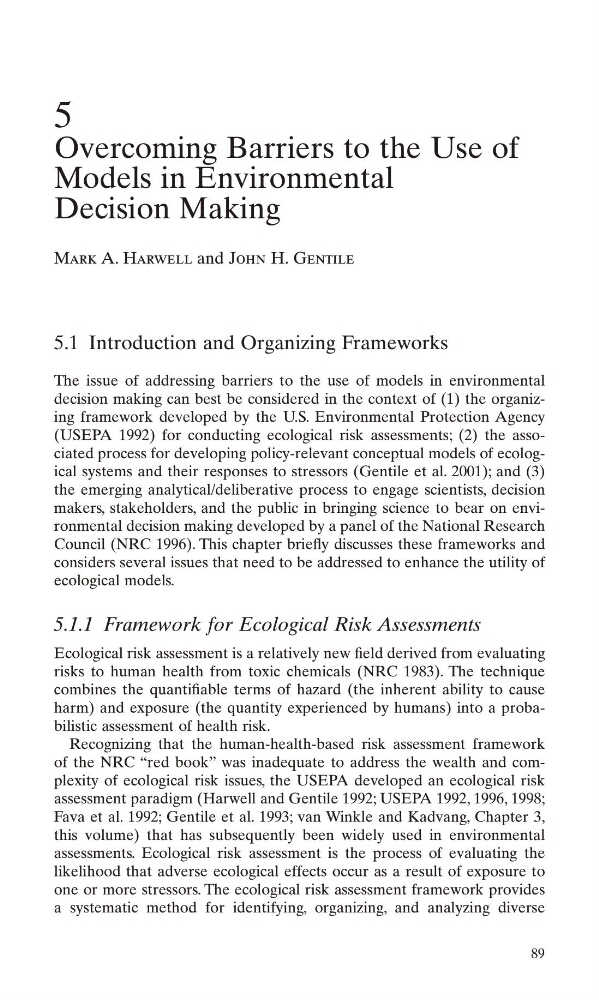
5
Overcoming Barriers to the Use of
Models in Environmental
Decision Making
Mark A. Harwell and John H. Gentile
89
5.1 Introduction and Organizing Frameworks
The issue of addressing barriers to the use of models in environmental
decision making can best be considered in the context of (1) the organizing framework developed by the U.S. Environmental Protection Agency
(USEPA 1992) for conducting ecological risk assessments; (2) the associated process for developing policy-relevant conceptual models of ecological systems and their responses to stressors (Gentile et al. 2001); and (3)
the emerging analytical/deliberative process to engage scientists, decision
makers, stakeholders, and the public in bringing science to bear on environmental decision making developed by a panel of the National Research
Council (NRC 1996). This chapter briefly discusses these frameworks and
considers several issues that need to be addressed to enhance the utility of
ecological models.
5.1.1 Framework for Ecological Risk Assessments
Ecological risk assessment is a relatively new field derived from evaluating
risks to human health from toxic chemicals (NRC 1983). The technique
combines the quantifiable terms of hazard (the inherent ability to cause
harm) and exposure (the quantity experienced by humans) into a probabilistic assessment of health risk.
Recognizing that the human-health-based risk assessment framework
of the NRC “red book” was inadequate to address the wealth and complexity of ecological risk issues, the USEPA developed an ecological risk
assessment paradigm (Harwell and Gentile 1992; USEPA 1992, 1996, 1998;
Fava et al. 1992; Gentile et al. 1993; van Winkle and Kadvang, Chapter 3,
this volume) that has subsequently been widely used in environmental
assessments. Ecological risk assessment is the process of evaluating the
likelihood that adverse ecological effects occur as a result of exposure to
one or more stressors. The ecological risk assessment framework provides
a systematic method for identifying, organizing, and analyzing diverse
Overcoming Barriers to the Use of
Models in Environmental
Decision Making
Mark A. Harwell and John H. Gentile
89
5.1 Introduction and Organizing Frameworks
The issue of addressing barriers to the use of models in environmental
decision making can best be considered in the context of (1) the organizing framework developed by the U.S. Environmental Protection Agency
(USEPA 1992) for conducting ecological risk assessments; (2) the associated process for developing policy-relevant conceptual models of ecological systems and their responses to stressors (Gentile et al. 2001); and (3)
the emerging analytical/deliberative process to engage scientists, decision
makers, stakeholders, and the public in bringing science to bear on environmental decision making developed by a panel of the National Research
Council (NRC 1996). This chapter briefly discusses these frameworks and
considers several issues that need to be addressed to enhance the utility of
ecological models.
5.1.1 Framework for Ecological Risk Assessments
Ecological risk assessment is a relatively new field derived from evaluating
risks to human health from toxic chemicals (NRC 1983). The technique
combines the quantifiable terms of hazard (the inherent ability to cause
harm) and exposure (the quantity experienced by humans) into a probabilistic assessment of health risk.
Recognizing that the human-health-based risk assessment framework
of the NRC “red book” was inadequate to address the wealth and complexity of ecological risk issues, the USEPA developed an ecological risk
assessment paradigm (Harwell and Gentile 1992; USEPA 1992, 1996, 1998;
Fava et al. 1992; Gentile et al. 1993; van Winkle and Kadvang, Chapter 3,
this volume) that has subsequently been widely used in environmental
assessments. Ecological risk assessment is the process of evaluating the
likelihood that adverse ecological effects occur as a result of exposure to
one or more stressors. The ecological risk assessment framework provides
a systematic method for identifying, organizing, and analyzing diverse