

formulation, analysis, and risk characterization. These steps can be viewed
as an iterative, highly interactive modeling process that evolves to address
the unique types of questions in each phase.
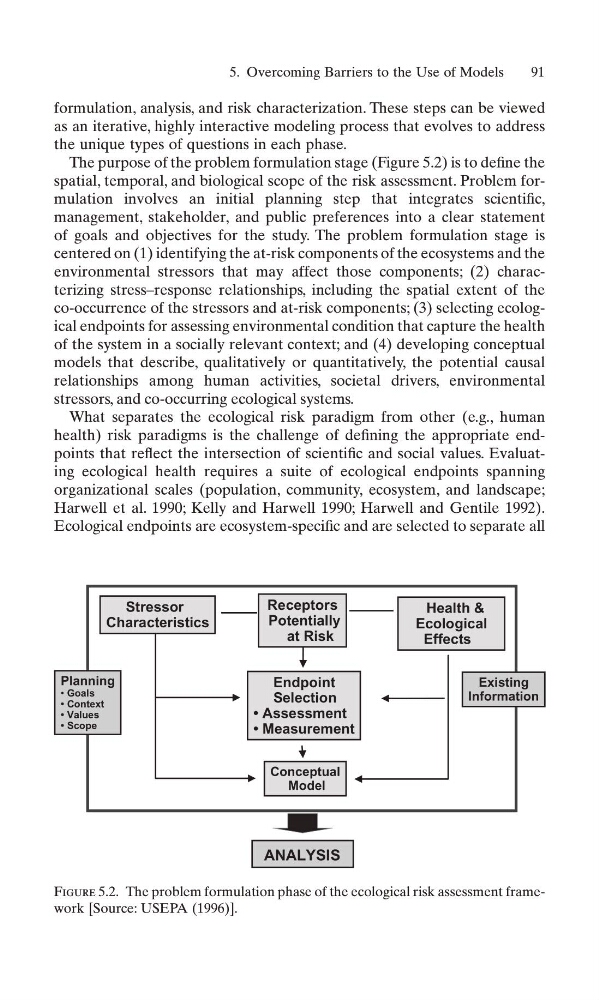
The purpose of the problem formulation stage (Figure 5.2) is to define the
spatial, temporal, and biological scope of the risk assessment. Problem formulation involves an initial planning step that integrates scientific,
management, stakeholder, and public preferences into a clear statement
of goals and objectives for the study. The problem formulation stage is
centered on (1) identifying the at-risk components of the ecosystems and the
environmental stressors that may affect those components; (2) characterizing stress–response relationships, including the spatial extent of the
co-occurrence of the stressors and at-risk components; (3) selecting ecological endpoints for assessing environmental condition that capture the health
of the system in a socially relevant context; and (4) developing conceptual
models that describe, qualitatively or quantitatively, the potential causal
relationships among human activities, societal drivers, environmental
stressors, and co-occurring ecological systems.
What separates the ecological risk paradigm from other (e.g., human
health) risk paradigms is the challenge of defining the appropriate endpoints that reflect the intersection of scientific and social values. Evaluating ecological health requires a suite of ecological endpoints spanning
organizational scales (population, community, ecosystem, and landscape;
Harwell et al. 1990; Kelly and Harwell 1990; Harwell and Gentile 1992).
Ecological endpoints are ecosystem-specific and are selected to separate all
5. Overcoming Barriers to the Use of Models
91
ANALYSIS
Stressor
Characteristics
Receptors
Potentially
at Risk
Health &
Ecological
Effects
Endpoint
Selection
• Assessment
• Measurement
Conceptual
Model
Existing
Information
Planning
• Goals
• Context
• Values
• Scope
Figure 5.2. The problem formulation phase of the ecological risk assessment framework [Source: USEPA (1996)].
as an iterative, highly interactive modeling process that evolves to address
the unique types of questions in each phase.
The purpose of the problem formulation stage (Figure 5.2) is to define the
spatial, temporal, and biological scope of the risk assessment. Problem formulation involves an initial planning step that integrates scientific,
management, stakeholder, and public preferences into a clear statement
of goals and objectives for the study. The problem formulation stage is
centered on (1) identifying the at-risk components of the ecosystems and the
environmental stressors that may affect those components; (2) characterizing stress–response relationships, including the spatial extent of the
co-occurrence of the stressors and at-risk components; (3) selecting ecological endpoints for assessing environmental condition that capture the health
of the system in a socially relevant context; and (4) developing conceptual
models that describe, qualitatively or quantitatively, the potential causal
relationships among human activities, societal drivers, environmental
stressors, and co-occurring ecological systems.
What separates the ecological risk paradigm from other (e.g., human
health) risk paradigms is the challenge of defining the appropriate endpoints that reflect the intersection of scientific and social values. Evaluating ecological health requires a suite of ecological endpoints spanning
organizational scales (population, community, ecosystem, and landscape;
Harwell et al. 1990; Kelly and Harwell 1990; Harwell and Gentile 1992).
Ecological endpoints are ecosystem-specific and are selected to separate all
5. Overcoming Barriers to the Use of Models
91
ANALYSIS
Stressor
Characteristics
Receptors
Potentially
at Risk
Health &
Ecological
Effects
Endpoint
Selection
• Assessment
• Measurement
Conceptual
Model
Existing
Information
Planning
• Goals
• Context
• Values
• Scope
Figure 5.2. The problem formulation phase of the ecological risk assessment framework [Source: USEPA (1996)].