

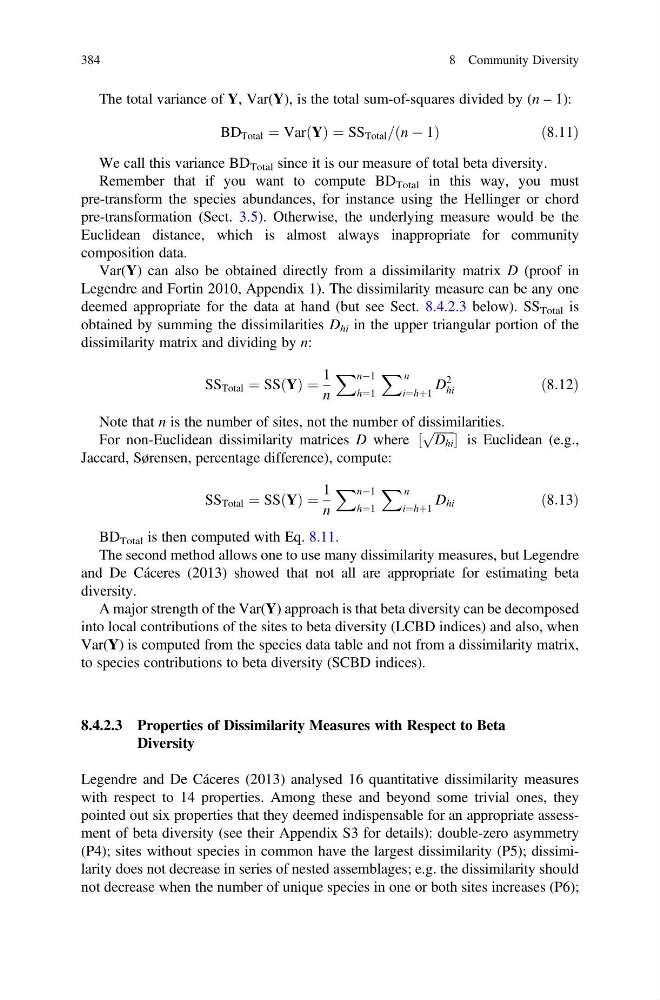
The total variance of Y, Var(Y), is the total sum-of-squares divided by (n – 1):
BD Total ¼ Var Y
ð Þ ¼ SS Total = n À 1
ð
Þ
ð8:11Þ
We call this variance BD Total since it is our measure of total beta diversity.
Remember that if you want to compute BD Total in this way, you must
pre-transform the species abundances, for instance using the Hellinger or chord
pre-transformation (Sect. 3.5). Otherwise, the underlying measure would be the
Euclidean distance, which is almost always inappropriate for community
composition data.
Var(Y) can also be obtained directly from a dissimilarity matrix D (proof in
Legendre and Fortin 2010, Appendix 1). The dissimilarity measure can be any one
deemed appropriate for the data at hand (but see Sect. 8.4.2.3 below). SS Total is
obtained by summing the dissimilarities D hi in the upper triangular portion of the
dissimilarity matrix and dividing by n:
SS Total ¼ SS Y
ð Þ ¼
1
n
X nÀ1
h¼1
X n
i¼hþ1
D
2
hi
ð8:12Þ
Note that n is the number of sites, not the number of dissimilarities.
For non-Euclidean dissimilarity matrices D where
ffiffiffiffiffiffi ffi
D hi
p
½
is Euclidean (e.g.,
Jaccard, Sørensen, percentage difference), compute:
SS Total ¼ SS Y
ð Þ ¼
1
n
X nÀ1
h¼1
X n
i¼hþ1
D hi
ð8:13Þ
BD Total is then computed with Eq. 8.11.
The second method allows one to use many dissimilarity measures, but Legendre
and De Cáceres (2013) showed that not all are appropriate for estimating beta
diversity.
A major strength of the Var(Y) approach is that beta diversity can be decomposed
into local contributions of the sites to beta diversity (LCBD indices) and also, when
Var(Y) is computed from the species data table and not from a dissimilarity matrix,
to species contributions to beta diversity (SCBD indices).
8.4.2.3 Properties of Dissimilarity Measures with Respect to Beta
Diversity
Legendre and De Cáceres (2013) analysed 16 quantitative dissimilarity measures
with respect to 14 properties. Among these and beyond some trivial ones, they
pointed out six properties that they deemed indispensable for an appropriate assessment of beta diversity (see their Appendix S3 for details): double-zero asymmetry
(P4); sites without species in common have the largest dissimilarity (P5); dissimilarity does not decrease in series of nested assemblages; e.g. the dissimilarity should
not decrease when the number of unique species in one or both sites increases (P6);
384
8 Community Diversity
BD Total ¼ Var Y
ð Þ ¼ SS Total = n À 1
ð
Þ
ð8:11Þ
We call this variance BD Total since it is our measure of total beta diversity.
Remember that if you want to compute BD Total in this way, you must
pre-transform the species abundances, for instance using the Hellinger or chord
pre-transformation (Sect. 3.5). Otherwise, the underlying measure would be the
Euclidean distance, which is almost always inappropriate for community
composition data.
Var(Y) can also be obtained directly from a dissimilarity matrix D (proof in
Legendre and Fortin 2010, Appendix 1). The dissimilarity measure can be any one
deemed appropriate for the data at hand (but see Sect. 8.4.2.3 below). SS Total is
obtained by summing the dissimilarities D hi in the upper triangular portion of the
dissimilarity matrix and dividing by n:
SS Total ¼ SS Y
ð Þ ¼
1
n
X nÀ1
h¼1
X n
i¼hþ1
D
2
hi
ð8:12Þ
Note that n is the number of sites, not the number of dissimilarities.
For non-Euclidean dissimilarity matrices D where
ffiffiffiffiffiffi ffi
D hi
p
½
is Euclidean (e.g.,
Jaccard, Sørensen, percentage difference), compute:
SS Total ¼ SS Y
ð Þ ¼
1
n
X nÀ1
h¼1
X n
i¼hþ1
D hi
ð8:13Þ
BD Total is then computed with Eq. 8.11.
The second method allows one to use many dissimilarity measures, but Legendre
and De Cáceres (2013) showed that not all are appropriate for estimating beta
diversity.
A major strength of the Var(Y) approach is that beta diversity can be decomposed
into local contributions of the sites to beta diversity (LCBD indices) and also, when
Var(Y) is computed from the species data table and not from a dissimilarity matrix,
to species contributions to beta diversity (SCBD indices).
8.4.2.3 Properties of Dissimilarity Measures with Respect to Beta
Diversity
Legendre and De Cáceres (2013) analysed 16 quantitative dissimilarity measures
with respect to 14 properties. Among these and beyond some trivial ones, they
pointed out six properties that they deemed indispensable for an appropriate assessment of beta diversity (see their Appendix S3 for details): double-zero asymmetry
(P4); sites without species in common have the largest dissimilarity (P5); dissimilarity does not decrease in series of nested assemblages; e.g. the dissimilarity should
not decrease when the number of unique species in one or both sites increases (P6);
384
8 Community Diversity