

λ ¼
X q
i¼1
n i
n
2 ¼
X q
i¼1
p
2
i
ð8:6Þ
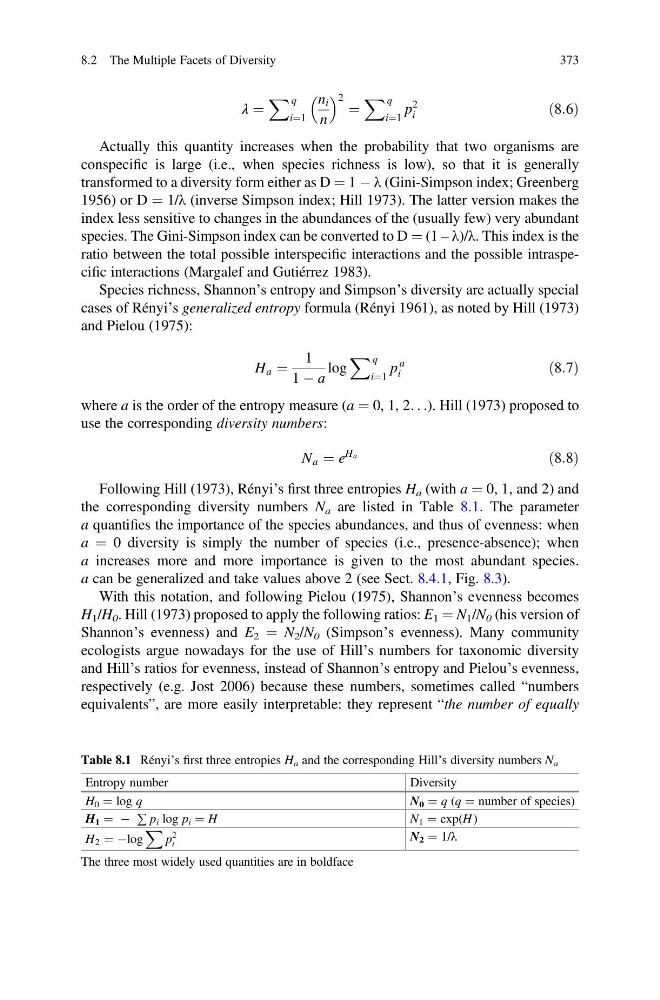
Actually this quantity increases when the probability that two organisms are
conspecific is large (i.e., when species richness is low), so that it is generally
transformed to a diversity form either as D ¼ 1 À λ (Gini-Simpson index; Greenberg
1956) or D ¼ 1/λ (inverse Simpson index; Hill 1973). The latter version makes the
index less sensitive to changes in the abundances of the (usually few) very abundant
species. The Gini-Simpson index can be converted to D ¼ (1 – λ)/λ. This index is the
ratio between the total possible interspecific interactions and the possible intraspecific interactions (Margalef and Gutiérrez 1983).
Species richness, Shannon’s entropy and Simpson’s diversity are actually special
cases of Rényi’s generalized entropy formula (Rényi 1961), as noted by Hill (1973)
and Pielou (1975):
H a ¼
1
1 À a
log
X q
i¼1
p
a
i
ð8:7Þ
where a is the order of the entropy measure (a ¼ 0, 1, 2. . .). Hill (1973) proposed to
use the corresponding diversity numbers:
N a ¼ e
H a
ð8:8Þ
Following Hill (1973), Rényi’s first three entropies H a (with a ¼ 0, 1, and 2) and
the corresponding diversity numbers N a are listed in Table 8.1. The parameter
a quantifies the importance of the species abundances, and thus of evenness: when
a ¼ 0 diversity is simply the number of species (i.e., presence-absence); when
a increases more and more importance is given to the most abundant species.
a can be generalized and take values above 2 (see Sect. 8.4.1, Fig. 8.3).
With this notation, and following Pielou (1975), Shannon’s evenness becomes
H 1 /H 0 . Hill (1973) proposed to apply the following ratios: E 1 ¼ N 1 /N 0 (his version of
Shannon’s evenness) and E 2 ¼ N 2 /N 0 (Simpson’s evenness). Many community
ecologists argue nowadays for the use of Hill’s numbers for taxonomic diversity
and Hill’s ratios for evenness, instead of Shannon’s entropy and Pielou’s evenness,
respectively (e.g. Jost 2006) because these numbers, sometimes called “numbers
equivalents”, are more easily interpretable: they represent “the number of equally
Table 8.1 Rényi’s first three entropies H a and the corresponding Hill’s diversity numbers N a
Entropy number
Diversity
H 0 ¼ log q
N 0 ¼ q (q ¼ number of species)
H 1 ¼ À ∑ p i log p i ¼ H
N 1 ¼ exp(H )
H 2 ¼ Àlog
X
p
2
i
N 2 ¼ 1/λ
The three most widely used quantities are in boldface
8.2 The Multiple Facets of Diversity
373
X q
i¼1
n i
n
2 ¼
X q
i¼1
p
2
i
ð8:6Þ
Actually this quantity increases when the probability that two organisms are
conspecific is large (i.e., when species richness is low), so that it is generally
transformed to a diversity form either as D ¼ 1 À λ (Gini-Simpson index; Greenberg
1956) or D ¼ 1/λ (inverse Simpson index; Hill 1973). The latter version makes the
index less sensitive to changes in the abundances of the (usually few) very abundant
species. The Gini-Simpson index can be converted to D ¼ (1 – λ)/λ. This index is the
ratio between the total possible interspecific interactions and the possible intraspecific interactions (Margalef and Gutiérrez 1983).
Species richness, Shannon’s entropy and Simpson’s diversity are actually special
cases of Rényi’s generalized entropy formula (Rényi 1961), as noted by Hill (1973)
and Pielou (1975):
H a ¼
1
1 À a
log
X q
i¼1
p
a
i
ð8:7Þ
where a is the order of the entropy measure (a ¼ 0, 1, 2. . .). Hill (1973) proposed to
use the corresponding diversity numbers:
N a ¼ e
H a
ð8:8Þ
Following Hill (1973), Rényi’s first three entropies H a (with a ¼ 0, 1, and 2) and
the corresponding diversity numbers N a are listed in Table 8.1. The parameter
a quantifies the importance of the species abundances, and thus of evenness: when
a ¼ 0 diversity is simply the number of species (i.e., presence-absence); when
a increases more and more importance is given to the most abundant species.
a can be generalized and take values above 2 (see Sect. 8.4.1, Fig. 8.3).
With this notation, and following Pielou (1975), Shannon’s evenness becomes
H 1 /H 0 . Hill (1973) proposed to apply the following ratios: E 1 ¼ N 1 /N 0 (his version of
Shannon’s evenness) and E 2 ¼ N 2 /N 0 (Simpson’s evenness). Many community
ecologists argue nowadays for the use of Hill’s numbers for taxonomic diversity
and Hill’s ratios for evenness, instead of Shannon’s entropy and Pielou’s evenness,
respectively (e.g. Jost 2006) because these numbers, sometimes called “numbers
equivalents”, are more easily interpretable: they represent “the number of equally
Table 8.1 Rényi’s first three entropies H a and the corresponding Hill’s diversity numbers N a
Entropy number
Diversity
H 0 ¼ log q
N 0 ¼ q (q ¼ number of species)
H 1 ¼ À ∑ p i log p i ¼ H
N 1 ¼ exp(H )
H 2 ¼ Àlog
X
p
2
i
N 2 ¼ 1/λ
The three most widely used quantities are in boldface
8.2 The Multiple Facets of Diversity
373