

The Sand Beach Ecosystem of Chile
223
AGUILA :=2-f>s
APOLILLADO := 29°5
MAR BRAVA :=4~5
2
. · .
3
DRY ZONE
DRIFT LINE
ft
2
r. ~ \ 4,
RESURGENCE
AND
SWASH ZONE
5
... -· 5
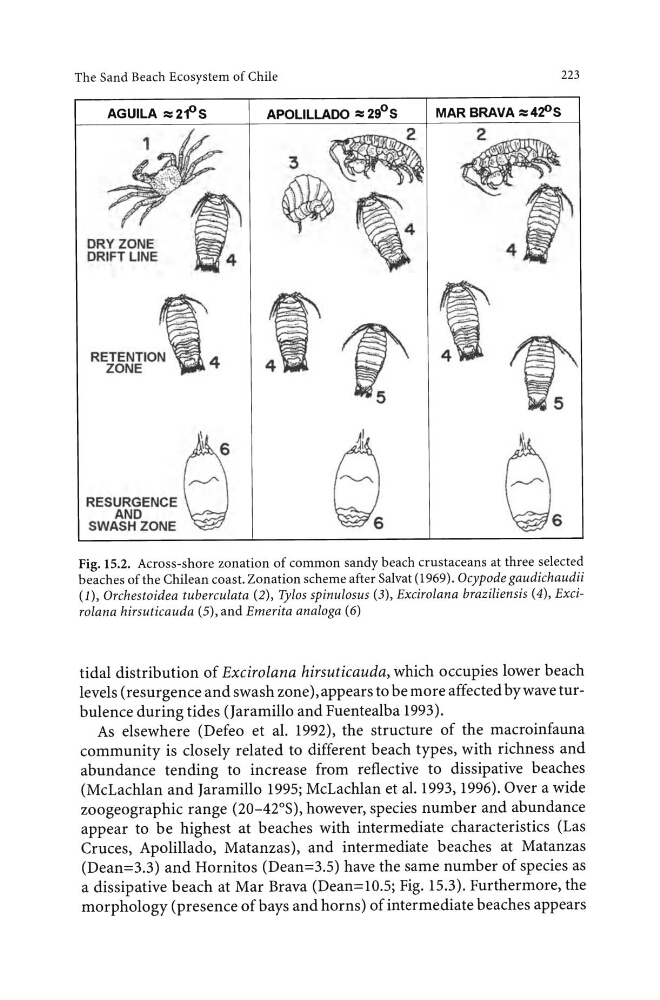
Fig. 15.2. Across-shore zonation of common sandy beach crustaceans at three selected
beaches of the Chilean coast Zonation scheme after Sal vat ( 1969). Ocy pode gaudichaudii
(1), Orchestoidea tuberculata (2), Ty los spinulosus (3), Excirolana braziliensis (4), Excirolana hirsuticauda (5), and Emerita analoga ( 6)
tidal distribution of Excirolana hirsuticauda, which occupies lower beach
levels (resurgence and swash zone), appears to be more affected by wave turbulence during tides (Jaramillo and Fuentealba 1993 ).
As elsewhere (Defeo et al. 1992), the structure of the macroinfauna
community is closely related to different beach types, with richness and
abundance tending to increase from reflective to dissipative beaches
(McLachlan and Jaramillo 1995; McLachlan et al. 1993, 1996). Over a wide
zoogeographic range (20-42°S), however, species number and abundance
appear to be highest at beaches with intermediate characteristics (Las
Cruces, Apolillado, Matanzas), and intermediate beaches at Matanzas
(Dean=3.3) and Hornitos (Dean=3.5) have the same number of species as
a dissipative beach at Mar Brava (Dean= l0.5; Fig. 15.3). Furthermore, the
morphology (presence of bays and horns) of intermediate beaches appears
223
AGUILA :=2-f>s
APOLILLADO := 29°5
MAR BRAVA :=4~5
2
. · .
3
DRY ZONE
DRIFT LINE
ft
2
r. ~ \ 4,
RESURGENCE
AND
SWASH ZONE
5
... -· 5
Fig. 15.2. Across-shore zonation of common sandy beach crustaceans at three selected
beaches of the Chilean coast Zonation scheme after Sal vat ( 1969). Ocy pode gaudichaudii
(1), Orchestoidea tuberculata (2), Ty los spinulosus (3), Excirolana braziliensis (4), Excirolana hirsuticauda (5), and Emerita analoga ( 6)
tidal distribution of Excirolana hirsuticauda, which occupies lower beach
levels (resurgence and swash zone), appears to be more affected by wave turbulence during tides (Jaramillo and Fuentealba 1993 ).
As elsewhere (Defeo et al. 1992), the structure of the macroinfauna
community is closely related to different beach types, with richness and
abundance tending to increase from reflective to dissipative beaches
(McLachlan and Jaramillo 1995; McLachlan et al. 1993, 1996). Over a wide
zoogeographic range (20-42°S), however, species number and abundance
appear to be highest at beaches with intermediate characteristics (Las
Cruces, Apolillado, Matanzas), and intermediate beaches at Matanzas
(Dean=3.3) and Hornitos (Dean=3.5) have the same number of species as
a dissipative beach at Mar Brava (Dean= l0.5; Fig. 15.3). Furthermore, the
morphology (presence of bays and horns) of intermediate beaches appears