

224
14~--------------~
y=6.95+0.12x
12
LC•
r=0.11
Cl)
m 10
z
:z:
~
0::
Cl)
6
w
~ 4
a.
Cl)
2
• co
•Ag
MB
•
-
0 -1----,..---.--r-,--.---r----1
E. Jaramillo
14,---------------~
y=4.68+0.11x
12 r= 0.31
10
8
6
4
.co
2
• LC
• /!JfJ
0-+----"-T--...----r-----1
0 2 4 6 8 10 12
0
10 20 30
1 /slope
40
n
160000·,-----~~~~~~160000.-~~~~~----~
Ap. Yr~ 3 0 9. 0 3 1 08.38+208.17x
y=6008.06-761.9.4x
-
"e
! 120000
w
0
:i 80000c
z
;::)
CD
<( 40000
0
0
-
r= ,...0.11
Ap
120000
80000
MB
• 40000
L~ .LC
LMLC
Le .• •Ho .Ag
Co
Ho•• •Le f9
Co
0
2 4 6 8 10 12
0
10
20 30 40
.n..
1 /slope
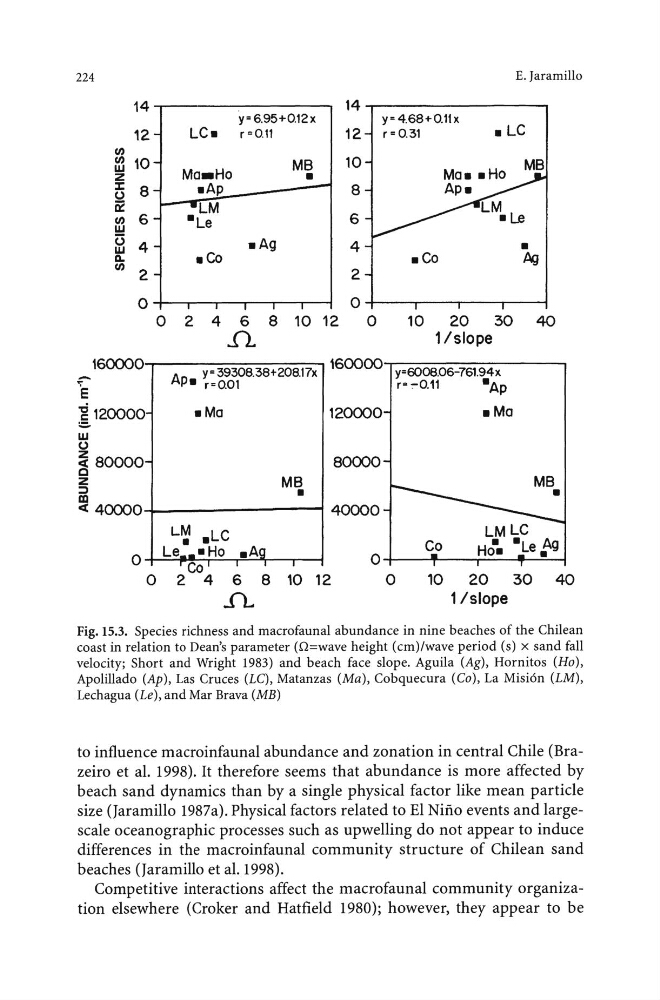
Fig. 15.3. Species richness and macrofauna! abundance in nine beaches of the Chilean
coast in relation to Dean's parameter (Q=wave height (cm)/wave period (s) x sand fall
velocity; Short and Wright 1983) and beach face slope. Aguila (Ag), Hornitos (Ho),
Apolillado (Ap), Las Cruces (LC), Matanzas (Ma), Cobquecura (Co), La Misi6n (LM),
Lechagua (Le), and Mar Brava (MB)
to influence macroinfaunal abundance and zonation in central Chile (Brazeiro et al. 1998). It therefore seems that abundance is more affected by
beach sand dynamics than by a single physical factor like mean particle
size (Jaramillo 1987a). Physical factors related to El Nino events and largescale oceanographic processes such as upwelling do not appear to induce
differences in the macroinfaunal community structure of Chilean sand
beaches (Jaramillo et al. 1998).
Competitive interactions affect the macrofauna! community organization elsewhere (Croker and Hatfield 1980); however, they appear to be
14~--------------~
y=6.95+0.12x
12
LC•
r=0.11
Cl)
m 10
z
:z:
~
0::
Cl)
6
w
~ 4
a.
Cl)
2
• co
•Ag
MB
•
-
0 -1----,..---.--r-,--.---r----1
E. Jaramillo
14,---------------~
y=4.68+0.11x
12 r= 0.31
10
8
6
4
.co
2
• LC
• /!JfJ
0-+----"-T--...----r-----1
0 2 4 6 8 10 12
0
10 20 30
1 /slope
40
n
160000·,-----~~~~~~160000.-~~~~~----~
Ap. Yr~ 3 0 9. 0 3 1 08.38+208.17x
y=6008.06-761.9.4x
-
"e
! 120000
w
0
:i 80000c
z
;::)
CD
<( 40000
0
0
-
r= ,...0.11
Ap
120000
80000
MB
• 40000
L~ .LC
LMLC
Le .• •Ho .Ag
Co
Ho•• •Le f9
Co
0
2 4 6 8 10 12
0
10
20 30 40
.n..
1 /slope
Fig. 15.3. Species richness and macrofauna! abundance in nine beaches of the Chilean
coast in relation to Dean's parameter (Q=wave height (cm)/wave period (s) x sand fall
velocity; Short and Wright 1983) and beach face slope. Aguila (Ag), Hornitos (Ho),
Apolillado (Ap), Las Cruces (LC), Matanzas (Ma), Cobquecura (Co), La Misi6n (LM),
Lechagua (Le), and Mar Brava (MB)
to influence macroinfaunal abundance and zonation in central Chile (Brazeiro et al. 1998). It therefore seems that abundance is more affected by
beach sand dynamics than by a single physical factor like mean particle
size (Jaramillo 1987a). Physical factors related to El Nino events and largescale oceanographic processes such as upwelling do not appear to induce
differences in the macroinfaunal community structure of Chilean sand
beaches (Jaramillo et al. 1998).
Competitive interactions affect the macrofauna! community organization elsewhere (Croker and Hatfield 1980); however, they appear to be