

222
E. Jaramillo
Emerita analoga and Excirolana braziliensis represent 90-99% of the
macroinfauna in sandy beaches at Aguila and Hornitos in northern Chile
(20-23°S) while the same crab and Excirolana hirsuticauda represent
about 72% of the macroinfauna at Apolillado beach in north-central Chile
(29°S). Emerita analoga, Excirolana hirsuticauda, and the talitrid amphipod Orchestoidea tuberculata are the dominant taxa at Cobquecura and
Mar Brava beaches in south-central Chile ( 40-42°S), with a similar abundance of the polychaete Euzonus heterocirrus at Mar Brava. Most of these
species are recruited during spring/early summer and in the fall (Emerita
analoga; Osorio et al. 1967; Nuiiez et al. 1974; Conan et al. 1975; Contreras
et al. 1998) or during summer (Excirolana braziliensis, E. hirsuticauda, 0.
tuberculata; Zuiiiga et al. 1985; Jaramillo 198 7 a). In general, macroinfaunal
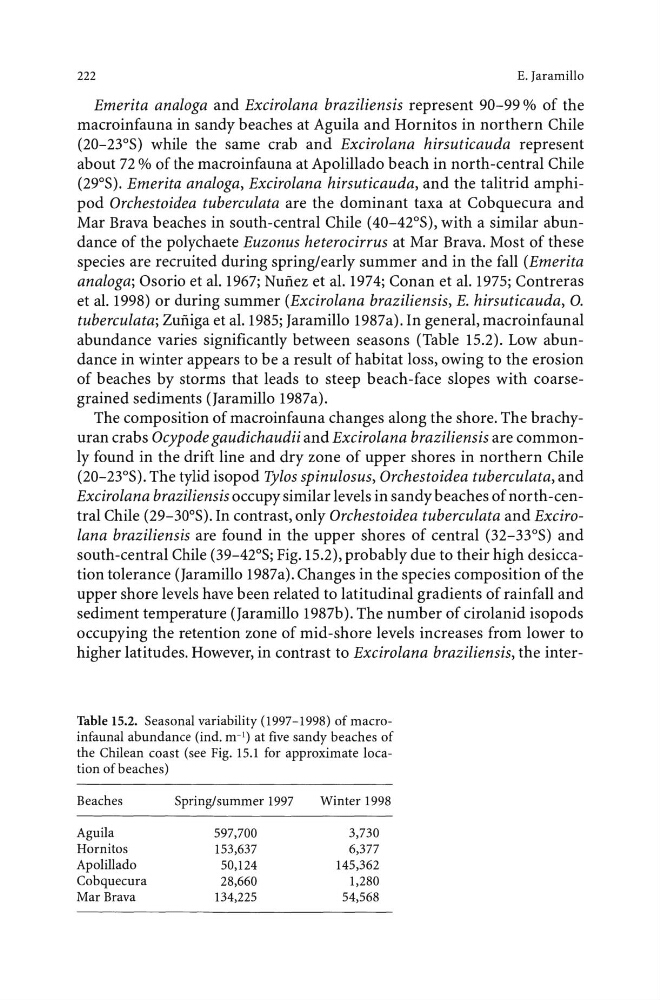
abundance varies significantly between seasons (Table 15.2). Low abundance in winter appears to be a result of habitat loss, owing to the erosion
of beaches by storms that leads to steep beach-face slopes with coarsegrained sediments (Jaramillo 1987a).
The composition of macroinfauna changes along the shore. The brachyuran crabs Ocypode gaudichaudii and Excirolana braziliensis are commonly found in the drift line and dry zone of upper shores in northern Chile
(20-23°S). The tylid isopod Tylos spinulosus, Orchestoidea tuberculata, and
Excirolana braziliensis occupy similar levels in sandy beaches of north-central Chile (29-30°S). In contrast, only Orchestoidea tuberculata and Excirolana braziliensis are found in the upper shores of central (32-33°S) and
south-central Chile (39-42°S; Fig. 15.2), probably due to their high desiccation tolerance (Jaramillo 1987a). Changes in the species composition of the
upper shore levels have been related to latitudinal gradients of rainfall and
sediment temperature (Jaramillo 1987b). The number of cirolanid isopods
occupying the retention zone of mid-shore levels increases from lower to
higher latitudes. However, in contrast to Excirolana braziliensis, the interTable 15.2. Seasonal variability (1997-1998) of macroinfaunal abundance (ind. m- 1 ) at five sandy beaches of
the Chilean coast (see Fig. 15.1 for approximate location of beaches)
Beaches
Spring/summer 1997
Winter 1998
Aguila
597,700
3,730
Hornitos
153,637
6,377
Apolillado
50,124
145,362
Cobquecura
28,660
1,280
Mar Brava
134,225
54,568
E. Jaramillo
Emerita analoga and Excirolana braziliensis represent 90-99% of the
macroinfauna in sandy beaches at Aguila and Hornitos in northern Chile
(20-23°S) while the same crab and Excirolana hirsuticauda represent
about 72% of the macroinfauna at Apolillado beach in north-central Chile
(29°S). Emerita analoga, Excirolana hirsuticauda, and the talitrid amphipod Orchestoidea tuberculata are the dominant taxa at Cobquecura and
Mar Brava beaches in south-central Chile ( 40-42°S), with a similar abundance of the polychaete Euzonus heterocirrus at Mar Brava. Most of these
species are recruited during spring/early summer and in the fall (Emerita
analoga; Osorio et al. 1967; Nuiiez et al. 1974; Conan et al. 1975; Contreras
et al. 1998) or during summer (Excirolana braziliensis, E. hirsuticauda, 0.
tuberculata; Zuiiiga et al. 1985; Jaramillo 198 7 a). In general, macroinfaunal
abundance varies significantly between seasons (Table 15.2). Low abundance in winter appears to be a result of habitat loss, owing to the erosion
of beaches by storms that leads to steep beach-face slopes with coarsegrained sediments (Jaramillo 1987a).
The composition of macroinfauna changes along the shore. The brachyuran crabs Ocypode gaudichaudii and Excirolana braziliensis are commonly found in the drift line and dry zone of upper shores in northern Chile
(20-23°S). The tylid isopod Tylos spinulosus, Orchestoidea tuberculata, and
Excirolana braziliensis occupy similar levels in sandy beaches of north-central Chile (29-30°S). In contrast, only Orchestoidea tuberculata and Excirolana braziliensis are found in the upper shores of central (32-33°S) and
south-central Chile (39-42°S; Fig. 15.2), probably due to their high desiccation tolerance (Jaramillo 1987a). Changes in the species composition of the
upper shore levels have been related to latitudinal gradients of rainfall and
sediment temperature (Jaramillo 1987b). The number of cirolanid isopods
occupying the retention zone of mid-shore levels increases from lower to
higher latitudes. However, in contrast to Excirolana braziliensis, the interTable 15.2. Seasonal variability (1997-1998) of macroinfaunal abundance (ind. m- 1 ) at five sandy beaches of
the Chilean coast (see Fig. 15.1 for approximate location of beaches)
Beaches
Spring/summer 1997
Winter 1998
Aguila
597,700
3,730
Hornitos
153,637
6,377
Apolillado
50,124
145,362
Cobquecura
28,660
1,280
Mar Brava
134,225
54,568