

2. Factors Controlling the Climate of the West Coast of North America 37
"New
. , Zealand
~UPWEU.ING
~
ZONE
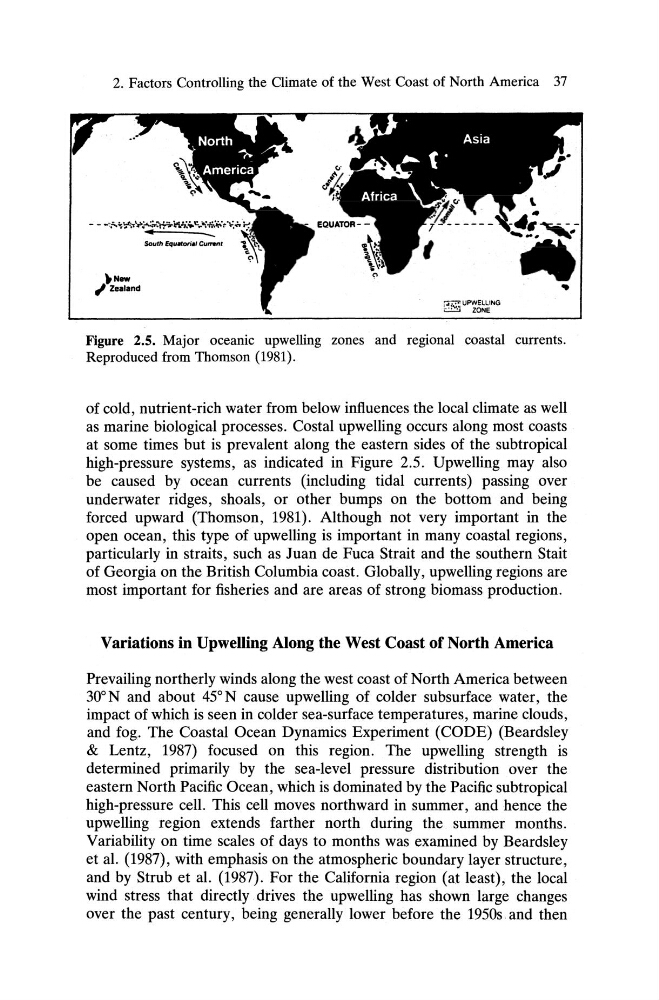
Figure 2.5. Major oceanic upwelling zones and regional coastal currents.
Reproduced from Thomson (1981).
of cold, nutrient -rich water from below influences the local climate as well
as marine biological processes. Costal upwelling occurs along most coasts
at some times but is prevalent along the eastern sides of the subtropical
high-pressure systems, as indicated in Figure 2.5. Upwelling may also
be caused by ocean currents (including tidal currents) passing over
underwater ridges, shoals, or other bumps on the bottom and being
forced upward (Thomson, 1981). Although not very important in the
open ocean, this type of upwelling is important in many coastal regions,
particularly in straits, such as Juan de Fuca Strait and the southern Stait
of Georgia on the British Columbia coast. Globally, upwelling regions are
most important for fisheries and are areas of strong biomass production .
Variations in Upwelling Along the West Coast of North America
Prevailing northerly winds along the west coast of North America between
30°N and about 45°N cause upwelling of colder subsurface water, the
impact of which is seen in colder sea-surface temperatures, marine clouds,
and fog. The Coastal Ocean Dynamics Experiment (CODE) (Beardsley
& Lentz, 1987) focused on this region. The upwelling strength is
determined primarily by the sea-level pressure distribution over the
eastern North Pacific Ocean, which is dominated by the Pacificsubtropical
high-pressure cell. This cell moves northward in summer, and hence the
upwelling region extends farther north during the summer months.
Variability on time scales of days to months was examined by Beardsley
et al. (1987), with emphasis on the atmospheric boundary layer structure,
and by Strub et al. (1987) . For the California region (at least), the local
wind stress that directly drives the upwelling has shown large changes
over the past century, being generally lower before the 1950s .and then
"New
. , Zealand
~UPWEU.ING
~
ZONE
Figure 2.5. Major oceanic upwelling zones and regional coastal currents.
Reproduced from Thomson (1981).
of cold, nutrient -rich water from below influences the local climate as well
as marine biological processes. Costal upwelling occurs along most coasts
at some times but is prevalent along the eastern sides of the subtropical
high-pressure systems, as indicated in Figure 2.5. Upwelling may also
be caused by ocean currents (including tidal currents) passing over
underwater ridges, shoals, or other bumps on the bottom and being
forced upward (Thomson, 1981). Although not very important in the
open ocean, this type of upwelling is important in many coastal regions,
particularly in straits, such as Juan de Fuca Strait and the southern Stait
of Georgia on the British Columbia coast. Globally, upwelling regions are
most important for fisheries and are areas of strong biomass production .
Variations in Upwelling Along the West Coast of North America
Prevailing northerly winds along the west coast of North America between
30°N and about 45°N cause upwelling of colder subsurface water, the
impact of which is seen in colder sea-surface temperatures, marine clouds,
and fog. The Coastal Ocean Dynamics Experiment (CODE) (Beardsley
& Lentz, 1987) focused on this region. The upwelling strength is
determined primarily by the sea-level pressure distribution over the
eastern North Pacific Ocean, which is dominated by the Pacificsubtropical
high-pressure cell. This cell moves northward in summer, and hence the
upwelling region extends farther north during the summer months.
Variability on time scales of days to months was examined by Beardsley
et al. (1987), with emphasis on the atmospheric boundary layer structure,
and by Strub et al. (1987) . For the California region (at least), the local
wind stress that directly drives the upwelling has shown large changes
over the past century, being generally lower before the 1950s .and then