

36
G.A. McBean
Oceanic Upwelling
Linkages between the atmosphere and the oceans take place on a wide
range of space and time scales, from basin scale ocean gyres, driven by
prevailing wind patterns, to capillary winds on wave crests, generated by
local winds. A very important phenomenon is the upwelling of subsurface
water to the surface, caused by variations in winds and/or winds
interacting with topography (Thomson, 1981). Upwelling occurs due to
the basic physics of wind stress on a water body on a rotating earth.
Whenever a wind stress is applied to the surface of the ocean, there is a
net transport of water to the right (in the Northern Hemisphere) due to
the Ekman spiral in the water. For uniform winds over the open ocean,
this results in a net horizontal transfer of water. However, if the wind is
spatially varying, the horizontal transport will also be spatially .varying,
and vertical motions in the ocean will be necessary to compensate
for converging or diverging surface waters; the result is upwelling (for
diverging surface waters) or downwelling. When the wind blows parallel
to the coast, there will be either transport toward or away from the coast,
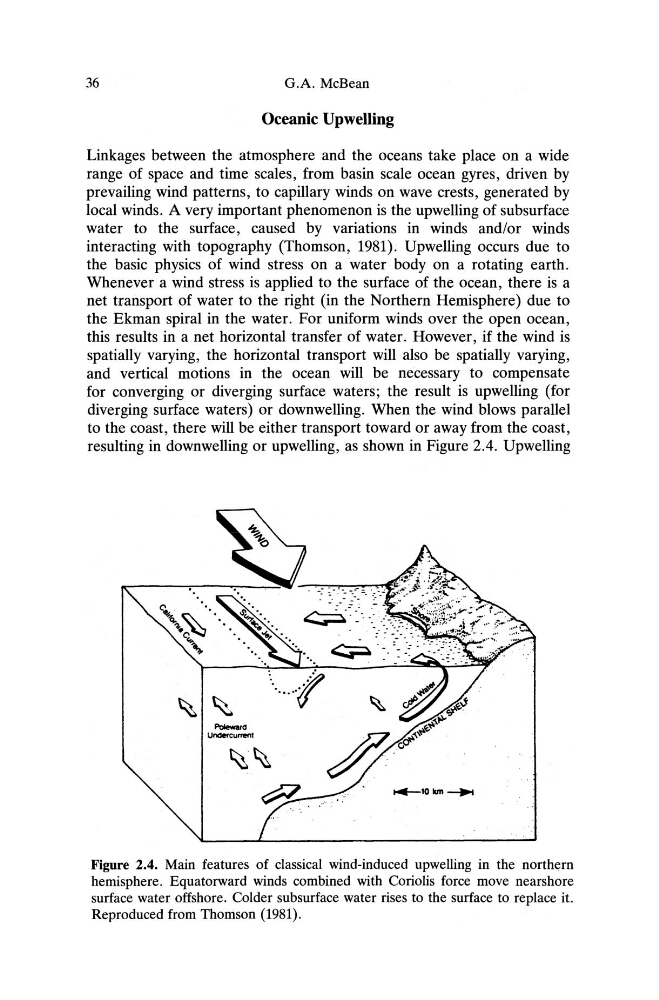
resulting in downwelling or upwelling, as shown in Figure 2.4. Upwelling
:.. .#
..... "-10km~
Figure 2.4. Main features of classical wind-induced upwelling in the northern
hemisphere . Equatorward winds combined with Coriolis force move nearshore
surface water offshore. Colder subsurface water rises to the surface to replace it.
Reproduced from Thomson (1981).
G.A. McBean
Oceanic Upwelling
Linkages between the atmosphere and the oceans take place on a wide
range of space and time scales, from basin scale ocean gyres, driven by
prevailing wind patterns, to capillary winds on wave crests, generated by
local winds. A very important phenomenon is the upwelling of subsurface
water to the surface, caused by variations in winds and/or winds
interacting with topography (Thomson, 1981). Upwelling occurs due to
the basic physics of wind stress on a water body on a rotating earth.
Whenever a wind stress is applied to the surface of the ocean, there is a
net transport of water to the right (in the Northern Hemisphere) due to
the Ekman spiral in the water. For uniform winds over the open ocean,
this results in a net horizontal transfer of water. However, if the wind is
spatially varying, the horizontal transport will also be spatially .varying,
and vertical motions in the ocean will be necessary to compensate
for converging or diverging surface waters; the result is upwelling (for
diverging surface waters) or downwelling. When the wind blows parallel
to the coast, there will be either transport toward or away from the coast,
resulting in downwelling or upwelling, as shown in Figure 2.4. Upwelling
:.. .#
..... "-10km~
Figure 2.4. Main features of classical wind-induced upwelling in the northern
hemisphere . Equatorward winds combined with Coriolis force move nearshore
surface water offshore. Colder subsurface water rises to the surface to replace it.
Reproduced from Thomson (1981).