

38
G.A. McBean
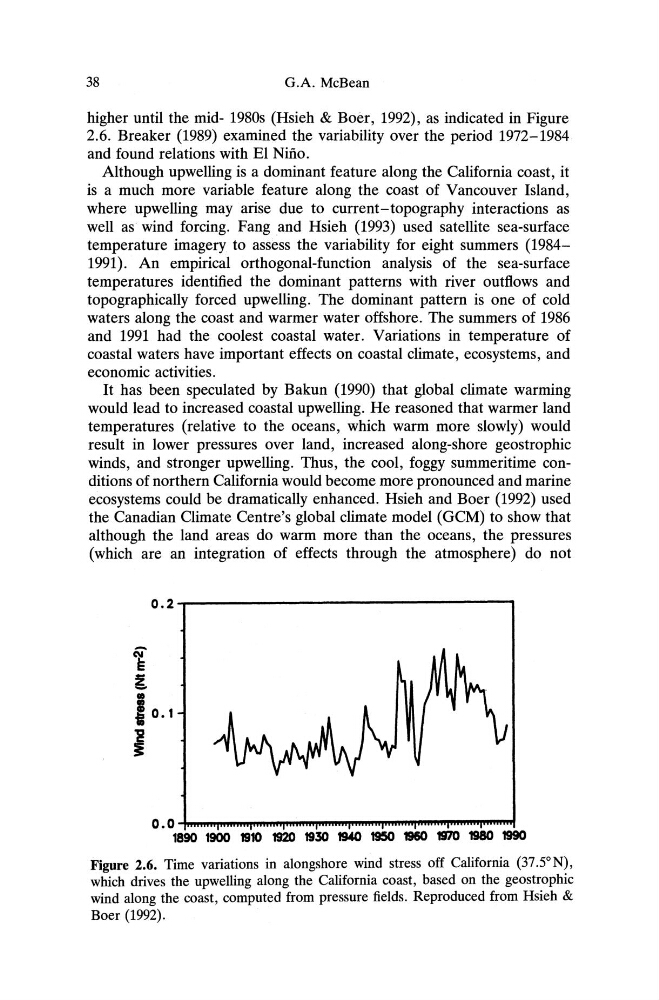
higher until the mid- 1980s (Hsieh & Boer, 1992), as indicated in Figure
2.6. Breaker (1989) examined the variability over the period 1972-1984
and found relations with EI Nino.
Although upwelling is a dominant feature along the California coast, it
is a much more variable feature along the coast of Vancouver Island,
where upwelling may arise due to current-topography interactions as
well as wind forcing . Fang and Hsieh (1993) used satellite sea-surface
temperature imagery to assess the variability for eight summers (19841991). An empirical orthogonal-function analysis of the sea-surface
temperatures identified the dominant patterns with river outflows and
topographically forced upwelling. The dominant pattern is one of cold
waters along the coast and warmer water offshore. The summers of 1986
and 1991 had the coolest coastal water. Variations in temperature of
coastal waters have important effects on coastal climate, ecosystems, and
economic activities.
It has been speculated by Bakun (1990) that global climate warming
would lead to increased coastal upwelling. He reasoned that warmer land
temperatures (relative to the oceans, which warm more slowly) would
result in lower pressures over land, increased along-shore geostrophic
winds, and stronger upwelling. Thus, the cool, foggy summeritime conditions of northern California would become more pronounced and marine
ecosystems could be dramatically enhanced. Hsieh and Boer (1992) used
the Canadian Climate Centre's global climate model (GCM) to show that
although the land areas do warm more than the oceans, the pressures
(which are an integration of effects through the atmosphere) do not
O.2-r----------------...,
o.0 ;-""'1"''"''''''1'''"'"'''I''"'''"''I'''''''''''''-'l'''''''''"T''''"''''T''''''''''I''''''''''''
1890 1900 1910 1920 1930 1940 1950 1960 1970 1980 1990
Figure 2.6. Time variations in alongshore wind stress off California (37SN) ,
which drives the upwelling along the California coast, based on the geostrophic
wind along the coast, computed from pressure fields. Reproduced from Hsieh &
Boer (1992).
G.A. McBean
higher until the mid- 1980s (Hsieh & Boer, 1992), as indicated in Figure
2.6. Breaker (1989) examined the variability over the period 1972-1984
and found relations with EI Nino.
Although upwelling is a dominant feature along the California coast, it
is a much more variable feature along the coast of Vancouver Island,
where upwelling may arise due to current-topography interactions as
well as wind forcing . Fang and Hsieh (1993) used satellite sea-surface
temperature imagery to assess the variability for eight summers (19841991). An empirical orthogonal-function analysis of the sea-surface
temperatures identified the dominant patterns with river outflows and
topographically forced upwelling. The dominant pattern is one of cold
waters along the coast and warmer water offshore. The summers of 1986
and 1991 had the coolest coastal water. Variations in temperature of
coastal waters have important effects on coastal climate, ecosystems, and
economic activities.
It has been speculated by Bakun (1990) that global climate warming
would lead to increased coastal upwelling. He reasoned that warmer land
temperatures (relative to the oceans, which warm more slowly) would
result in lower pressures over land, increased along-shore geostrophic
winds, and stronger upwelling. Thus, the cool, foggy summeritime conditions of northern California would become more pronounced and marine
ecosystems could be dramatically enhanced. Hsieh and Boer (1992) used
the Canadian Climate Centre's global climate model (GCM) to show that
although the land areas do warm more than the oceans, the pressures
(which are an integration of effects through the atmosphere) do not
O.2-r----------------...,
o.0 ;-""'1"''"''''''1'''"'"'''I''"'''"''I'''''''''''''-'l'''''''''"T''''"''''T''''''''''I''''''''''''
1890 1900 1910 1920 1930 1940 1950 1960 1970 1980 1990
Figure 2.6. Time variations in alongshore wind stress off California (37SN) ,
which drives the upwelling along the California coast, based on the geostrophic
wind along the coast, computed from pressure fields. Reproduced from Hsieh &
Boer (1992).