

288
G.A . Bradshaw et al.
certain extent, species production and timing of release are autogenicall y
determined; however , the amount and timing of seed release are also
related to regional climatic dynamics (1. Means , personal communication).
Because abiotic factor s (e.g. , solar radiation, temperature , and moisture
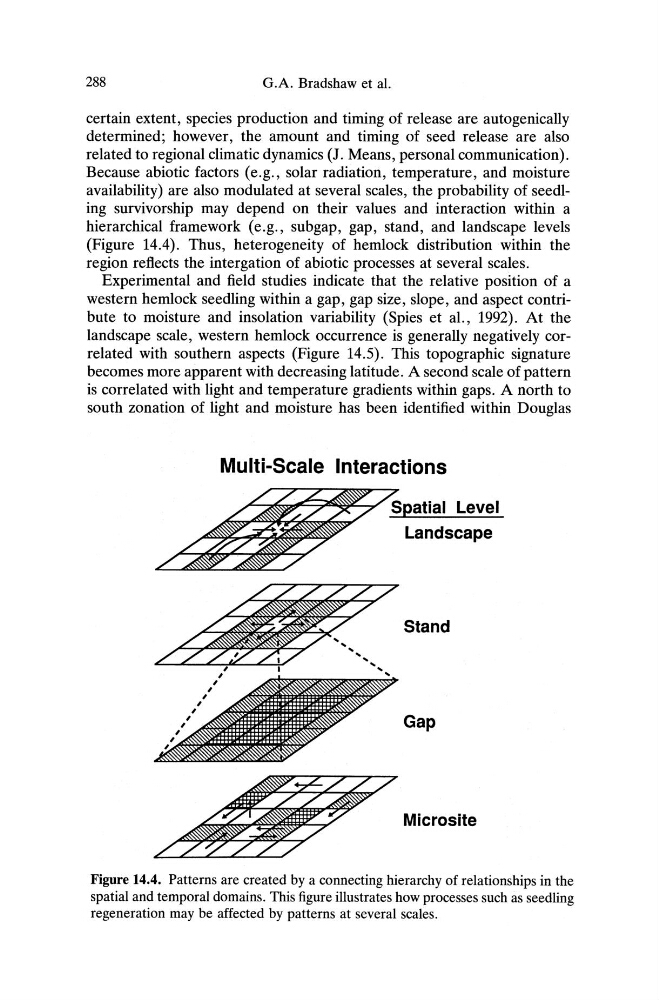
availability) are also modulated at several scales, the probability of seedling survivorship may depend on their values and interaction within a
hierarchical framework (e.g., subgap , gap, stand, and landscape levels
(Figure 14.4). Thus , heterogeneity of hemlock distribution within the
region reflects the intergation of abiotic processes at several scales.
Experimental and field studie s indicate that the relative position of a
western hemlock seedling within a gap , gap size, slope , and aspect contribute to moisture and insolation variability (Spies et aI., 1992). At the
landscape scale, western hemlock occurrence is gener ally negatively correlated with southern aspects (Figure 14.5). This topographic signature
becomes more apparent with decreasing latitude. A second scale of pattern
is correlated with light and temperature gradients within gaps. A north to
south zonation of light and moisture has been identified within Douglas
Multi-Scale Interactions
~7Sp.atial level
Landscape
, /
~ 7
F Microsite
, /
Figure 14.4. Patterns are created by a connecting hierarch y of relationships in the
spatial and temporal domains. This figure illustrates how processes such as seedling
regeneration may be affected by patterns at several scales.
G.A . Bradshaw et al.
certain extent, species production and timing of release are autogenicall y
determined; however , the amount and timing of seed release are also
related to regional climatic dynamics (1. Means , personal communication).
Because abiotic factor s (e.g. , solar radiation, temperature , and moisture
availability) are also modulated at several scales, the probability of seedling survivorship may depend on their values and interaction within a
hierarchical framework (e.g., subgap , gap, stand, and landscape levels
(Figure 14.4). Thus , heterogeneity of hemlock distribution within the
region reflects the intergation of abiotic processes at several scales.
Experimental and field studie s indicate that the relative position of a
western hemlock seedling within a gap , gap size, slope , and aspect contribute to moisture and insolation variability (Spies et aI., 1992). At the
landscape scale, western hemlock occurrence is gener ally negatively correlated with southern aspects (Figure 14.5). This topographic signature
becomes more apparent with decreasing latitude. A second scale of pattern
is correlated with light and temperature gradients within gaps. A north to
south zonation of light and moisture has been identified within Douglas
Multi-Scale Interactions
~7Sp.atial level
Landscape
, /
~ 7
F Microsite
, /
Figure 14.4. Patterns are created by a connecting hierarch y of relationships in the
spatial and temporal domains. This figure illustrates how processes such as seedling
regeneration may be affected by patterns at several scales.