

14. Patch Dynamics for Forested Ecosystems in the Pacific Northwest
287
IGeologyI
soil
topography
geologic provinces
IPrecipitationI
Ielevation rainshadow global
latitude I
ITemperatureI
elevation
vertical
canopy
Istructure
ILight I
i----------Vegetatlon - - - - - - - - -
cm
m
100 m
10 km
Spatial Scale
1000 km
I
10 3 km
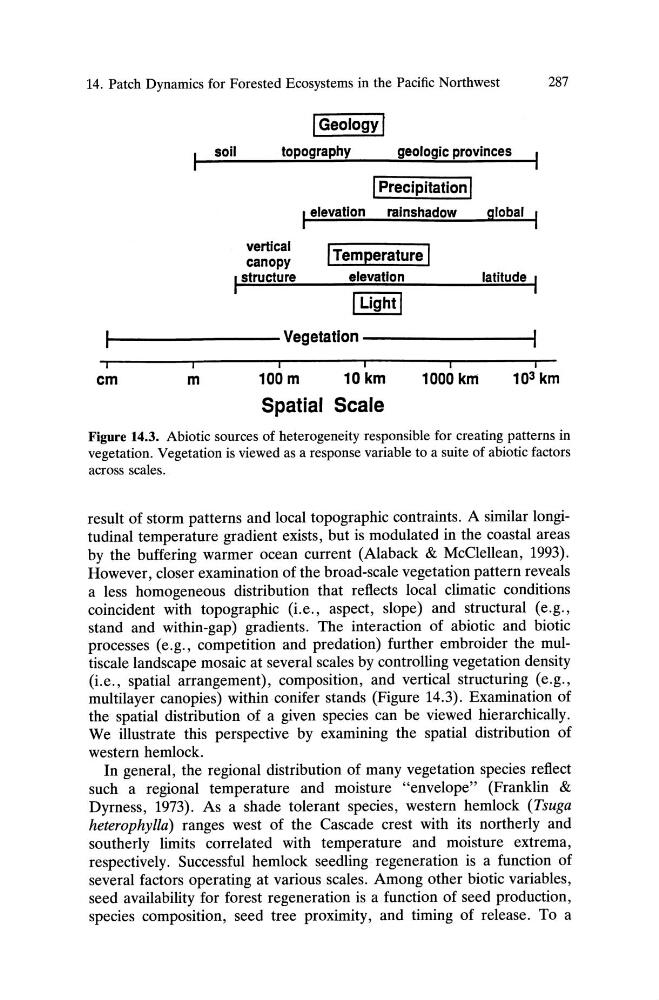
Figure 14.3. Abiot ic sources of heterogeneity responsible for creating patterns in
vegetation. Vegetation is viewed as a response variable to a suite of abiotic factors
across scales.
result of storm patterns and local topographic contraints. A similar longitudinal temperature gradient exists, but is modulated in the coastal areas
by the buffering warmer ocean current (Alaback & McClellean , 1993).
However, closer examination of the broad-scale vegetation pattern reveals
a less homogeneous distribution that reflects local climatic conditions
coincident with topographic (i.e. , aspect, slope) and structural (e.g. ,
stand and within-gap) gradients. The interaction of abiotic and biotic
processes (e.g ., competition and predation) further embroider the multiscale landscape mosaic at several scales by controlling vegetation density
(i.e., spatial arrangement) , composition, and vertical structuring (e.g. ,
multilayer canopie s) within conifer stands (Figure 14.3). Examination of
the spatial distribution of a given species can be viewed hierarchically .
We illustrate this perspective by examining the spatial distribution of
western hemlock.
In general , the regional distribution of many vegetation species reflect
such a regional temperature and moisture " envelope" (Franklin &
Dyrness, 1973). As a shade tolerant species, western hemlock (Tsuga
heterophylla) ranges west of the Cascade crest with its north erly and
southerly limits correlated with temperature and moisture extrem a,
respectively. Successful hemlock seedling regeneration is a function of
several factors operating at various scales. Among other biotic variables ,
seed availability for forest regeneration is a function of seed production,
species composition, seed tree proximity, and timing of release. To a
287
IGeologyI
soil
topography
geologic provinces
IPrecipitationI
Ielevation rainshadow global
latitude I
ITemperatureI
elevation
vertical
canopy
Istructure
ILight I
i----------Vegetatlon - - - - - - - - -
cm
m
100 m
10 km
Spatial Scale
1000 km
I
10 3 km
Figure 14.3. Abiot ic sources of heterogeneity responsible for creating patterns in
vegetation. Vegetation is viewed as a response variable to a suite of abiotic factors
across scales.
result of storm patterns and local topographic contraints. A similar longitudinal temperature gradient exists, but is modulated in the coastal areas
by the buffering warmer ocean current (Alaback & McClellean , 1993).
However, closer examination of the broad-scale vegetation pattern reveals
a less homogeneous distribution that reflects local climatic conditions
coincident with topographic (i.e. , aspect, slope) and structural (e.g. ,
stand and within-gap) gradients. The interaction of abiotic and biotic
processes (e.g ., competition and predation) further embroider the multiscale landscape mosaic at several scales by controlling vegetation density
(i.e., spatial arrangement) , composition, and vertical structuring (e.g. ,
multilayer canopie s) within conifer stands (Figure 14.3). Examination of
the spatial distribution of a given species can be viewed hierarchically .
We illustrate this perspective by examining the spatial distribution of
western hemlock.
In general , the regional distribution of many vegetation species reflect
such a regional temperature and moisture " envelope" (Franklin &
Dyrness, 1973). As a shade tolerant species, western hemlock (Tsuga
heterophylla) ranges west of the Cascade crest with its north erly and
southerly limits correlated with temperature and moisture extrem a,
respectively. Successful hemlock seedling regeneration is a function of
several factors operating at various scales. Among other biotic variables ,
seed availability for forest regeneration is a function of seed production,
species composition, seed tree proximity, and timing of release. To a