

10. Terrestrial Vertebrate Diversity in New World Temperate Rainforests
219
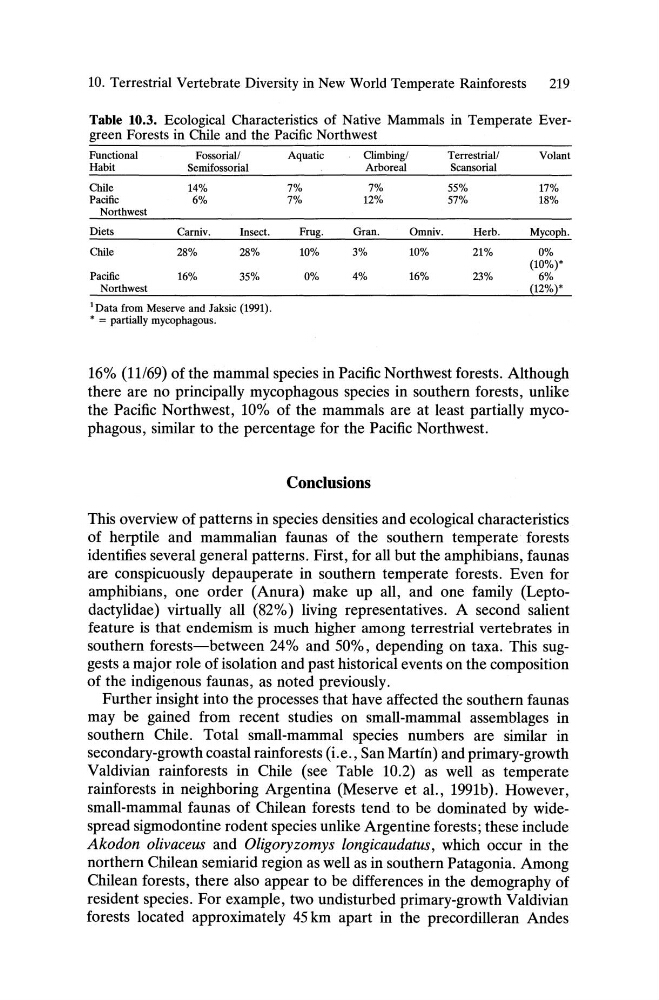
Table 10.3. Ecological Characteristics of Native Mammals in Temperate Evergreen Forests in Chile and the Pacific Northwest
Functional
Fossoriall
Aquatic
Climbing/
Terrestrial/
Volant
Habit
Semifossorial
Arboreal
Scansorial
Chile
14%
7%
7%
55%
17%
Pacific
6%
7%
12%
57%
18%
Northwest
Diets
Carniv.
Insect.
Frug.
Gran.
Omniv.
Herb .
Mycoph.
Chile
28%
28%
10%
3%
10%
21%
0%
(10%)'
Pacific
16%
35%
0%
4%
16%
23%
6%
Northwest
(12%)'
I Data from Meserve and Jaksic (1991).
, = partially mycophagous.
16% (11/69) of the mammal species in Pacific Northwest forests. Although
there are no principally mycophagous species in southern forests, unlike
the Pacific Northwest, 10% of the mammals are at least partially mycophagous, similar to the percentage for the Pacific Northwest.
Conclusions
This overview of patterns in species densities and ecological characteristics
of herptile and mammalian faunas of the southern temperate forests
identifies several general patterns. First, for all but the amphibians, faunas
are conspicuously depauperate in southern temperate forests. Even for
amphibians, one order (Anura) make up all, and one family (Leptodactylidae) virtually all (82%) living representatives. A second salient
feature is that endemism is much higher among terrestrial vertebrates in
southern forests-between 24% and 50%, depending on taxa . This suggests a major role of isolation and past historical events on the composition
of the indigenous faunas, as noted previously.
Further insight into the processes that have affected the southern faunas
may be gained from recent studies on small-mammal assemblages in
southern Chile. Total small-mammal species numbers are similar in
secondary-growth coastal rainforests (i.e., San Martin) and primary-growth
Valdivian rainforests in Chile (see Table 10.2) as well as temperate
rainforests in neighboring Argentina (Meserve et aI., 1991b). However,
small-mammal faunas of Chilean forests tend to be dominated by widespread sigmodontine rodent species unlike Argentine forests; these include
Akodon olivaceus and Oligoryzomys longicaudatus, which occur in the
northern Chilean semiarid region as well as in southern Patagonia. Among
Chilean forests, there also appear to be differences in the demography of
resident species. For example , two undisturbed primary-growth Valdivian
forests located approximately 45 km apart in the precordilleran Andes
219
Table 10.3. Ecological Characteristics of Native Mammals in Temperate Evergreen Forests in Chile and the Pacific Northwest
Functional
Fossoriall
Aquatic
Climbing/
Terrestrial/
Volant
Habit
Semifossorial
Arboreal
Scansorial
Chile
14%
7%
7%
55%
17%
Pacific
6%
7%
12%
57%
18%
Northwest
Diets
Carniv.
Insect.
Frug.
Gran.
Omniv.
Herb .
Mycoph.
Chile
28%
28%
10%
3%
10%
21%
0%
(10%)'
Pacific
16%
35%
0%
4%
16%
23%
6%
Northwest
(12%)'
I Data from Meserve and Jaksic (1991).
, = partially mycophagous.
16% (11/69) of the mammal species in Pacific Northwest forests. Although
there are no principally mycophagous species in southern forests, unlike
the Pacific Northwest, 10% of the mammals are at least partially mycophagous, similar to the percentage for the Pacific Northwest.
Conclusions
This overview of patterns in species densities and ecological characteristics
of herptile and mammalian faunas of the southern temperate forests
identifies several general patterns. First, for all but the amphibians, faunas
are conspicuously depauperate in southern temperate forests. Even for
amphibians, one order (Anura) make up all, and one family (Leptodactylidae) virtually all (82%) living representatives. A second salient
feature is that endemism is much higher among terrestrial vertebrates in
southern forests-between 24% and 50%, depending on taxa . This suggests a major role of isolation and past historical events on the composition
of the indigenous faunas, as noted previously.
Further insight into the processes that have affected the southern faunas
may be gained from recent studies on small-mammal assemblages in
southern Chile. Total small-mammal species numbers are similar in
secondary-growth coastal rainforests (i.e., San Martin) and primary-growth
Valdivian rainforests in Chile (see Table 10.2) as well as temperate
rainforests in neighboring Argentina (Meserve et aI., 1991b). However,
small-mammal faunas of Chilean forests tend to be dominated by widespread sigmodontine rodent species unlike Argentine forests; these include
Akodon olivaceus and Oligoryzomys longicaudatus, which occur in the
northern Chilean semiarid region as well as in southern Patagonia. Among
Chilean forests, there also appear to be differences in the demography of
resident species. For example , two undisturbed primary-growth Valdivian
forests located approximately 45 km apart in the precordilleran Andes