

218
P.L. Meserve
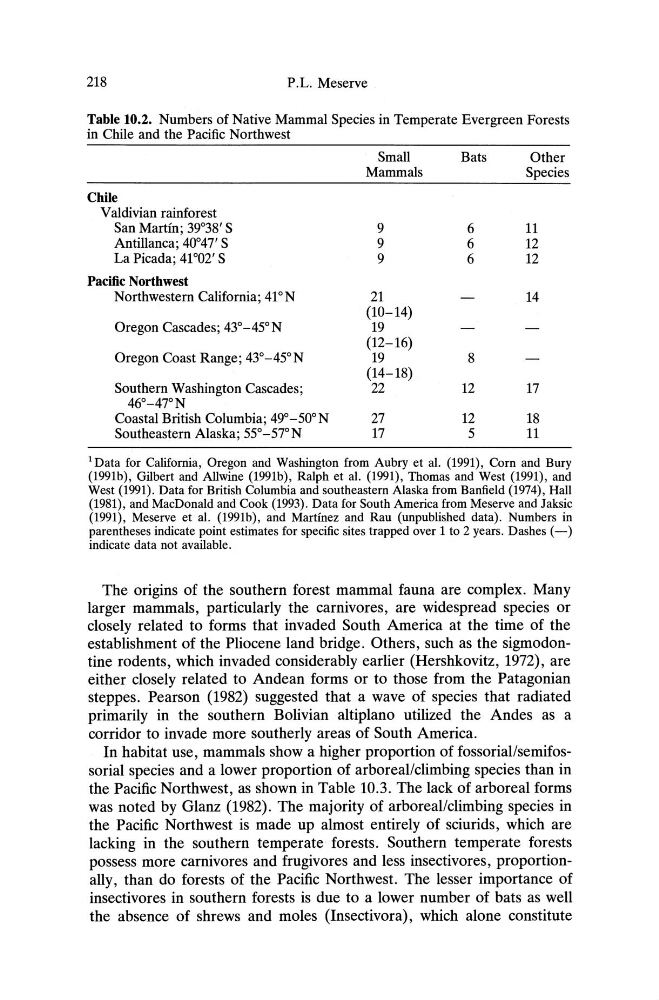
Table 10.2. Numbers of Native Mammal Species in Temperate Evergreen Forests
in Chile and the Pacific Northwest
Small
Bats
Other
Mammals
Species
Chile
Valdivian rainforest
San Martin; 39
038'
S
9
6
11
Antillanca; 40
047'
S
9
6
12
La Picada; 41
002'
S
9
6
12
Pacific Northwest
Northwestern California; 41°N
21
14
(10-14)
Oregon Cascades; 43°-45°N
19
(12-16)
Oregon Coast Range; 43°-45°N
19
8
(14-18)
SouthernWashington Cascades;
22
12
17
46°-47°N
Coastal British Columbia; 49°-50
0N
27
12
18
SoutheasternAlaska; 55°-57°N
17
5
11
1 Data for California, Oregon and Washington from Aubry et al. (1991), Corn and Bury
(1991b), Gilbert and Allwine (1991b), Ralph et al. (1991), Thomas and West (1991), and
West (1991). Data for British Columbia and southeastern Alaska from Banfield (1974), Hall
(1981), and MacDonald and Cook (1993). Data for South America from Meserve and Jaksic
(1991), Meserve et al. (1991b), and Martinez and Rau (unpublished data) . Numbers in
parentheses indicate point estimates for specific sites trapped over 1 to 2 years. Dashes (-)
indicate data not available.
The origins of the southern forest mammal fauna are complex. Many
larger mammals, particularly the carnivores, are widespread species or
closely related to forms that invaded South America at the time of the
establishment of the Pliocene land bridge. Others, such as the sigmodontine rodents, which invaded considerably earlier (Hershkovitz, 1972), are
either closely related to Andean forms or to those from the Patagonian
steppes. Pearson (1982) suggested that a wave of species that radiated
primarily in the southern Bolivian altiplano utilized the Andes as a
corridor to invade more southerly areas of South America.
In habitat use, mammals show a higher proportion of fossorial/semifossorial species and a lower proportion of arboreallclimbing species than in
the Pacific Northwest, as shown in Table 10.3. The lack of arboreal forms
was noted by Glanz (1982). The majority of arboreallclimbing species in
the Pacific Northwest is made up almost entirely of sciurids, which are
lacking in the southern temperate forests. Southern temperate forests
possess more carnivores and frugivores and less insectivores, proportionally, than do forests of the Pacific Northwest. The lesser importance of
insectivores in southern forests is due to a lower number of bats as well
the absence of shrews and moles (Insectivora), which alone constitute
P.L. Meserve
Table 10.2. Numbers of Native Mammal Species in Temperate Evergreen Forests
in Chile and the Pacific Northwest
Small
Bats
Other
Mammals
Species
Chile
Valdivian rainforest
San Martin; 39
038'
S
9
6
11
Antillanca; 40
047'
S
9
6
12
La Picada; 41
002'
S
9
6
12
Pacific Northwest
Northwestern California; 41°N
21
14
(10-14)
Oregon Cascades; 43°-45°N
19
(12-16)
Oregon Coast Range; 43°-45°N
19
8
(14-18)
SouthernWashington Cascades;
22
12
17
46°-47°N
Coastal British Columbia; 49°-50
0N
27
12
18
SoutheasternAlaska; 55°-57°N
17
5
11
1 Data for California, Oregon and Washington from Aubry et al. (1991), Corn and Bury
(1991b), Gilbert and Allwine (1991b), Ralph et al. (1991), Thomas and West (1991), and
West (1991). Data for British Columbia and southeastern Alaska from Banfield (1974), Hall
(1981), and MacDonald and Cook (1993). Data for South America from Meserve and Jaksic
(1991), Meserve et al. (1991b), and Martinez and Rau (unpublished data) . Numbers in
parentheses indicate point estimates for specific sites trapped over 1 to 2 years. Dashes (-)
indicate data not available.
The origins of the southern forest mammal fauna are complex. Many
larger mammals, particularly the carnivores, are widespread species or
closely related to forms that invaded South America at the time of the
establishment of the Pliocene land bridge. Others, such as the sigmodontine rodents, which invaded considerably earlier (Hershkovitz, 1972), are
either closely related to Andean forms or to those from the Patagonian
steppes. Pearson (1982) suggested that a wave of species that radiated
primarily in the southern Bolivian altiplano utilized the Andes as a
corridor to invade more southerly areas of South America.
In habitat use, mammals show a higher proportion of fossorial/semifossorial species and a lower proportion of arboreallclimbing species than in
the Pacific Northwest, as shown in Table 10.3. The lack of arboreal forms
was noted by Glanz (1982). The majority of arboreallclimbing species in
the Pacific Northwest is made up almost entirely of sciurids, which are
lacking in the southern temperate forests. Southern temperate forests
possess more carnivores and frugivores and less insectivores, proportionally, than do forests of the Pacific Northwest. The lesser importance of
insectivores in southern forests is due to a lower number of bats as well
the absence of shrews and moles (Insectivora), which alone constitute