

83
system is often utilized in the New World but not very much in the Old World (IndoWest Pacific region), where the species richness is much higher (Woodroff 1992).
3.5 Organic Materials As an Energy Source
for the Inhabitants of Mangrove Ecosystems
When plant seeds germinate in soil and start to grow, the organic matter content in
that location is changed. As they grow, green plants photosynthesize and produce
organic materials, including leaves, twigs, stems, trunks, and roots, thus increasing
the accumulation of organic matter. Furthermore, plants continuously drop leaves
and twigs as litter onto the forest floor, and as the litter decays it enriches the organic
matter content of the soil. Below ground, plants continuously produce new roots,
and as old roots die, they become detached from the plant and also enrich the soil
organic matter content. Plant litter, dead roots, and other detrital organic matter is
decomposed in the soil by organisms such as bacteria and fungi. Under aerobic
conditions, carbon contained in the organic matter is converted by decomposition
into gaseous CO 2 , and under anaerobic conditions, it is converted into CH 4 and
HCO 3
−
. In wet environments such as mangrove forest, conditions in the submerged
soil are typically anoxic, and the decomposition rate is extremely low. As a result,
the rate at which organic materials are supplied usually exceeds the rate at which
they decompose. For this reason, wetland ecosystems can store large amounts of
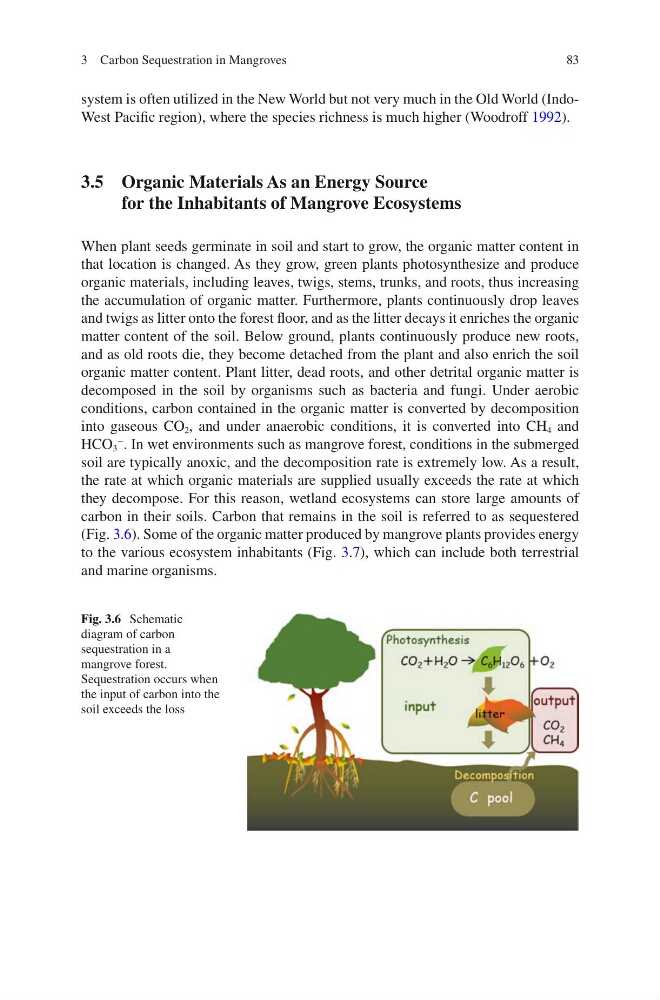
carbon in their soils. Carbon that remains in the soil is referred to as sequestered
(Fig. 3.6). Some of the organic matter produced by mangrove plants provides energy
to the various ecosystem inhabitants (Fig. 3.7), which can include both terrestrial
and marine organisms.
Fig. 3.6 Schematic
diagram of carbon
sequestration in a
mangrove forest.
Sequestration occurs when
the input of carbon into the
soil exceeds the loss
3 Carbon Sequestration in Mangroves
system is often utilized in the New World but not very much in the Old World (IndoWest Pacific region), where the species richness is much higher (Woodroff 1992).
3.5 Organic Materials As an Energy Source
for the Inhabitants of Mangrove Ecosystems
When plant seeds germinate in soil and start to grow, the organic matter content in
that location is changed. As they grow, green plants photosynthesize and produce
organic materials, including leaves, twigs, stems, trunks, and roots, thus increasing
the accumulation of organic matter. Furthermore, plants continuously drop leaves
and twigs as litter onto the forest floor, and as the litter decays it enriches the organic
matter content of the soil. Below ground, plants continuously produce new roots,
and as old roots die, they become detached from the plant and also enrich the soil
organic matter content. Plant litter, dead roots, and other detrital organic matter is
decomposed in the soil by organisms such as bacteria and fungi. Under aerobic
conditions, carbon contained in the organic matter is converted by decomposition
into gaseous CO 2 , and under anaerobic conditions, it is converted into CH 4 and
HCO 3
−
. In wet environments such as mangrove forest, conditions in the submerged
soil are typically anoxic, and the decomposition rate is extremely low. As a result,
the rate at which organic materials are supplied usually exceeds the rate at which
they decompose. For this reason, wetland ecosystems can store large amounts of
carbon in their soils. Carbon that remains in the soil is referred to as sequestered
(Fig. 3.6). Some of the organic matter produced by mangrove plants provides energy
to the various ecosystem inhabitants (Fig. 3.7), which can include both terrestrial
and marine organisms.
Fig. 3.6 Schematic
diagram of carbon
sequestration in a
mangrove forest.
Sequestration occurs when
the input of carbon into the
soil exceeds the loss
3 Carbon Sequestration in Mangroves