

84
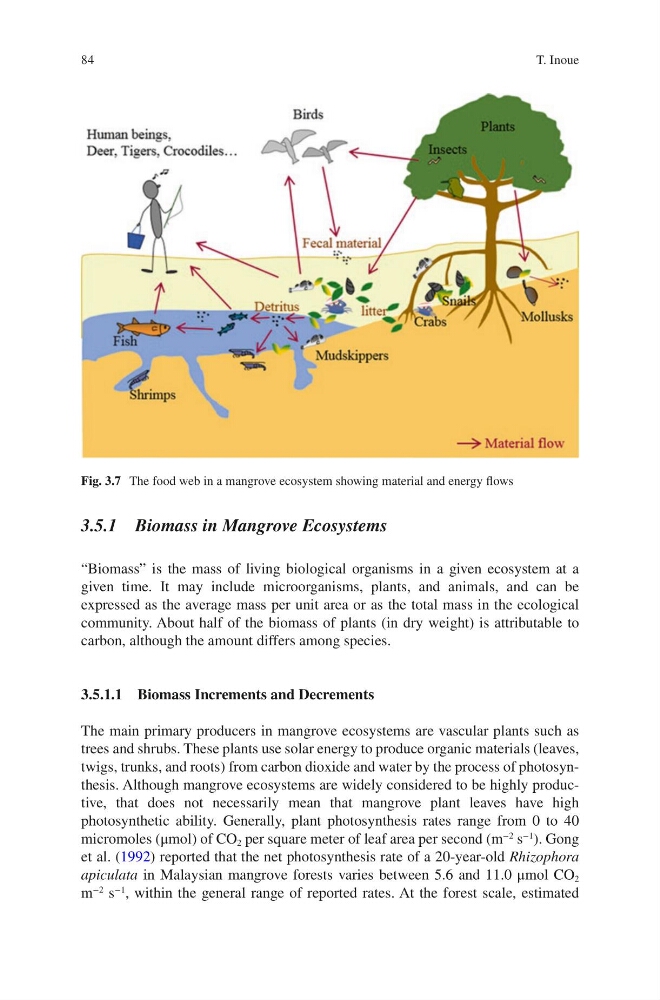
Fig. 3.7 The food web in a mangrove ecosystem showing material and energy flows
3.5.1 Biomass in Mangrove Ecosystems
“Biomass” is the mass of living biological organisms in a given ecosystem at a
given time. It may include microorganisms, plants, and animals, and can be
expressed as the average mass per unit area or as the total mass in the ecological
community. About half of the biomass of plants (in dry weight) is attributable to
carbon, although the amount differs among species.
3.5.1.1 Biomass Increments and Decrements
The main primary producers in mangrove ecosystems are vascular plants such as
trees and shrubs. These plants use solar energy to produce organic materials (leaves,
twigs, trunks, and roots) from carbon dioxide and water by the process of photosynthesis. Although mangrove ecosystems are widely considered to be highly productive, that does not necessarily mean that mangrove plant leaves have high
photosynthetic ability. Generally, plant photosynthesis rates range from 0 to 40
micromoles (μmol) of CO 2 per square meter of leaf area per second (m
−2
s
−1
). Gong
et al. (1992) reported that the net photosynthesis rate of a 20-year-old Rhizophora
apiculata in Malaysian mangrove forests varies between 5.6 and 11.0 μmol CO 2
m
−2
s
−1
, within the general range of reported rates. At the forest scale, estimated
T. Inoue
Fig. 3.7 The food web in a mangrove ecosystem showing material and energy flows
3.5.1 Biomass in Mangrove Ecosystems
“Biomass” is the mass of living biological organisms in a given ecosystem at a
given time. It may include microorganisms, plants, and animals, and can be
expressed as the average mass per unit area or as the total mass in the ecological
community. About half of the biomass of plants (in dry weight) is attributable to
carbon, although the amount differs among species.
3.5.1.1 Biomass Increments and Decrements
The main primary producers in mangrove ecosystems are vascular plants such as
trees and shrubs. These plants use solar energy to produce organic materials (leaves,
twigs, trunks, and roots) from carbon dioxide and water by the process of photosynthesis. Although mangrove ecosystems are widely considered to be highly productive, that does not necessarily mean that mangrove plant leaves have high
photosynthetic ability. Generally, plant photosynthesis rates range from 0 to 40
micromoles (μmol) of CO 2 per square meter of leaf area per second (m
−2
s
−1
). Gong
et al. (1992) reported that the net photosynthesis rate of a 20-year-old Rhizophora
apiculata in Malaysian mangrove forests varies between 5.6 and 11.0 μmol CO 2
m
−2
s
−1
, within the general range of reported rates. At the forest scale, estimated
T. Inoue