

82
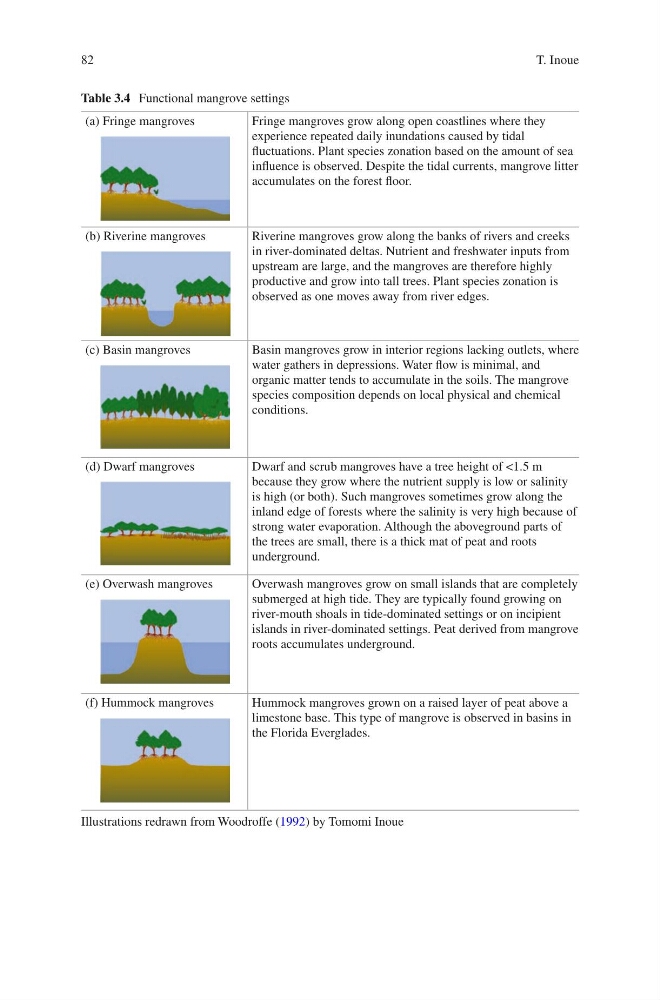
Table 3.4 Functional mangrove settings
(a) Fringe mangroves
Fringe mangroves grow along open coastlines where they
experience repeated daily inundations caused by tidal
fluctuations. Plant species zonation based on the amount of sea
influence is observed. Despite the tidal currents, mangrove litter
accumulates on the forest floor.
(b) Riverine mangroves
Riverine mangroves grow along the banks of rivers and creeks
in river-dominated deltas. Nutrient and freshwater inputs from
upstream are large, and the mangroves are therefore highly
productive and grow into tall trees. Plant species zonation is
observed as one moves away from river edges.
(c) Basin mangroves
Basin mangroves grow in interior regions lacking outlets, where
water gathers in depressions. Water flow is minimal, and
organic matter tends to accumulate in the soils. The mangrove
species composition depends on local physical and chemical
conditions.
(d) Dwarf mangroves
Dwarf and scrub mangroves have a tree height of <1.5 m
because they grow where the nutrient supply is low or salinity
is high (or both). Such mangroves sometimes grow along the
inland edge of forests where the salinity is very high because of
strong water evaporation. Although the aboveground parts of
the trees are small, there is a thick mat of peat and roots
underground.
(e) Overwash mangroves
Overwash mangroves grow on small islands that are completely
submerged at high tide. They are typically found growing on
river-mouth shoals in tide- dominated settings or on incipient
islands in river-dominated settings. Peat derived from mangrove
roots accumulates underground.
(f) Hummock mangroves
Hummock mangroves grown on a raised layer of peat above a
limestone base. This type of mangrove is observed in basins in
the Florida Everglades.
Illustrations redrawn from Woodroffe (1992) by Tomomi Inoue
T. Inoue
Table 3.4 Functional mangrove settings
(a) Fringe mangroves
Fringe mangroves grow along open coastlines where they
experience repeated daily inundations caused by tidal
fluctuations. Plant species zonation based on the amount of sea
influence is observed. Despite the tidal currents, mangrove litter
accumulates on the forest floor.
(b) Riverine mangroves
Riverine mangroves grow along the banks of rivers and creeks
in river-dominated deltas. Nutrient and freshwater inputs from
upstream are large, and the mangroves are therefore highly
productive and grow into tall trees. Plant species zonation is
observed as one moves away from river edges.
(c) Basin mangroves
Basin mangroves grow in interior regions lacking outlets, where
water gathers in depressions. Water flow is minimal, and
organic matter tends to accumulate in the soils. The mangrove
species composition depends on local physical and chemical
conditions.
(d) Dwarf mangroves
Dwarf and scrub mangroves have a tree height of <1.5 m
because they grow where the nutrient supply is low or salinity
is high (or both). Such mangroves sometimes grow along the
inland edge of forests where the salinity is very high because of
strong water evaporation. Although the aboveground parts of
the trees are small, there is a thick mat of peat and roots
underground.
(e) Overwash mangroves
Overwash mangroves grow on small islands that are completely
submerged at high tide. They are typically found growing on
river-mouth shoals in tide- dominated settings or on incipient
islands in river-dominated settings. Peat derived from mangrove
roots accumulates underground.
(f) Hummock mangroves
Hummock mangroves grown on a raised layer of peat above a
limestone base. This type of mangrove is observed in basins in
the Florida Everglades.
Illustrations redrawn from Woodroffe (1992) by Tomomi Inoue
T. Inoue