

81
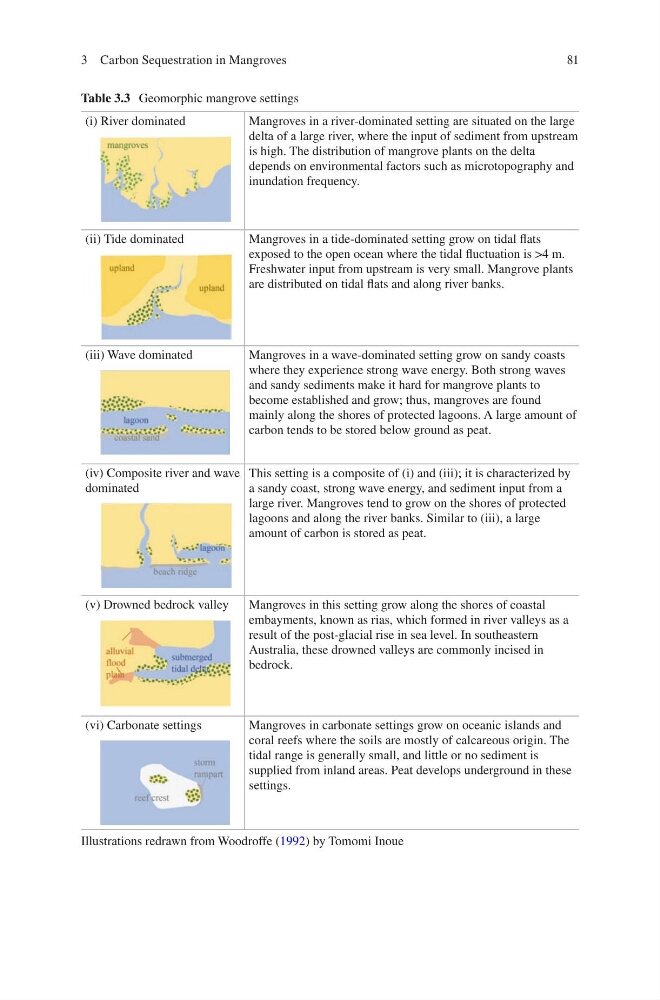
Table 3.3 Geomorphic mangrove settings
(i) River dominated
Mangroves in a river-dominated setting are situated on the large
delta of a large river, where the input of sediment from upstream
is high. The distribution of mangrove plants on the delta
depends on environmental factors such as microtopography and
inundation frequency.
(ii) Tide dominated
Mangroves in a tide-dominated setting grow on tidal flats
exposed to the open ocean where the tidal fluctuation is >4 m.
Freshwater input from upstream is very small. Mangrove plants
are distributed on tidal flats and along river banks.
(iii) Wave dominated
Mangroves in a wave-dominated setting grow on sandy coasts
where they experience strong wave energy. Both strong waves
and sandy sediments make it hard for mangrove plants to
become established and grow; thus, mangroves are found
mainly along the shores of protected lagoons. A large amount of
carbon tends to be stored below ground as peat.
(iv) Composite river and wave
dominated
This setting is a composite of (i) and (iii); it is characterized by
a sandy coast, strong wave energy, and sediment input from a
large river. Mangroves tend to grow on the shores of protected
lagoons and along the river banks. Similar to (iii), a large
amount of carbon is stored as peat.
(v) Drowned bedrock valley
Mangroves in this setting grow along the shores of coastal
embayments, known as rias, which formed in river valleys as a
result of the post-glacial rise in sea level. In southeastern
Australia, these drowned valleys are commonly incised in
bedrock.
(vi) Carbonate settings
Mangroves in carbonate settings grow on oceanic islands and
coral reefs where the soils are mostly of calcareous origin. The
tidal range is generally small, and little or no sediment is
supplied from inland areas. Peat develops underground in these
settings.
Illustrations redrawn from Woodroffe (1992) by Tomomi Inoue
3 Carbon Sequestration in Mangroves
Table 3.3 Geomorphic mangrove settings
(i) River dominated
Mangroves in a river-dominated setting are situated on the large
delta of a large river, where the input of sediment from upstream
is high. The distribution of mangrove plants on the delta
depends on environmental factors such as microtopography and
inundation frequency.
(ii) Tide dominated
Mangroves in a tide-dominated setting grow on tidal flats
exposed to the open ocean where the tidal fluctuation is >4 m.
Freshwater input from upstream is very small. Mangrove plants
are distributed on tidal flats and along river banks.
(iii) Wave dominated
Mangroves in a wave-dominated setting grow on sandy coasts
where they experience strong wave energy. Both strong waves
and sandy sediments make it hard for mangrove plants to
become established and grow; thus, mangroves are found
mainly along the shores of protected lagoons. A large amount of
carbon tends to be stored below ground as peat.
(iv) Composite river and wave
dominated
This setting is a composite of (i) and (iii); it is characterized by
a sandy coast, strong wave energy, and sediment input from a
large river. Mangroves tend to grow on the shores of protected
lagoons and along the river banks. Similar to (iii), a large
amount of carbon is stored as peat.
(v) Drowned bedrock valley
Mangroves in this setting grow along the shores of coastal
embayments, known as rias, which formed in river valleys as a
result of the post-glacial rise in sea level. In southeastern
Australia, these drowned valleys are commonly incised in
bedrock.
(vi) Carbonate settings
Mangroves in carbonate settings grow on oceanic islands and
coral reefs where the soils are mostly of calcareous origin. The
tidal range is generally small, and little or no sediment is
supplied from inland areas. Peat develops underground in these
settings.
Illustrations redrawn from Woodroffe (1992) by Tomomi Inoue
3 Carbon Sequestration in Mangroves