

80
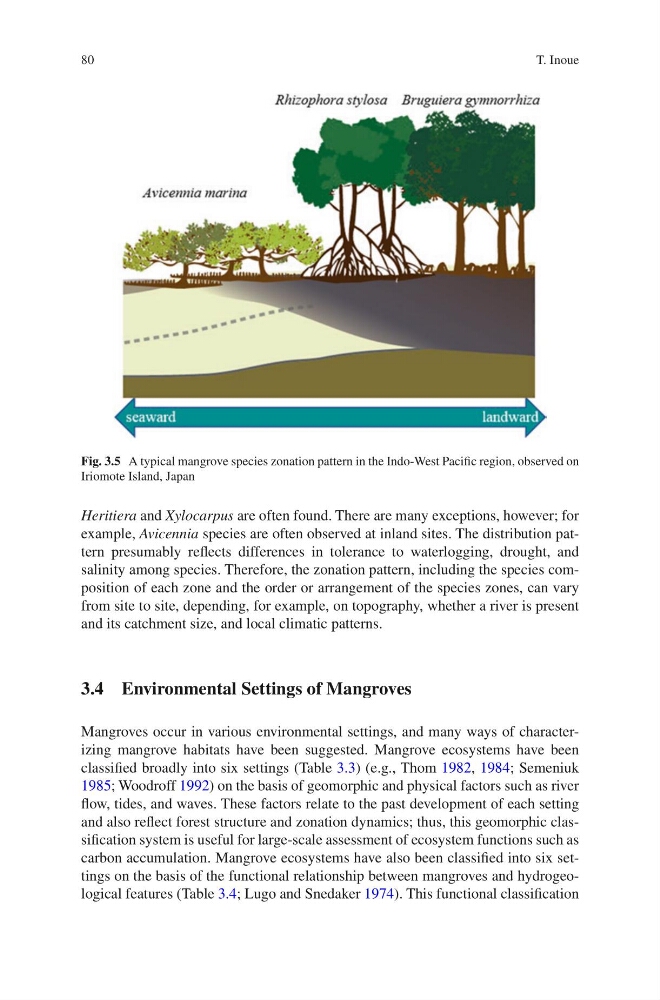
Heritiera and Xylocarpus are often found. There are many exceptions, however; for
example, Avicennia species are often observed at inland sites. The distribution pattern presumably reflects differences in tolerance to waterlogging, drought, and
salinity among species. Therefore, the zonation pattern, including the species composition of each zone and the order or arrangement of the species zones, can vary
from site to site, depending, for example, on topography, whether a river is present
and its catchment size, and local climatic patterns.
3.4 Environmental Settings of Mangroves
Mangroves occur in various environmental settings, and many ways of characterizing mangrove habitats have been suggested. Mangrove ecosystems have been
classified broadly into six settings (Table 3.3) (e.g., Thom 1982, 1984; Semeniuk
1985; Woodroff 1992) on the basis of geomorphic and physical factors such as river
flow, tides, and waves. These factors relate to the past development of each setting
and also reflect forest structure and zonation dynamics; thus, this geomorphic classification system is useful for large-scale assessment of ecosystem functions such as
carbon accumulation. Mangrove ecosystems have also been classified into six settings on the basis of the functional relationship between mangroves and hydrogeological features (Table 3.4; Lugo and Snedaker 1974). This functional classification
Fig. 3.5 A typical mangrove species zonation pattern in the Indo-West Pacific region, observed on
Iriomote Island, Japan
T. Inoue
Heritiera and Xylocarpus are often found. There are many exceptions, however; for
example, Avicennia species are often observed at inland sites. The distribution pattern presumably reflects differences in tolerance to waterlogging, drought, and
salinity among species. Therefore, the zonation pattern, including the species composition of each zone and the order or arrangement of the species zones, can vary
from site to site, depending, for example, on topography, whether a river is present
and its catchment size, and local climatic patterns.
3.4 Environmental Settings of Mangroves
Mangroves occur in various environmental settings, and many ways of characterizing mangrove habitats have been suggested. Mangrove ecosystems have been
classified broadly into six settings (Table 3.3) (e.g., Thom 1982, 1984; Semeniuk
1985; Woodroff 1992) on the basis of geomorphic and physical factors such as river
flow, tides, and waves. These factors relate to the past development of each setting
and also reflect forest structure and zonation dynamics; thus, this geomorphic classification system is useful for large-scale assessment of ecosystem functions such as
carbon accumulation. Mangrove ecosystems have also been classified into six settings on the basis of the functional relationship between mangroves and hydrogeological features (Table 3.4; Lugo and Snedaker 1974). This functional classification
Fig. 3.5 A typical mangrove species zonation pattern in the Indo-West Pacific region, observed on
Iriomote Island, Japan
T. Inoue