

79
3.3.2 Species Distribution Pattern in Global Scale
When mangrove species distributions among countries are considered (e.g., TroCEP
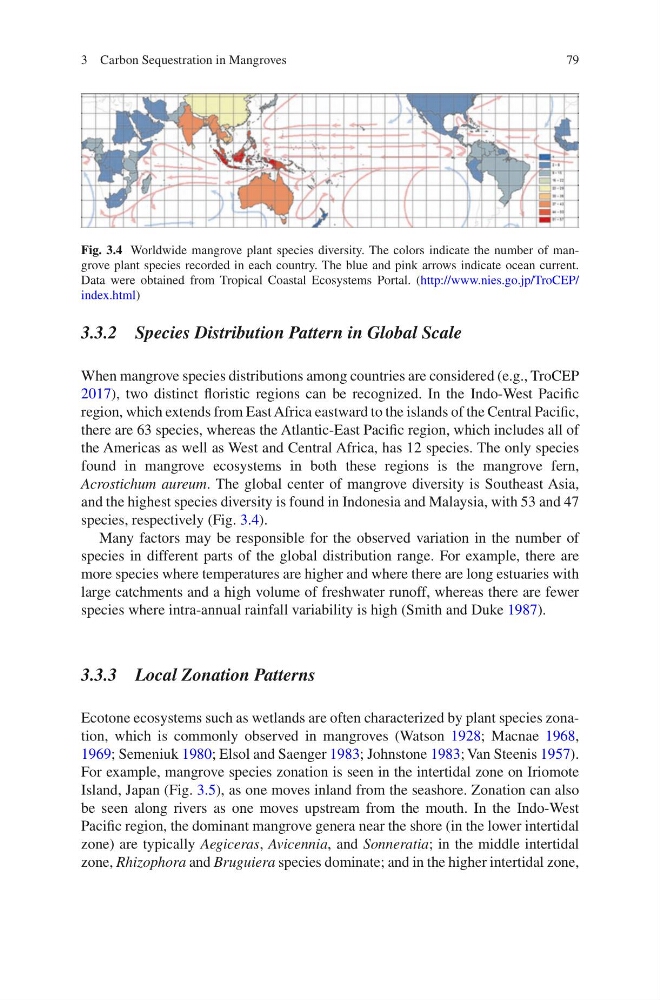
2017), two distinct floristic regions can be recognized. In the Indo-West Pacific
region, which extends from East Africa eastward to the islands of the Central Pacific,
there are 63 species, whereas the Atlantic-East Pacific region, which includes all of
the Americas as well as West and Central Africa, has 12 species. The only species
found in mangrove ecosystems in both these regions is the mangrove fern,
Acrostichum aureum. The global center of mangrove diversity is Southeast Asia,
and the highest species diversity is found in Indonesia and Malaysia, with 53 and 47
species, respectively (Fig. 3.4).
Many factors may be responsible for the observed variation in the number of
species in different parts of the global distribution range. For example, there are
more species where temperatures are higher and where there are long estuaries with
large catchments and a high volume of freshwater runoff, whereas there are fewer
species where intra-annual rainfall variability is high (Smith and Duke 1987).
3.3.3 Local Zonation Patterns
Ecotone ecosystems such as wetlands are often characterized by plant species zonation, which is commonly observed in mangroves (Watson 1928; Macnae 1968,
1969; Semeniuk 1980; Elsol and Saenger 1983; Johnstone 1983; Van Steenis 1957).
For example, mangrove species zonation is seen in the intertidal zone on Iriomote
Island, Japan (Fig. 3.5), as one moves inland from the seashore. Zonation can also
be seen along rivers as one moves upstream from the mouth. In the Indo-West
Pacific region, the dominant mangrove genera near the shore (in the lower intertidal
zone) are typically Aegiceras, Avicennia, and Sonneratia; in the middle intertidal
zone, Rhizophora and Bruguiera species dominate; and in the higher intertidal zone,
Fig. 3.4 Worldwide mangrove plant species diversity. The colors indicate the number of mangrove plant species recorded in each country. The blue and pink arrows indicate ocean current.
Data were obtained from Tropical Coastal Ecosystems Portal. (http://www.nies.go.jp/TroCEP/
index.html)
3 Carbon Sequestration in Mangroves
3.3.2 Species Distribution Pattern in Global Scale
When mangrove species distributions among countries are considered (e.g., TroCEP
2017), two distinct floristic regions can be recognized. In the Indo-West Pacific
region, which extends from East Africa eastward to the islands of the Central Pacific,
there are 63 species, whereas the Atlantic-East Pacific region, which includes all of
the Americas as well as West and Central Africa, has 12 species. The only species
found in mangrove ecosystems in both these regions is the mangrove fern,
Acrostichum aureum. The global center of mangrove diversity is Southeast Asia,
and the highest species diversity is found in Indonesia and Malaysia, with 53 and 47
species, respectively (Fig. 3.4).
Many factors may be responsible for the observed variation in the number of
species in different parts of the global distribution range. For example, there are
more species where temperatures are higher and where there are long estuaries with
large catchments and a high volume of freshwater runoff, whereas there are fewer
species where intra-annual rainfall variability is high (Smith and Duke 1987).
3.3.3 Local Zonation Patterns
Ecotone ecosystems such as wetlands are often characterized by plant species zonation, which is commonly observed in mangroves (Watson 1928; Macnae 1968,
1969; Semeniuk 1980; Elsol and Saenger 1983; Johnstone 1983; Van Steenis 1957).
For example, mangrove species zonation is seen in the intertidal zone on Iriomote
Island, Japan (Fig. 3.5), as one moves inland from the seashore. Zonation can also
be seen along rivers as one moves upstream from the mouth. In the Indo-West
Pacific region, the dominant mangrove genera near the shore (in the lower intertidal
zone) are typically Aegiceras, Avicennia, and Sonneratia; in the middle intertidal
zone, Rhizophora and Bruguiera species dominate; and in the higher intertidal zone,
Fig. 3.4 Worldwide mangrove plant species diversity. The colors indicate the number of mangrove plant species recorded in each country. The blue and pink arrows indicate ocean current.
Data were obtained from Tropical Coastal Ecosystems Portal. (http://www.nies.go.jp/TroCEP/
index.html)
3 Carbon Sequestration in Mangroves